On this page
- What Is an Online Trading Journal?
- Why Every Trader Needs the Best Online Trading Journal
- Problems Traders Face Without a Trading Journal
- How Long Before a Trading Journal Actually Shows Results?
- Features to Look for in the Best Online Trading Journal
- Why Dhanith Trading Journal Can Be Your Best Online Trading Journal
- Example: How a Trading Journal Improves Your Trading
- Who Should Use Dhanith Trading Journal?
- Best Online Trading Journal vs Manual Excel Journal
- Building a Simple Daily Review Routine
- FAQ
Looking for the best online trading journal? Track trades, emotions & mistakes with Dhanith Trading Journal. Build real trading discipline today.
Most traders do not lose only because of bad strategies. They lose because they do not track their trades, emotions, mistakes, and discipline. Aapne shayad ek perfect setup dekha, entry li, aur phir bhi loss ho gaya — lekin kyun? Agar aapke paas iska jawab nahi hai, to yahi sabse bada problem hai.
This is exactly where the best online trading journal comes in. A trading journal is not just a record-keeping tool — it is the single habit that separates traders who improve every month from traders who repeat the same five mistakes for years. Whether you trade Nifty, BankNifty, intraday stocks, or options, your charts and strategy can only take you so far. What actually moves the needle is knowing why you win and why you lose — and that only comes from consistent, honest tracking.
In this guide, we'll break down what an online trading journal actually is, why every serious trader needs one, the exact features to look for, and how Dhanith Trading Journal can become the simple, beginner-friendly system that helps you build real discipline — one trade at a time.
Ready to stop guessing and start reviewing? Start tracking your trades with Dhanith Trading Journal today.
What Is an Online Trading Journal?
Let's keep this simple. An online trading journal is a digital tool where traders record every trade, including entry, exit, stop loss, target, quantity, setup, emotion, mistake, screenshot, and result.
Think of it like a diary, but specifically for your trades — except instead of just writing "I made money today" or "I lost money today," a proper trading journal forces you to answer deeper questions:
- Kya maine apna setup follow kiya, ya random entry li?
- Stop loss kahan tha, aur kya maine usko respect kiya?
- Kya yeh trade emotion se li thi (FOMO, revenge, boredom) ya logic se?
- Risk-reward ratio kya tha actually?
- Kya yeh trade meri winning strategy ka part thi, ya ek experiment?
A basic paper notebook or a simple Excel sheet can technically be called a trading journal. But in 2026, with so many trades happening across intraday, options, and swing setups, most traders need something faster, cleaner, and built specifically for trading — which is where a trading journal app like Dhanith comes in, instead of manually maintaining rows and columns every single day.
The core idea remains the same everywhere: you cannot improve what you do not measure. And in trading, the thing you most need to measure is not just your profit and loss — it's your behavior.
Why Every Trader Needs the Best Online Trading Journal
Here's the honest truth: most traders treat their trading like a guessing game. Entry lo, target lagao, agar chal gaya to khush, nahi chala to bhool jao aur next trade dhoondo. Is cycle mein koi learning nahi hoti — sirf repetition hoti hai.
This is exactly why the best online trading journal is not a luxury — it is a necessity if you want to take trading seriously. Here's what a proper journal actually does for you:
Track every trade. Every entry, exit, quantity, and result gets logged automatically or manually in one place — no more trying to remember "wo Wednesday wala trade kaisa gaya tha."
Review mistakes. Instead of vaguely feeling like "main bahut mistakes karta hoon," you get an actual list — overtrading, revenge trading, ignoring stop loss, entering without confirmation — that you can work on, one at a time.
Improve discipline. Jab aapko pata hota hai ki har trade record hone wala hai, aap automatically zyada careful ho jaate ho. This single shift in awareness often improves trading discipline more than any new strategy ever could.
Control emotions. A good journal asks you to log your emotional state during each trade — calm, anxious, greedy, fearful. Over weeks, patterns emerge: maybe most of your losses happen specifically when you're trading "to recover" a previous loss.
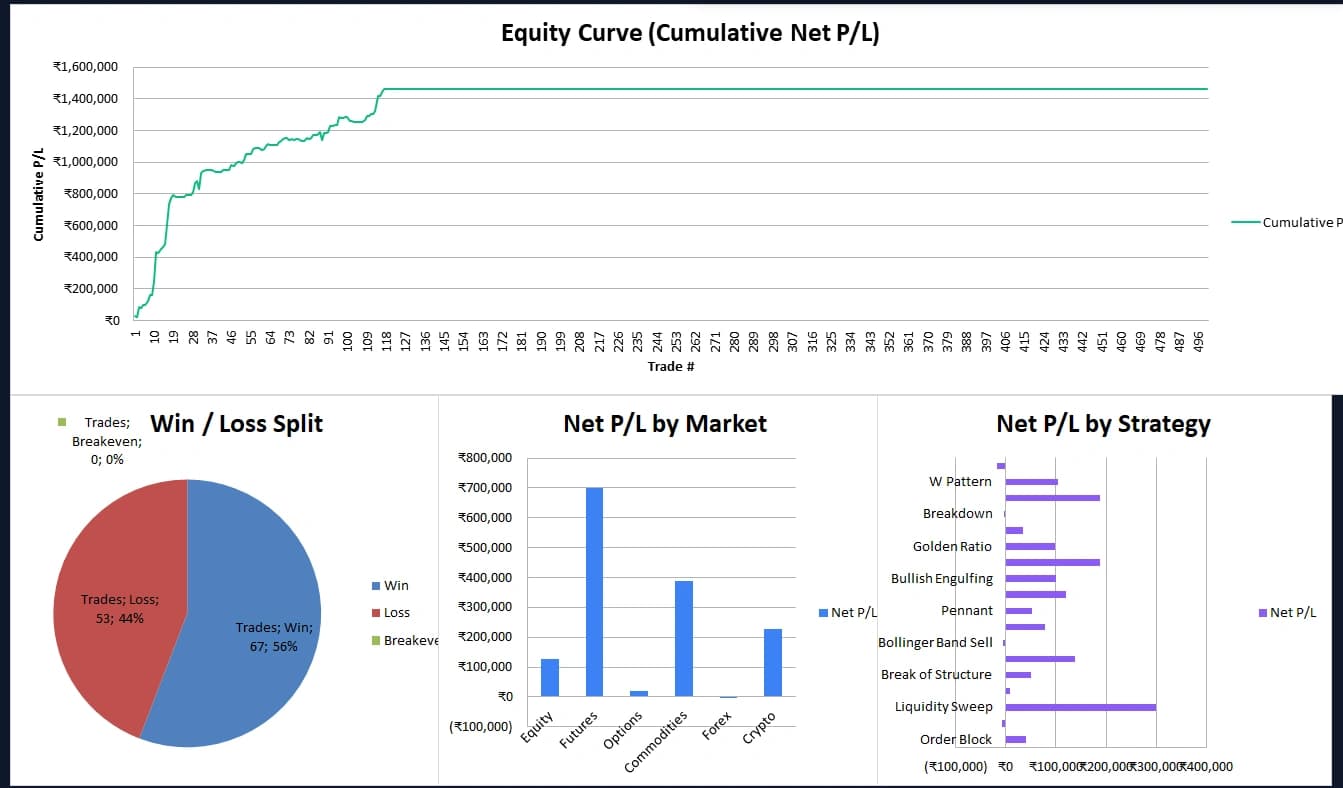
Track profit and loss properly. Not just the overall number, but P&L broken down by setup, by time of day, by instrument — so you know exactly where your money is actually coming from and going.
Understand risk-reward. Are you risking ₹1,000 to make ₹500? Or risking ₹500 to make ₹1,500? Without a journal tracking this trade-by-trade, most traders have no real idea what their actual average risk-reward ratio looks like.
Find your best trading setups. Maybe your breakout trades on Nifty have a 65% win rate, but your reversal trades on small-cap stocks have a 30% win rate. You will never know this without tracking setups individually.
Avoid overtrading. A journal makes your trade count visible. Seeing "15 trades today" in black and white is often the wake-up call traders need to stop revenge-clicking the buy button.
Build consistency. At the end of the day, consistent traders are the ones who survive. And consistency comes from repeating what works and eliminating what doesn't — which is impossible without data.
This is exactly the kind of tracking Dhanith Trading Journal was built to make simple, even if you've never journaled a single trade before.
Problems Traders Face Without a Trading Journal
Agar aap abhi tak koi trading journal use nahi kar rahe, to chances hain ki aap in problems mein se kuch already face kar rahe ho — even if aap unhe is naam se nahi pehchaante.
Random entries. Without a journal forcing you to write down why you're entering a trade, it becomes incredibly easy to take entries based on a tip, a feeling, or a chart pattern you half-recognized — rather than a tested setup.
Revenge trading. Loss hone ke baad, bina socha-samjha agla trade le lena — is the single most account-destroying habit in trading. Without tracking, you won't even realize how often this is actually happening.
No stop loss discipline. "Bas thoda aur wait karta hoon, recover ho jayega" — this thought process kills more trading accounts than bad strategies ever do. A journal that tracks stop-loss adherence makes this pattern impossible to ignore.
Overtrading. Taking 10-15 trades a day with no real edge, just to "stay busy" in the market — a classic beginner trap that a visible trade count immediately exposes.
Repeating the same mistake. Without a record, the same mistake — say, entering before candle close confirmation — can repeat for months, quietly draining your account, simply because nobody ever wrote it down and connected the dots.
No performance review. Most traders only look at their account balance. They never sit down weekly or monthly and ask: "Which setups actually worked? Which didn't?"
Not knowing which setup works. Trading 4-5 different strategies simultaneously without knowing which one actually has an edge is one of the most common (and most fixable) problems in retail trading.
Only focusing on profit/loss instead of process. A trader who made money on a bad, undisciplined trade often thinks "that worked!" — reinforcing exactly the wrong behavior, simply because they're not looking at the process, only the outcome. Yeh sabse dangerous trap hai, kyunki ek lucky win aapko confirm kar deta hai ki bad habit actually "kaam kar rahi hai" — jab tak agle 5 trades mein wahi habit account ko nuksaan nahi pohochati.
There's also a quieter, less obvious cost to not journaling: decision fatigue. Without a structured place to offload your thoughts after each trade, every single decision — whether to take a trade, how big to size it, when to exit — ends up relying purely on memory and gut feeling, session after session. Over weeks, this mental load builds up, and tired, unstructured decision-making is exactly when emotional trades sneak in.
Sound familiar? Don't worry — almost every trader goes through this phase. The traders who eventually become consistent are simply the ones who decide to start tracking before it's too late.
How Long Before a Trading Journal Actually Shows Results?
Ek common sawaal yeh hota hai: "Journal maintain karne se kitne din mein fayda dikhega?"
Honestly, the answer depends on how consistently you log — but most traders start noticing real patterns within 2 to 4 weeks of honest, daily journaling. Yahan 30 trades ka ek practical timeline hai:
- Week 1: You simply build the habit of logging every trade — entry, exit, basic notes. Iss stage par koi bada insight nahi milega, sirf consistency bann rahi hoti hai.
- Week 2: Small patterns start emerging — maybe you notice you're entering trades faster than you'd like, or skipping your checklist on certain days.
- Week 3-4: With enough trades logged, your win rate by setup, your most common mistake tags, and your emotional patterns become statistically visible — not just a feeling, but actual data confirming or disproving what you suspected.
This is exactly why daily, weekly, and monthly reports matter so much inside a proper trading journal app — they turn raw, scattered trade logs into a clear, structured story about your trading behavior over time. Without this structure, even diligent journaling can feel like effort with no visible payoff, which is often why traders give up on Excel sheets after a few weeks — there's no dashboard pulling the story together for them automatically.
Features to Look for in the Best Online Trading Journal
Not all trading journal apps are built the same way. Before choosing one, here's what actually matters:
- Easy trade entry — logging a trade should take seconds, not minutes, or you'll simply stop doing it
- Entry and exit tracking — exact prices, times, and quantities for full clarity
- P&L tracking — automatic profit and loss calculation, not manual math
- Risk-reward tracking — so you can see your actual R:R ratio trade by trade, not just guess it
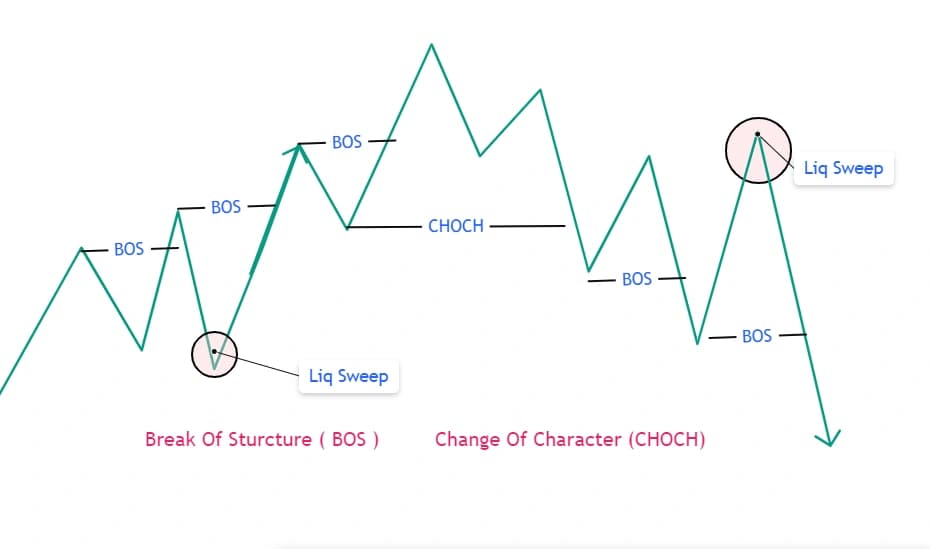
- Setup tracking — tagging trades by strategy type (breakout, reversal, trend-following, etc.)
- Mistake tracking — a dedicated way to log what went wrong, not just what happened
- Emotion tracking — recording your mental state during the trade
- Screenshot upload — attaching your actual chart at entry, so you can review the exact visual context later
- Notes section — space for free-form thoughts, observations, and lessons
- Performance dashboard — a single view showing your overall trading health at a glance
- Win rate — your actual percentage of winning trades, tracked automatically
- Daily, weekly, and monthly reports — so you can review progress at every level, not just day-to-day
- Discipline score — a way to measure how well you're following your own rules, separate from raw profit
- Beginner-friendly checklist — pre-trade prompts that catch mistakes before they happen, not after
If a trading journal app is missing more than two or three of these, it's probably not going to give you the full picture you need to actually improve.
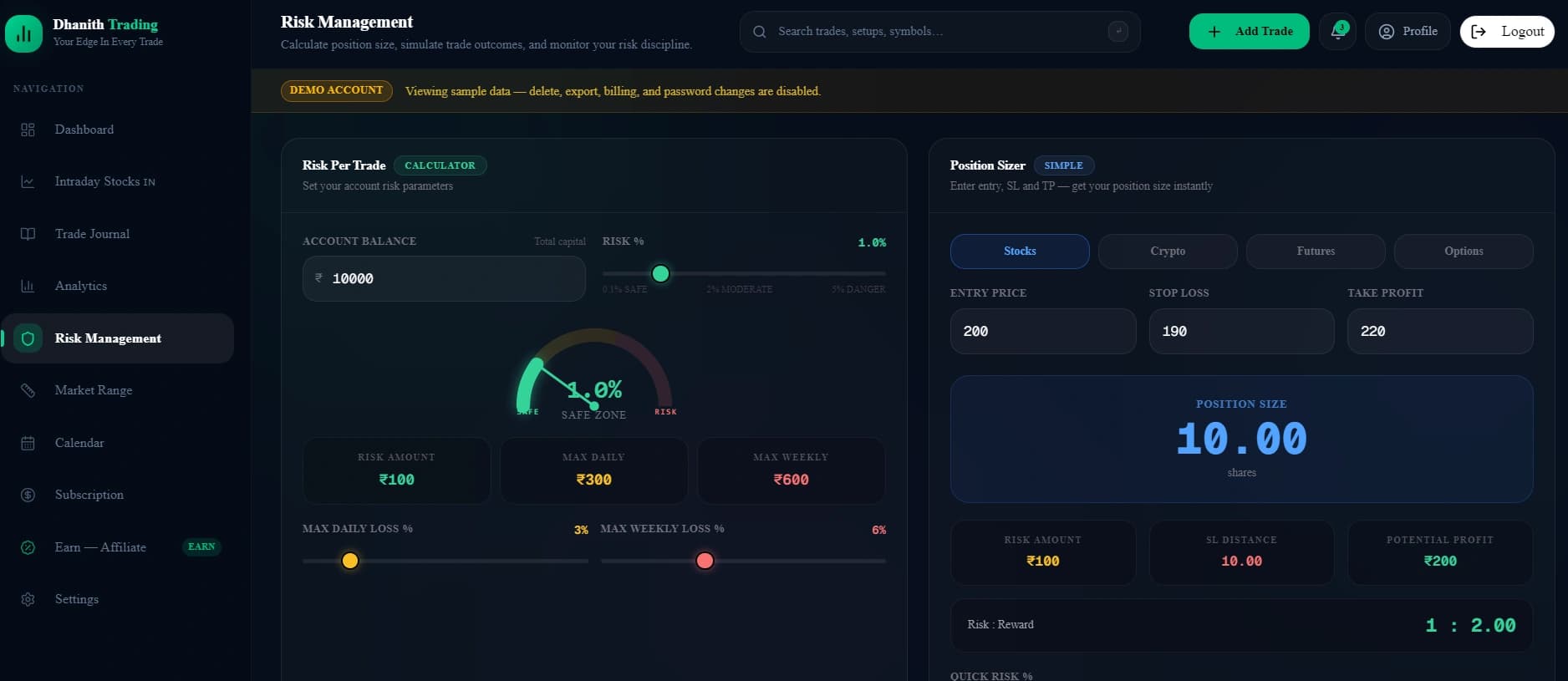
Dhanith Trading Journal was built specifically around this exact feature list — designed for Indian traders who want simplicity without sacrificing depth.
Why Dhanith Trading Journal Can Be Your Best Online Trading Journal
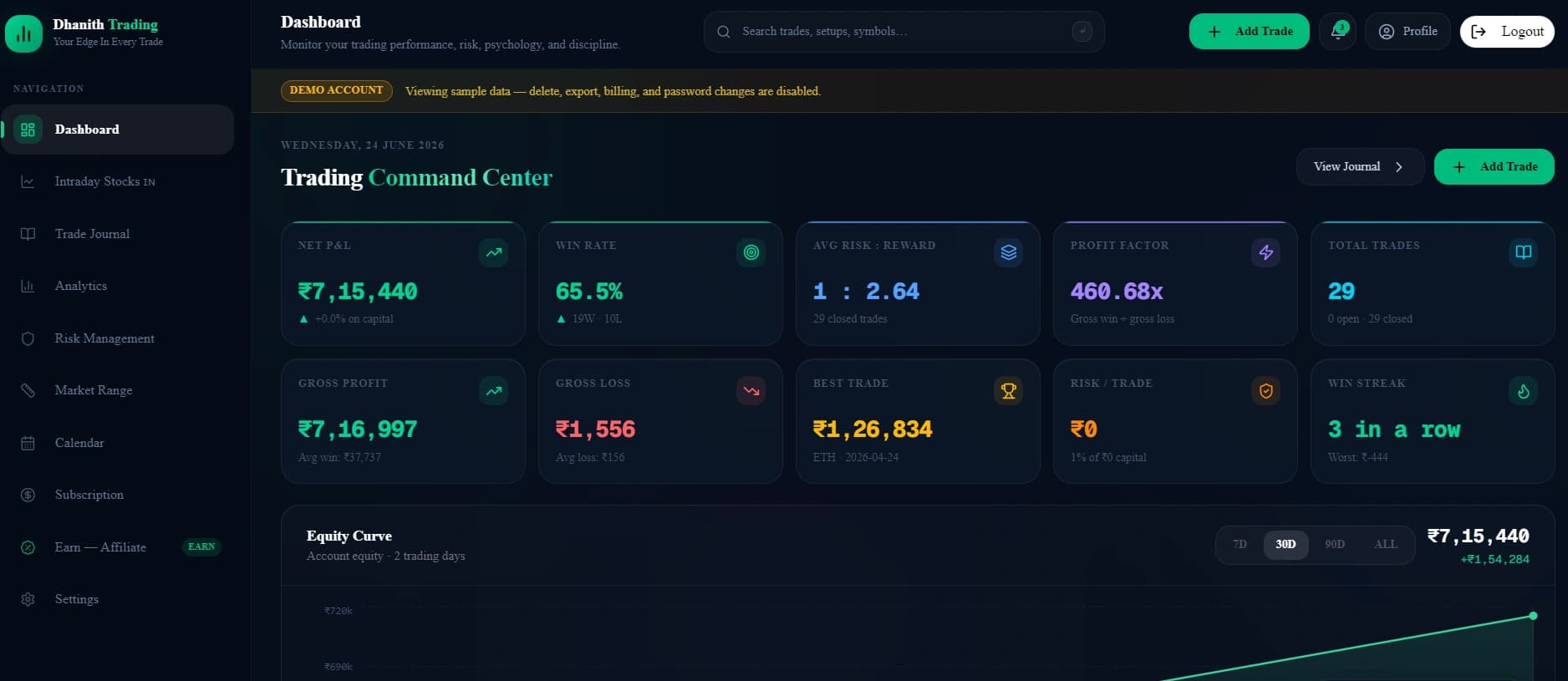
Dhanith Trading Journal is designed to help traders track, review, and improve their trades in one simple online dashboard. Iska poora focus hai simplicity aur usability par — kyunki agar journal complicated hoga, to log kaun karega?
Here's what's built into Dhanith:
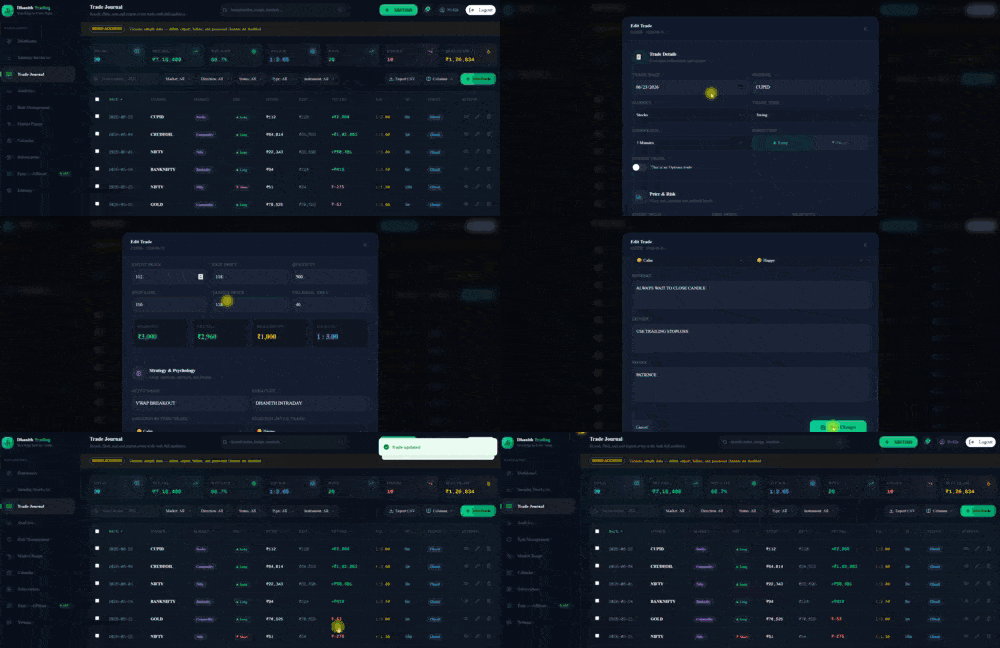
- Trade entry journal — log every trade quickly, with all the key details captured in one clean form
- Exit tracking — record exactly how and when you closed each position
- Profit/loss tracking — automatically calculated, no manual spreadsheet math required
- Risk per trade — see exactly how much capital was at risk on each individual trade
- Risk percentage — track what percentage of your total capital you risked, trade by trade
- Risk-reward ratio — automatically calculated for every trade, so the pattern becomes obvious over time
- Setup tracking — tag and categorize each trade by the strategy or pattern used
- Mistake tracking — a dedicated field specifically for logging errors, so they don't get buried in general notes
- Emotion tracking — log how you felt during entry and exit, building real self-awareness over time
- Trade notes — space to write context, observations, and lessons for future reference
- Screenshot upload — attach your actual chart, so you can visually review the setup weeks or months later
- Performance dashboard — a clean, single-glance overview of your overall trading health
- Win rate — automatically calculated and updated as you log more trades
- Best and worst trades — quickly identify your standout wins and your most costly mistakes
- Daily, weekly, and monthly reports — structured reviews built right into the platform
- Discipline score — a unique metric tracking how consistently you follow your own trading rules
- Beginner checklist — guided prompts that walk newer traders through what to check before entering a trade
Dhanith was not built for hedge funds or professional desks with complex requirements. It was built for the everyday Indian trader — the intraday trader watching Nifty open, the options trader tracking BankNifty moves, the swing trader holding stock positions for a few days — who simply wants one clean place to see the full truth about their own trading.
Try Dhanith Trading Journal and see your trading patterns clearly for the first time.
Dhanith Trading Journal
Track every trade. Find your real edge.
Log your setups, grade your entries, and review your trading patterns — all in one place. The journal built for serious SMC traders.
Example: How a Trading Journal Improves Your Trading
Let's make this practical with a simple example.
A trader takes 30 trades in a month. Without a journal, he only remembers overall profit or loss — maybe he ends the month down ₹8,000, and his only conclusion is "market mera against tha" or "strategy kaam nahi kar rahi."
But with Dhanith, the picture changes completely. When he opens his monthly report, he sees:
- Out of 30 trades, 12 were tagged as "revenge trades" — taken immediately after a loss, without following his usual checklist
- 8 trades had no stop loss set at entry, or the stop loss was moved further away mid-trade
- His tagged breakout setups had a 70% win rate, while his untagged "random" trades had only a 20% win rate
- His emotion log shows that most losing trades were marked "anxious" or "rushed," while his winning trades were overwhelmingly marked "calm" or "confident"
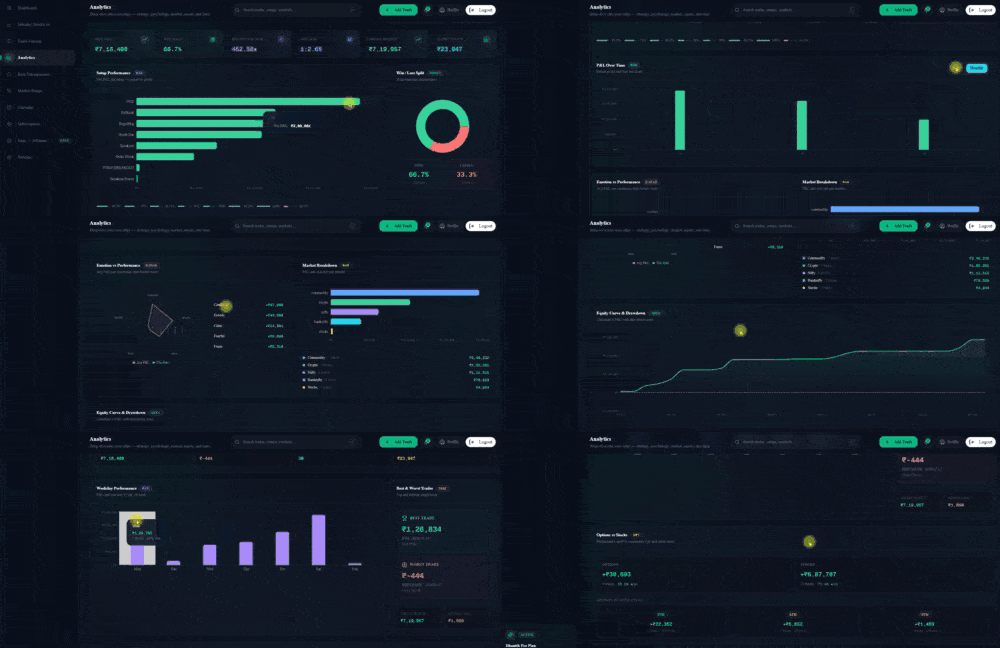
Suddenly, the story isn't "the market was against me." The story is: "Mere actual tested setup achha perform kar raha hai — main jab discipline se trade karta hoon, tab profit hota hai. Problem yeh hai ki main emotional trades le raha hoon jo mere plan ka part hi nahi hain."
This is the real power of tracking. It doesn't just show you what happened — it shows you why it happened, in a way that's impossible to see by just staring at your account balance. And once you can see the pattern clearly, fixing it becomes a hundred times easier than trying to "be more disciplined" in some vague, general sense.
Who Should Use Dhanith Trading Journal?
Dhanith Trading Journal is built for a wide range of traders across the Indian market, including:
- Intraday traders who need to log fast-paced trades without slowing down their workflow
- Stock traders holding positions for days or weeks, who want to track setups across a longer timeframe
- Options traders managing strike selection, premium decay, and risk in a more complex instrument
- Nifty and BankNifty traders specifically tracking index-based setups and intraday volatility
- Beginner traders who are still building their foundational habits and need guided structure, not a blank spreadsheet
- Traders struggling with discipline — revenge trading, overtrading, ignoring stop losses — who need an honest mirror held up to their own behavior
- Traders who want to review performance seriously, on a weekly and monthly basis, rather than just glancing at their account balance occasionally
Whether you're three months into trading or three years in, the underlying need is the same: a clear, honest record of what you actually did, so you can separate what's working from what isn't.
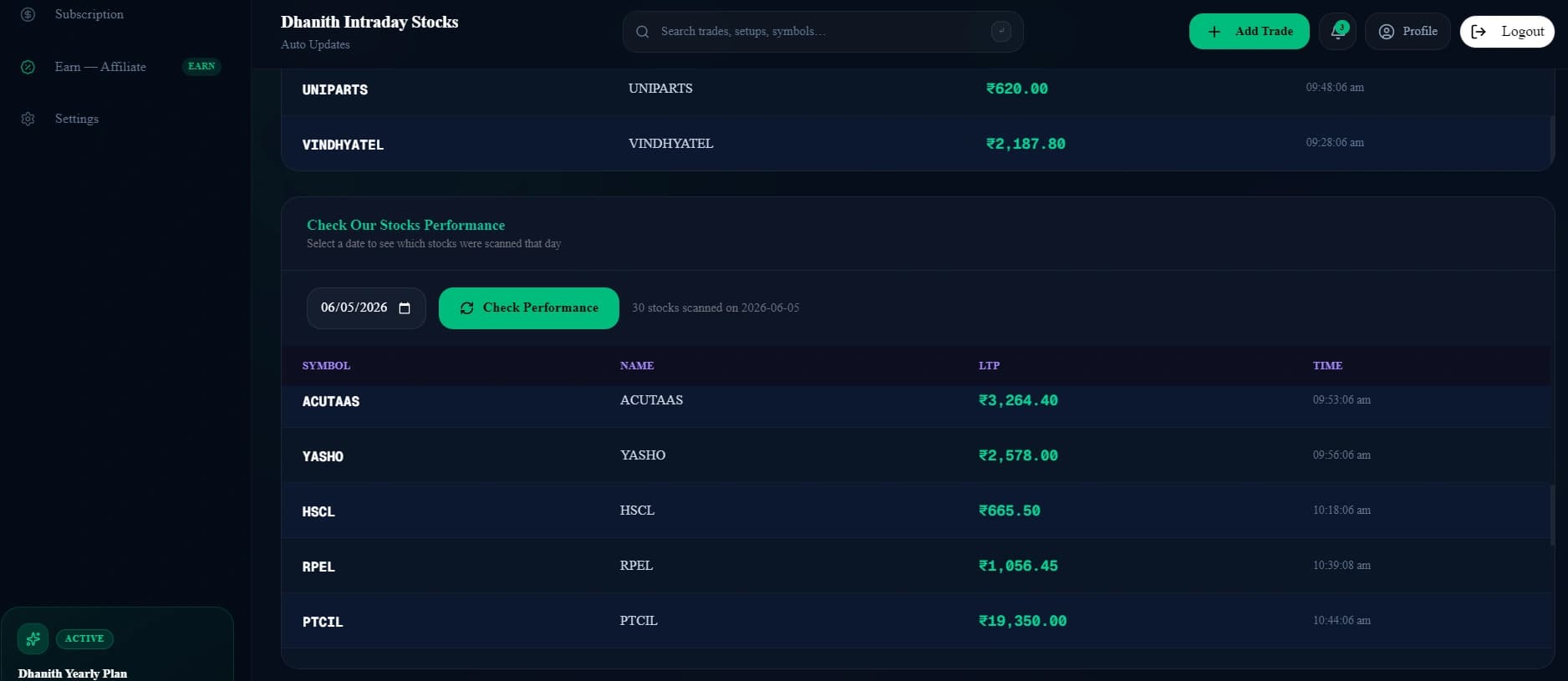
No matter where you are in your trading journey, Dhanith Trading Journal adapts to your style — start logging your next trade in minutes.
Best Online Trading Journal vs Manual Excel Journal
Bahut se traders sochte hain, "Mujhe app kyun chahiye, Excel hi kaafi hai." Aur shuru mein, yeh sahi bhi lagta hai. Lekin jaise jaise trades badhte hain, Excel ki limitations clearly dikhne lagti hain.
| Factor | Manual Excel Journal | Online Trading Journal (Dhanith) |
|---|---|---|
| Speed of logging | Slow — manual formulas, manual entry | Fast — built specifically for trade logging |
| Screenshots | Difficult to organize, often skipped entirely | Built-in screenshot upload per trade |
| P&L calculation | Manual, error-prone | Automatic and accurate |
| Performance reports | Requires building your own pivot tables/charts | Ready-made daily, weekly, monthly dashboards |
| Risk-reward tracking | Manual calculation, easy to skip | Automatically calculated per trade |
| Mistake/emotion tracking | Rarely tracked consistently | Dedicated fields built into every entry |
| Long-term discipline | Easy to abandon after a few weeks | Designed for daily habit-building |
| Accessibility | Usually desktop-only | Accessible online, anywhere |
An online journal is faster, cleaner, easier to review, better for screenshots, performance tracking, reports, and long-term discipline. Excel isn't bad — it's just not built specifically for the job. A stock trading journal or intraday trading journal built for trading will almost always save you more time and reveal more insight than a general-purpose spreadsheet tool, simply because every feature is designed around the exact problem you're trying to solve.
Building a Simple Daily Review Routine
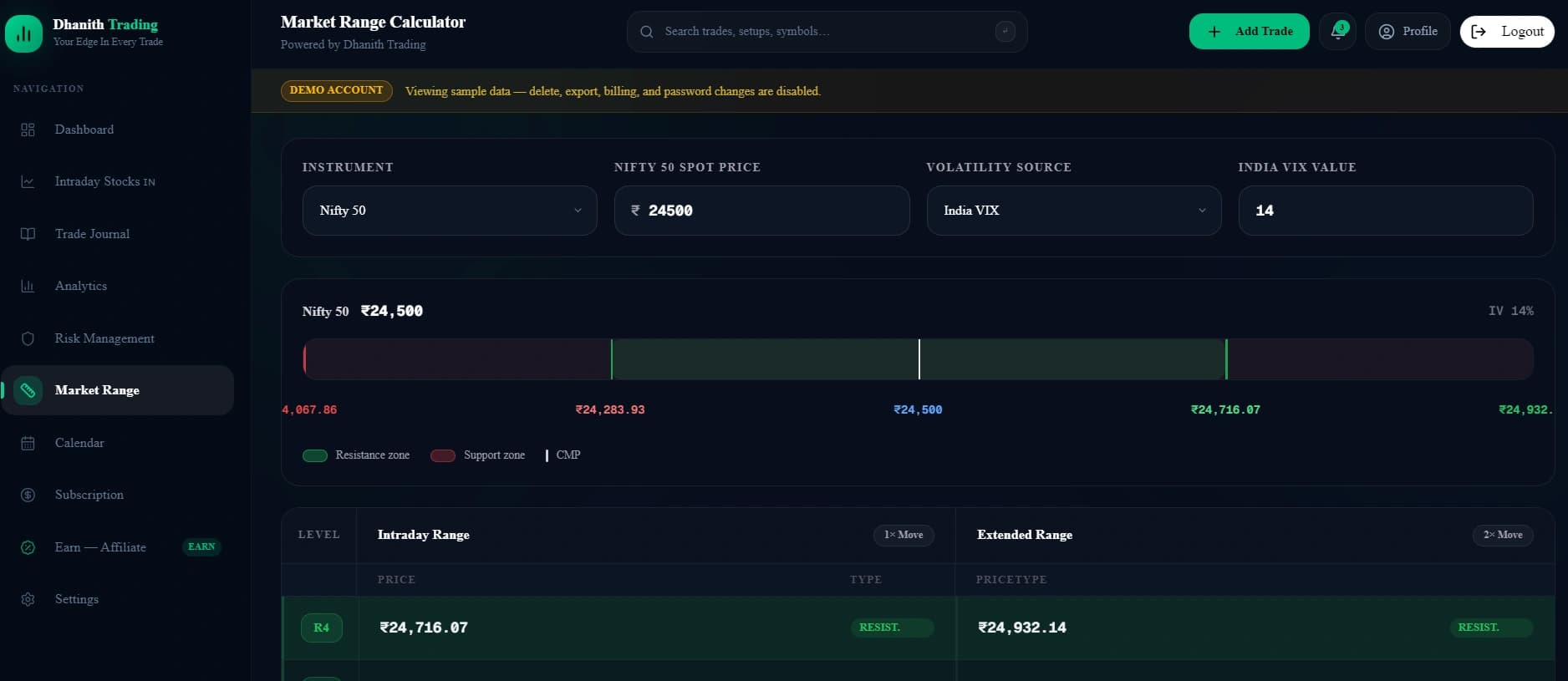
Ek journal sirf logging tool nahi hai — uska real power tab dikhta hai jab aap usse regularly review karte ho. Yahan ek simple, beginner-friendly routine hai jo aap Dhanith ke saath follow kar sakte ho:
End of trading day (5-10 minutes): Log every trade taken that day — entry, exit, setup tag, emotion, and a quick note on what went right or wrong. Attach a screenshot if the setup is one you want to remember or study later.
End of week (15 minutes): Open your weekly report. Check your win rate by setup, your most common mistake tag, and your average risk-reward ratio. Ask yourself: "Is there one specific habit — overtrading, ignoring stop loss, revenge trading — that shows up repeatedly this week?"
End of month (20-30 minutes): Review your monthly dashboard in full. Compare this month's discipline score and win rate to last month's. Identify your single best-performing setup and your single most costly mistake, and set one specific, focused goal for the next month based on what the data is actually telling you — not based on a vague feeling.
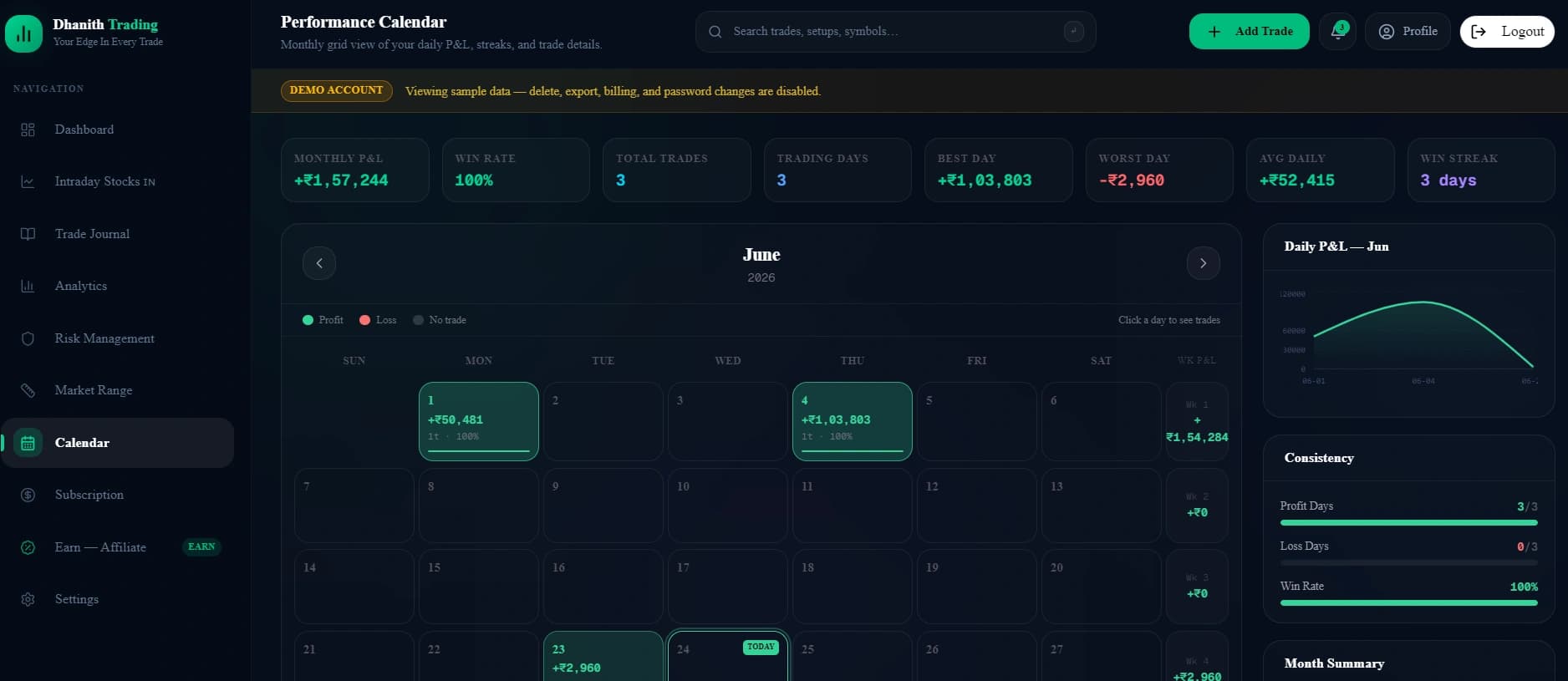
This routine doesn't need to take hours. The entire point of a proper trade tracking software is to make this review process fast enough that you'll actually stick with it — because a trading journal you abandon after two weeks provides zero value, no matter how detailed it was while you were using it.
If you want to become a serious trader, stop guessing and start reviewing. Trading is not just about finding the perfect setup — it's about understanding your own behavior, your own patterns, and your own mistakes well enough to actually fix them.
The best online trading journal is the one you actually use daily — not the one with the most features sitting unused, and not the Excel sheet you opened once and never touched again. Consistency in tracking is what eventually produces consistency in trading results.
Dhanith Trading Journal helps you build that habit. It's simple enough for beginners, detailed enough for serious intraday and options traders, and structured specifically around the problems Indian retail traders actually face — emotional trading, inconsistent discipline, and a lack of clear performance review.
Start tracking your trades with Dhanith Trading Journal today — your future self, looking back at three months of honest data, will thank you.
FAQ
Q: What is the best online trading journal? The best online trading journal is one that helps you track every trade — entry, exit, stop loss, target, setup, mistake, and emotion — in a simple, consistent way that you'll actually use every day. Dhanith Trading Journal is designed specifically for this, with a beginner-friendly dashboard built for Indian intraday, stock, and options traders.
Q: Why should traders use an online trading journal? An online trading journal helps traders track every trade, review mistakes, improve discipline, control emotions, and understand exactly which setups work and which don't. Without this kind of tracking, most traders end up repeating the same costly mistakes — like revenge trading or overtrading — for months or years without realizing it.
Q: Is Dhanith Trading Journal useful for beginners? Yes. Dhanith includes a beginner-friendly checklist, simple trade entry forms, and a clear performance dashboard, making it easy for new traders to start building good tracking habits from day one, without needing any prior journaling experience.
Q: Can I use Dhanith for intraday trading? Yes. Dhanith Trading Journal is well-suited for intraday traders, including those trading Nifty, BankNifty, and individual stocks, with fast trade entry and setup tracking designed to keep up with a faster-paced trading style.
Q: What should I record in a trading journal? At minimum, you should record your entry price, exit price, stop loss, target, quantity, the setup or strategy used, your emotional state during the trade, any mistakes made, and a screenshot of the chart. Dhanith captures all of this in one structured entry, so nothing important gets missed.
Q: Is an online trading journal better than Excel? For most traders, yes. An online trading journal like Dhanith is faster to use, automatically calculates your P&L and risk-reward ratios, lets you attach screenshots easily, and provides ready-made performance reports — all of which require significant manual effort to replicate in Excel.
Disclaimer: This blog is for educational purposes only and not investment advice.
Further reading: How to Become a Successful Intraday Trader | Intraday Trading Rules You Must Follow | Free Trading Journal Excel Download | 25 Trading Risk Management Rules Every Trader Must Follow | Best Risk Reward Ratio for Day Trading | How to Become a Disciplined Trader | 5 Best Intraday Trading Strategies for NSE India | What is Account Flipping in Trading
Have a question about this article?
Comment on our latest Instagram post or send us a DM — we reply to every one.
@dhanith_officialWas this article helpful?
Click to rate
Founder, Dhanith Trading
7+ years trading Nifty, Bank Nifty, NSE stocks, and commodities — specializing in Smart Money Concepts (SMC) and ICT price action. Founder of Dhanith — a trading journal, intraday screener, and risk tools platform built for retail traders.
Dhanith Newsletter
Enjoyed this article? Get more like it.
New trading guides, candlestick patterns, SMC strategies, and tool updates — straight to your inbox. Free, for Indian traders.
No spam. Unsubscribe anytime.
Continue Reading