On this page
- What Is a Break of Structure (BOS)?
- What Is a Change of Character (CHoCH)?
- BOS vs CHoCH — What's the Difference?
- Why Check Structure Before Anything Else?
- What Makes a BOS Real (Not Fake)?
- What Makes a CHoCH Real (Not Just Noise)?
- What Does a Bullish BOS Look Like, and How Do You Spot It?
- What Does a Bearish BOS Look Like, and How Do You Spot It?
- What Does a Bullish CHoCH Look Like, and How Do You Spot It?
- What Does a Bearish CHoCH Look Like, and How Do You Spot It?
- What Timeframe Is Best for BOS and CHoCH?
- Common Mistakes
- FAQ
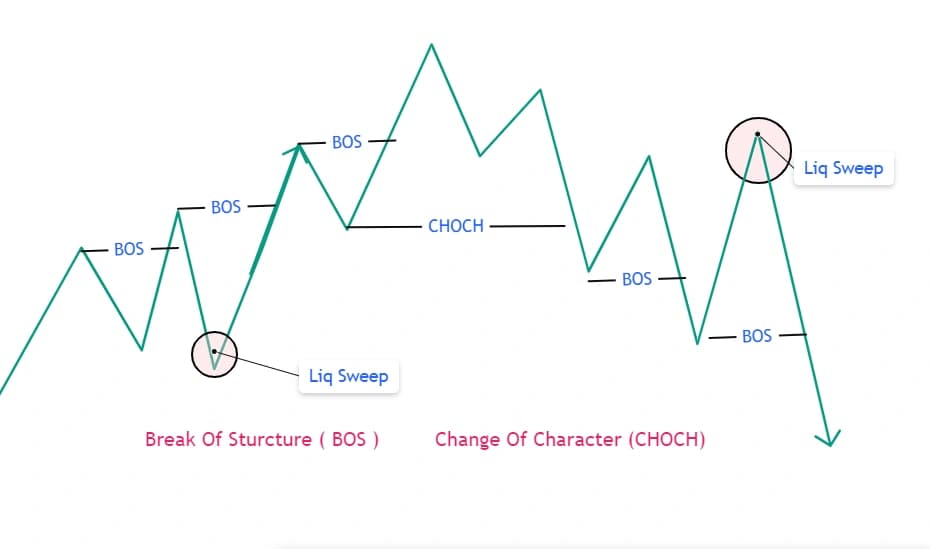
What Break of Structure (BOS) and Change of Character (CHoCH) actually mean, how to spot Valid and Invalid BOS, how to spot bullish and bearish versions of each, and which timeframe to trust.
What Is a Break of Structure (BOS)?
Price just did something it hasn't done in a while — closed above the last swing high, or below the last swing low. That's a Break of Structure. Nothing more mystical than that.
It matters because it's the market telling you, in plain terms, that whoever's been in control — buyers or sellers — just proved it again. Think of it as a trend renewing its lease. No BOS, no fresh confirmation — you're just assuming the trend is still alive.
What Is a Change of Character (CHoCH)?
Price just broke a level it was never supposed to break — at least not while the current trend was still healthy. That's a Change of Character. It's the first time price moves against the trend it's been in, instead of with it.
If BOS is the trend renewing its lease, CHoCH is the landlord getting a letter that says the tenant might not stay. Nothing's confirmed yet. But something's changed.
BOS vs CHoCH — What's the Difference?
Same mechanism — a candle closing beyond a swing point — pointed in opposite directions relative to the trend.
A BOS moves with the existing trend and confirms it's still intact. A CHoCH moves against the existing trend, for the first time, and signals it might be ending.
The other key difference is what each one tells you to do. A BOS is a green light to keep trading with the trend. A CHoCH is a pause button — it tells you to stop assuming the old direction and start watching closely, not to immediately flip your bias and trade the reversal.
Why Check Structure Before Anything Else?
Before you look at an order block, a fair value gap, or anything else — check whether the most recent structural event was a BOS or a CHoCH. It tells you which side of the market you should even be looking at. No serious SMC setup gets built without knowing this first.
What Makes a BOS Real (Not Fake)?
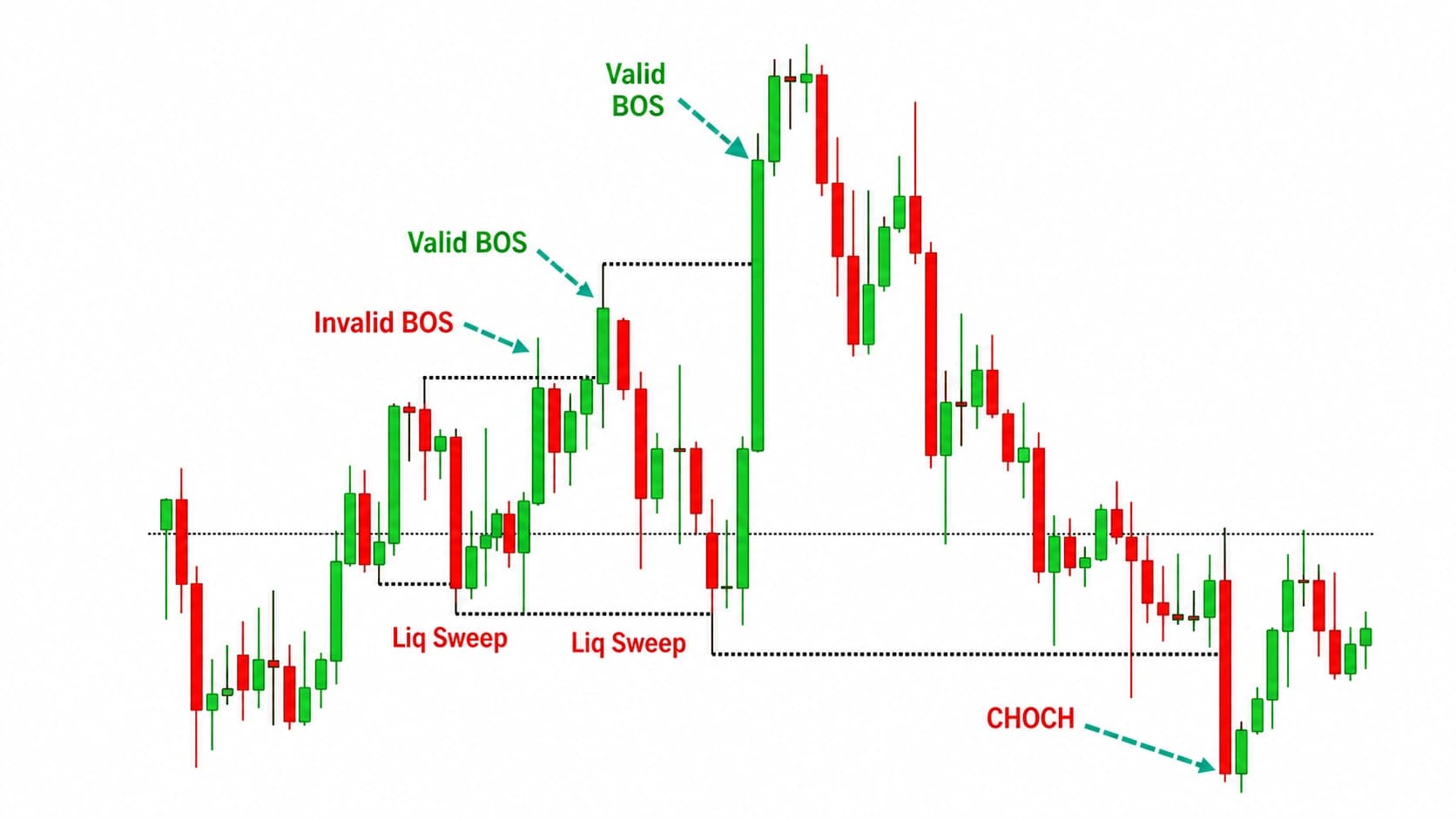
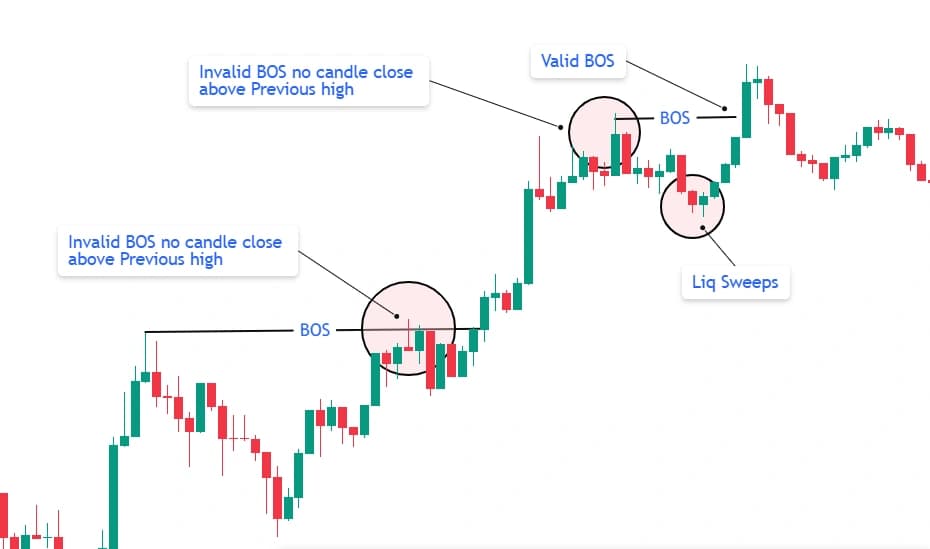
A valid BOS requires both a liquidity sweep and a confirmed closure above — or below, in a bearish trend — the critical structural level. Miss either piece and what looks like a BOS is usually something else.
There has to be a liquidity sweep first. Price should take out the resting orders around the level — the obvious stops sitting just beyond it — before the real break happens. A break with no sweep beforehand is more likely to be an early, unconfirmed move than genuine institutional follow-through.
The candle has to close beyond the level. A wick that spikes through and comes right back isn't a BOS — that's usually a stop hunt. Close matters, wick doesn't.
The move needs some force behind it. A slow, grinding candle that barely creeps past the level isn't the same as a sharp, decisive push.
If any of these is missing, don't mark it. Wait for the next one.
What Makes a CHoCH Real (Not Just Noise)?
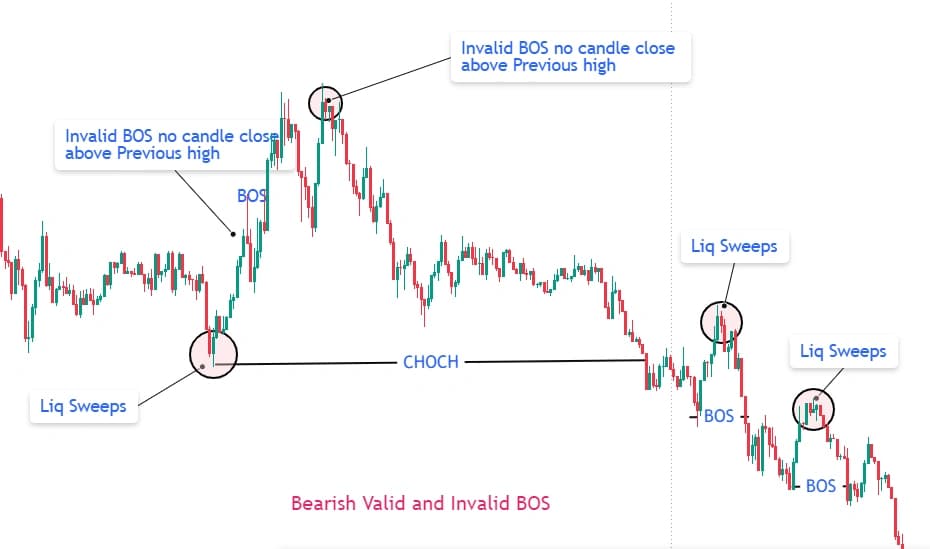
Not every dip or bounce counts. A valid CHoCH has to break the swing point that actually mattered — the one created by the last real Break of Structure — not some minor wiggle that formed during a pullback.
If you're marking every small swing as a potential CHoCH, you'll see reversal signals constantly and most of them will be wrong. The level has to be structurally significant, and ideally, the break should come with a decisive candle close — not a wick that pokes through and retreats.
What Does a Bullish BOS Look Like, and How Do You Spot It?
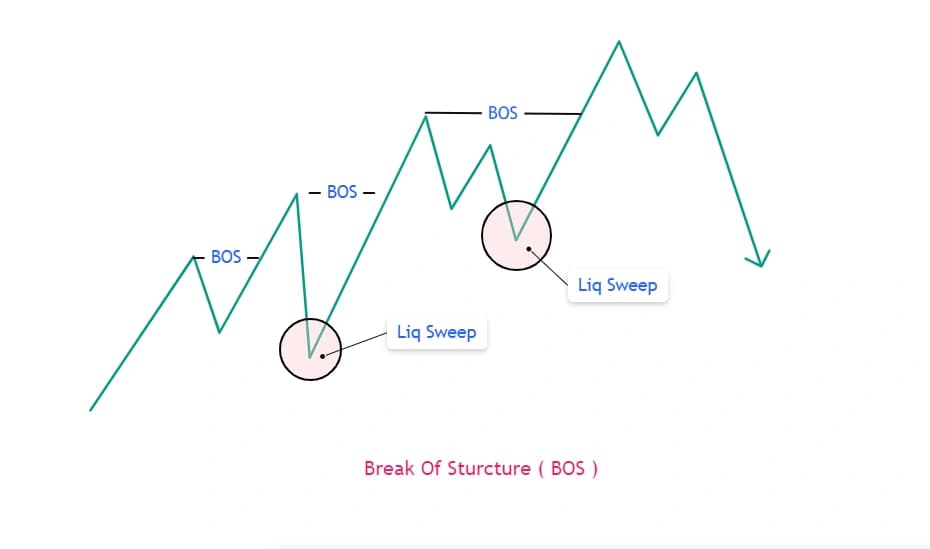
A bullish BOS happens when price closes above the most recent swing high, while the market is already in an uptrend.
- Find the last clear swing high on your chart — the most recent peak price pulled back from.
- Watch for price to approach that level again, ideally sweeping the liquidity resting just above it first.
- Confirm the candle actually closes above it — not just wicks through.
- Check the candle itself: is it noticeably larger than the ones around it, with a strong close near its high?
Once confirmed, the pullback that follows isn't a warning sign — it's usually where you look to buy. The old swing high often becomes support once price returns to test it.
What Does a Bearish BOS Look Like, and How Do You Spot It?
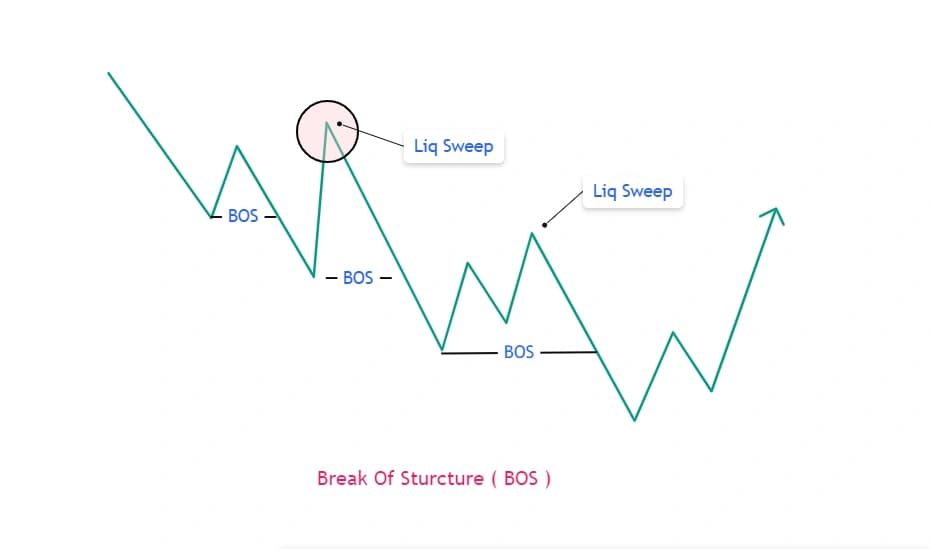
A bearish BOS is the mirror image — price closes below the most recent swing low, while the market is already in a downtrend.
- Find the last clear swing low — the most recent trough price bounced from.
- Watch for price to approach that level again, ideally sweeping the liquidity resting just below it first.
- Confirm the candle closes below it — a wick alone doesn't count.
- Check for a strong, decisive candle close near its low, not a weak drift through the level.
Once confirmed, the bounce that follows is usually where you look to sell. The old swing low often becomes resistance once price returns to test it.
What Does a Bullish CHoCH Look Like, and How Do You Spot It?
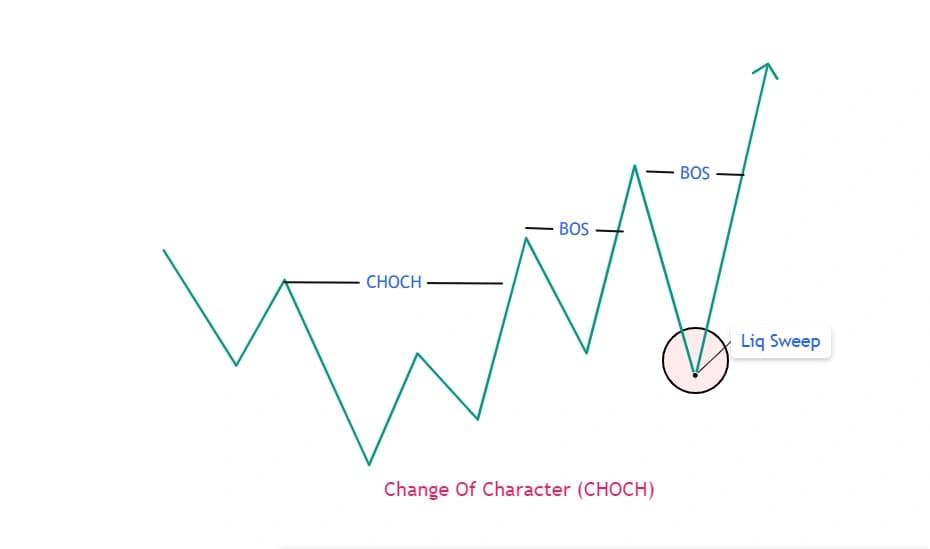
A bullish CHoCH happens in an established downtrend, when price closes above the most recent Lower High for the first time.
- Confirm you're in a downtrend — a clear sequence of Lower Highs and Lower Lows.
- Identify the most recent Lower High — the one that formed after the last bearish BOS.
- Watch for price to close above that level.
- Once confirmed, treat the downtrend as paused. Stop looking for shorts and watch for the next signal before considering longs.
What Does a Bearish CHoCH Look Like, and How Do You Spot It?
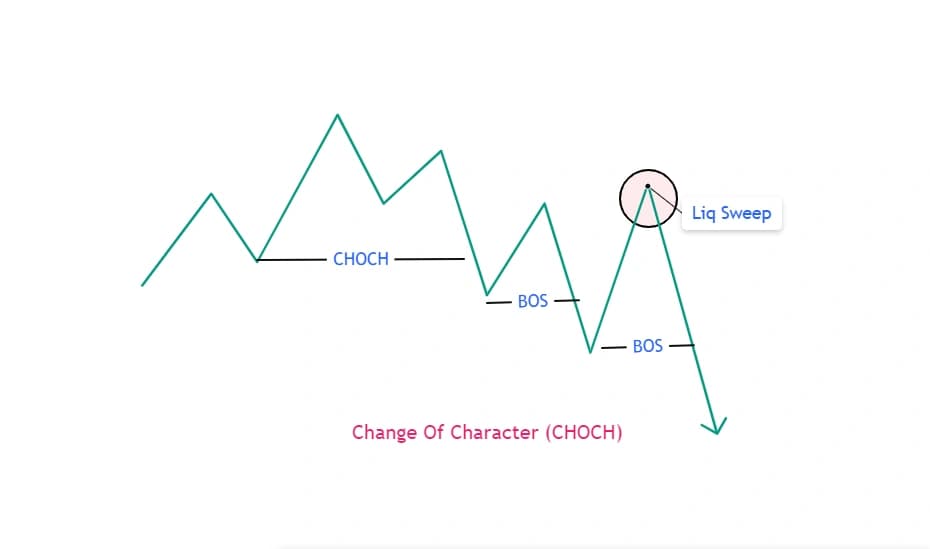
A bearish CHoCH happens in an established uptrend, when price closes below the most recent Higher Low for the first time.
- Confirm you're actually in an uptrend — a clear sequence of Higher Highs and Higher Lows.
- Identify the most recent Higher Low — specifically the one that formed after the last BOS, not just any recent low.
- Watch for price to close below that level.
- Once it closes below, treat the uptrend as paused — not reversed. Stop looking for longs and start watching for confirmation of a real reversal.
What Timeframe Is Best for BOS and CHoCH?
The mechanics are identical on every timeframe — but the weight either signal carries isn't.
On the daily chart, both a BOS and a CHoCH reflect real conviction. A daily BOS confirms your overall bias; a daily CHoCH is worth pausing and reassessing that bias entirely.
On the 4-hour chart, a BOS is useful for narrowing down where price is likely to react next within the daily bias. A CHoCH here is more common and more often temporary — sometimes it resolves into a real reversal, sometimes the original trend just resumes after a deeper pullback.
On the 5-minute or 15-minute chart, both happen constantly and mean far less on their own. They're mostly useful for timing an entry once price has already reached a zone identified on a higher timeframe — not for deciding direction, and not as a standalone reversal signal.
The practical rule: use the daily to decide direction, a mid timeframe (4-hour) to find the zone, and treat lower-timeframe BOS or CHoCH signals as noise whenever they contradict the daily trend.
Common Mistakes
Treating a wick as a BOS. Price pokes above a high on light volume, gets excited, buys, and price snaps right back down. Wait for the close.
Treating a CHoCH as an entry trigger. Seeing a CHoCH and immediately entering the new direction is how traders get caught in what turns out to be nothing more than a deeper pullback. A CHoCH tells you to stop, watch, and wait for real confirmation — not to flip your bias on the spot.
Marking every minor swing as a CHoCH. Only a break of the swing point created by the last real BOS counts — not every small wiggle inside a pullback.
Ignoring the timeframe hierarchy. A 5-minute CHoCH or BOS that contradicts the daily trend isn't a signal — it's noise inside a bigger move.
FAQ
Is a Break of Structure the same as a breakout? They're related but not identical. A breakout is any move past a visible level — it can happen anywhere, for any reason, including news. A BOS specifically confirms an existing trend is continuing, and only counts with a proper close, not just a spike through the level.
What's the difference between a BOS and a liquidity sweep? A liquidity sweep pokes past a level and reverses — no close beyond it. A BOS closes beyond the level and continues. They can look identical in the first few seconds, which is exactly why waiting for the candle close matters.
Does a CHoCH mean the trend has definitely reversed? No. It only means the trend's momentum has shifted enough to break a key level for the first time. It can lead to a full reversal, a period of ranging, or just a deeper pullback before the original trend resumes.
How long should I wait after a CHoCH before trading the new direction? There's no fixed number of candles — what you're actually waiting for is confirmation: a liquidity sweep, a stronger follow-through move, or price reacting cleanly at a new zone in the new direction. Acting the moment the CHoCH prints is usually too early.
Can a CHoCH happen without a prior liquidity sweep? Yes, but it's less reliable when it does. The most convincing CHoCH setups usually follow a sweep of the nearby liquidity first.
How many candles does it take to confirm a BOS? Just one — the candle whose close crosses the level. What takes longer is confirming it wasn't a fluke, which comes down to checking volume and follow-through on the next candle or two.
Have a question about this article?
Comment on our latest Instagram post or send us a DM — we reply to every one.
@dhanith_officialWas this article helpful?
Click to rate
Founder, Dhanith Trading
7+ years trading Nifty, Bank Nifty, NSE stocks, and commodities — specializing in Smart Money Concepts (SMC) and ICT price action. Founder of Dhanith — a trading journal, intraday screener, and risk tools platform built for retail traders.
Dhanith Newsletter
Enjoyed this article? Get more like it.
New trading guides, candlestick patterns, SMC strategies, and tool updates — straight to your inbox. Free, for Indian traders.
No spam. Unsubscribe anytime.
Continue Reading