On this page
Learn to read SMC market structure — BOS, CHoCH, and MSS explained simply, with strong vs. weak swing levels and a real multi-timeframe trade walkthrough.
TL;DR — Key Takeaways
- Market structure has three states: uptrend (HH/HL), downtrend (LH/LL), and range (consolidation)
- A Break of Structure (BOS) confirms trend continuation — trade with it
- A Change of Character (CHoCH) is the first warning of trend reversal — wait for confirmation
- A Market Structure Shift (MSS) is a CHoCH confirmed with displacement — the stronger reversal signal
- Strong swing levels caused a BOS; weak levels didn't — weak levels get taken out, strong levels hold
- Higher timeframe structure always overrides lower timeframe structure — no exceptions
Introduction
Every trade decision in Smart Money Concepts starts with the same question: what is the market structure right now?
Not which order block to enter at. Not which fair value gap to target. Structure first — always.
Market structure is the skeleton of price action — the sequence of swing highs and lows that tells you which side is in control, and whether a trend is still alive or quietly dying. Get this wrong and every other SMC concept you apply is built on a cracked foundation.
The Three Market States
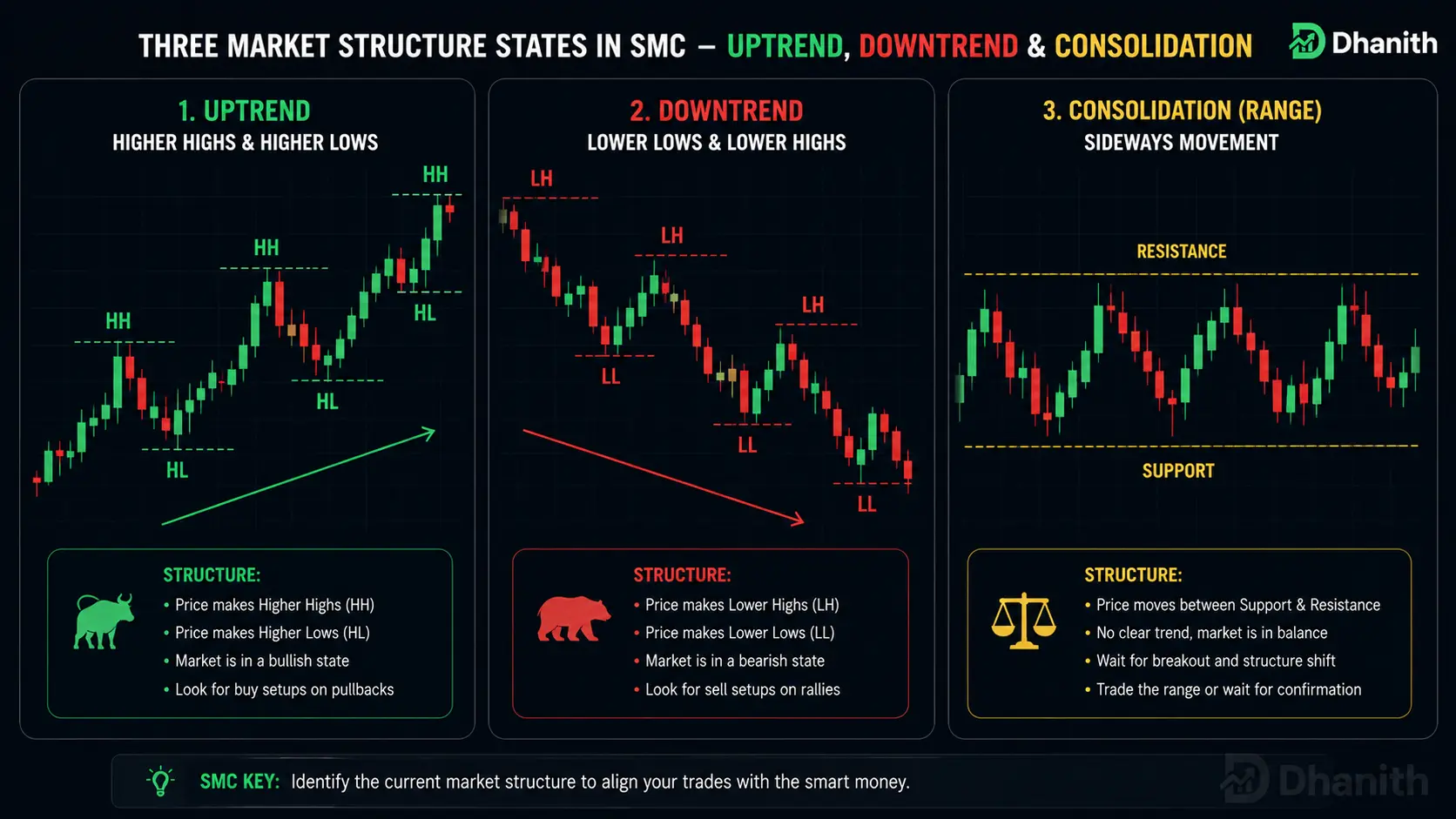
Every market, on every timeframe, sits in one of three states.
Uptrend: price makes Higher Highs and Higher Lows. Each rally clears the last peak, each pullback holds above the last trough. Buyers are in control — look for longs.
Downtrend: price makes Lower Highs and Lower Lows. Each rally fails, each decline breaks lower. Sellers are in control — look for shorts.
Consolidation: price bounces between a defined ceiling and floor without making meaningful new highs or lows. This isn't dead time — it's usually where institutions quietly build the position for the next move. Mark the range boundaries and wait for a confirmed break before assuming a direction.
Break of Structure and Change of Character
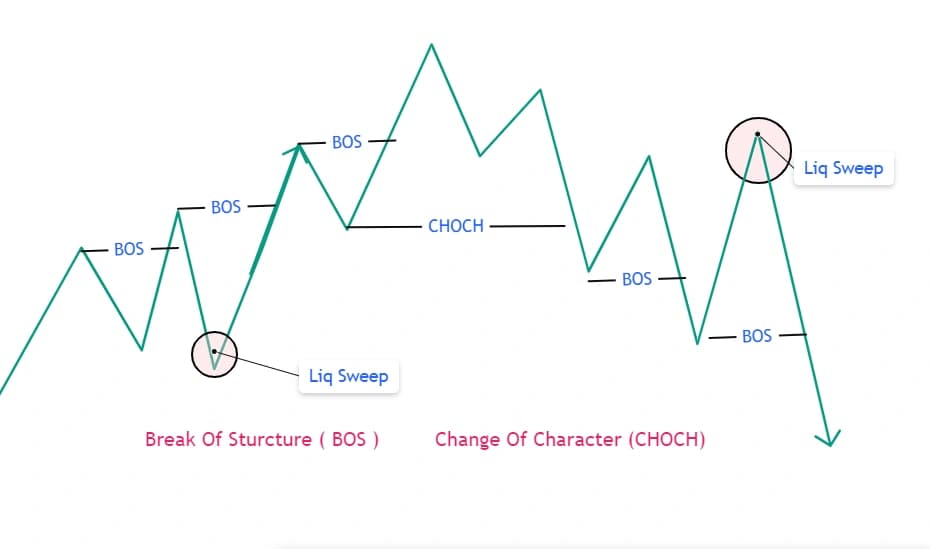
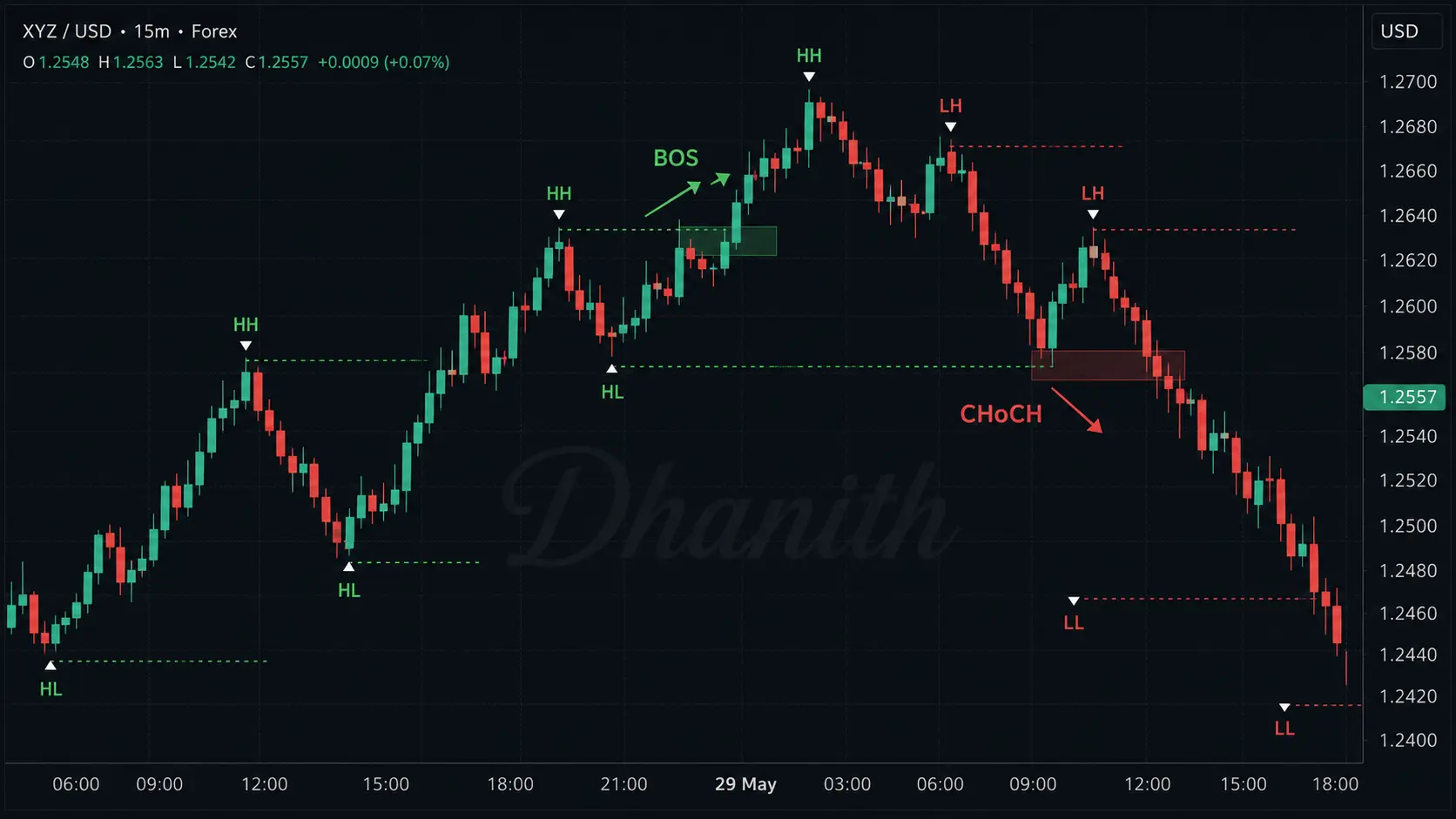
A Break of Structure (BOS) is price closing beyond a swing point in the direction of the existing trend — confirmation the trend still has fuel. A Change of Character (CHoCH) is the opposite: price closing beyond a swing point against the trend, for the first time. It's the market's first admission that something's shifted.
The distinction that trips most people up: a CHoCH is a warning, not a signal to reverse your position immediately. It just means stop trading with the old trend and wait for confirmation — either a second structural break or a Market Structure Shift.
Two things separate a real break from noise. First, it needs a candle close beyond the level — a wick that pokes through and snaps back is usually a liquidity sweep, not a break. Second, it needs displacement — a slow grind through a level carries far less weight than a sharp, impulsive move.
One nuance worth getting right: a valid CHoCH breaks the swing point that the most recent BOS created — not just any minor wiggle that formed during a pullback. Calling every small dip a CHoCH is the most common way traders misread structure.
Market Structure Shift (MSS)
An MSS is a CHoCH's stronger sibling — the same structural break, but confirmed with a strong displacement candle instead of a slow grind. In practice, the sequence usually goes: CHoCH appears first as the early warning, then MSS confirms it with conviction. Traders typically treat the MSS, not the CHoCH, as the actual entry trigger.
| Signal | Direction | Meaning | Action |
|---|---|---|---|
| BOS | With the trend | Continuation confirmed | Trade with it |
| CHoCH | Against the trend | First warning | Pause, wait for confirmation |
| MSS | Against the trend | Reversal confirmed | Look for reversal entries |
Strong vs. Weak Swing Levels
Not every swing high or low deserves your attention equally, and this is the filter that separates intermediate SMC traders from advanced ones.
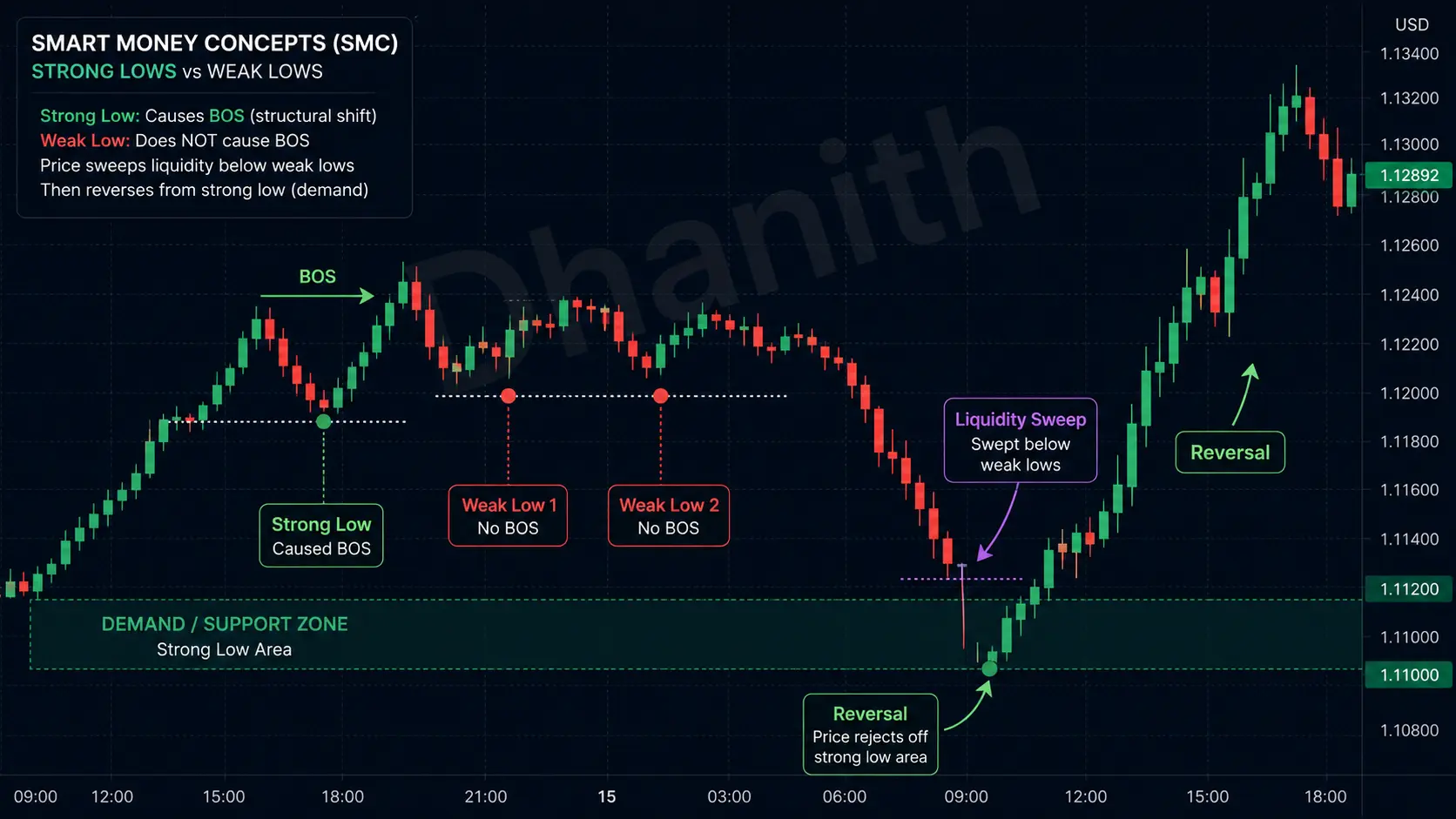
A strong level is one that caused a BOS — the origin of a move powerful enough to break prior structure. Institutional orders are likely still sitting there, which is why price tends to hold when it returns.
A weak level never caused a break. It's just a pullback low or high — the kind of place retail traders park stops, but with no real institutional wall behind it. When price approaches a cluster of levels, the weak ones usually get swept first, and the strong one is where the actual reaction happens.
Practically: mark your swings, ask which ones caused a break, and treat only those as real support or resistance. Everything else is a liquidity target on the way there.
Internal vs. External Structure
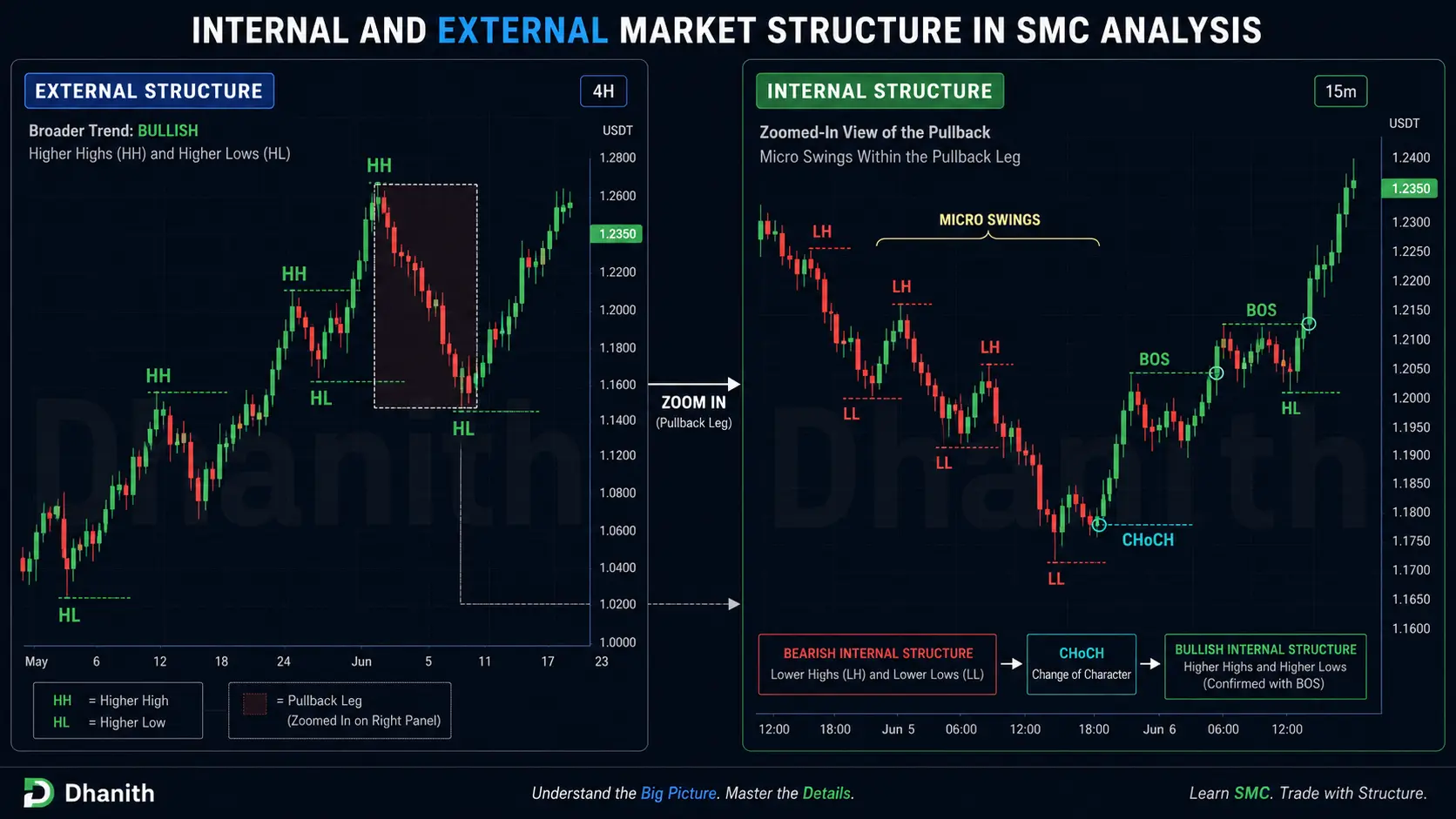
Structure exists on two layers at once. External structure is the major swing highs and lows that define the overall trend — this is where you read your bias. Internal structure is the smaller swings that form inside each pullback — this is where you time entries.
The rule in one line: use external structure to decide direction, internal structure to decide timing. A bullish shift on a 15-minute chart means nothing if the daily is clearly bearish — internal structure only matters within the higher timeframe's bias, never against it.
Reading Structure Across Timeframes
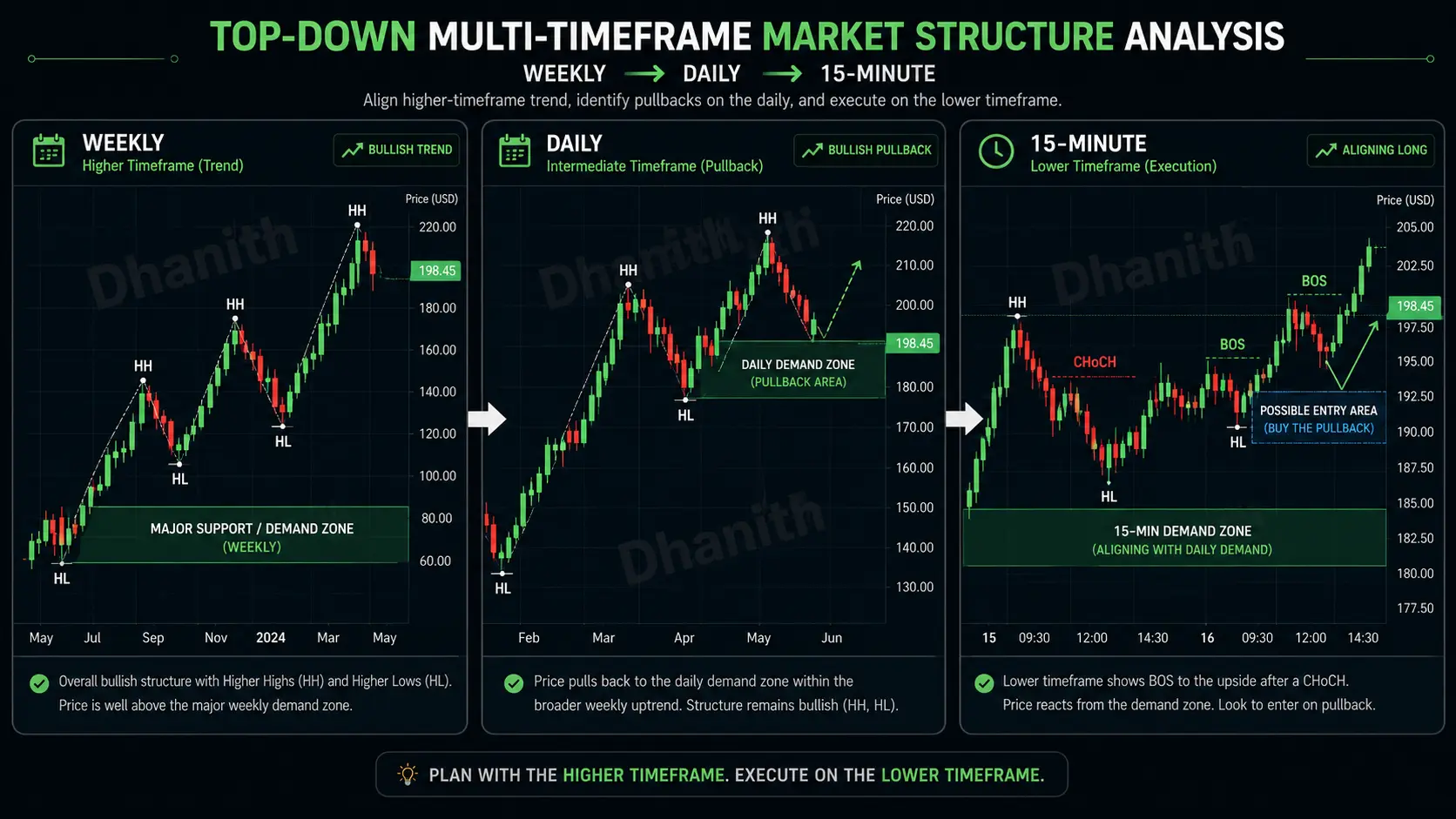
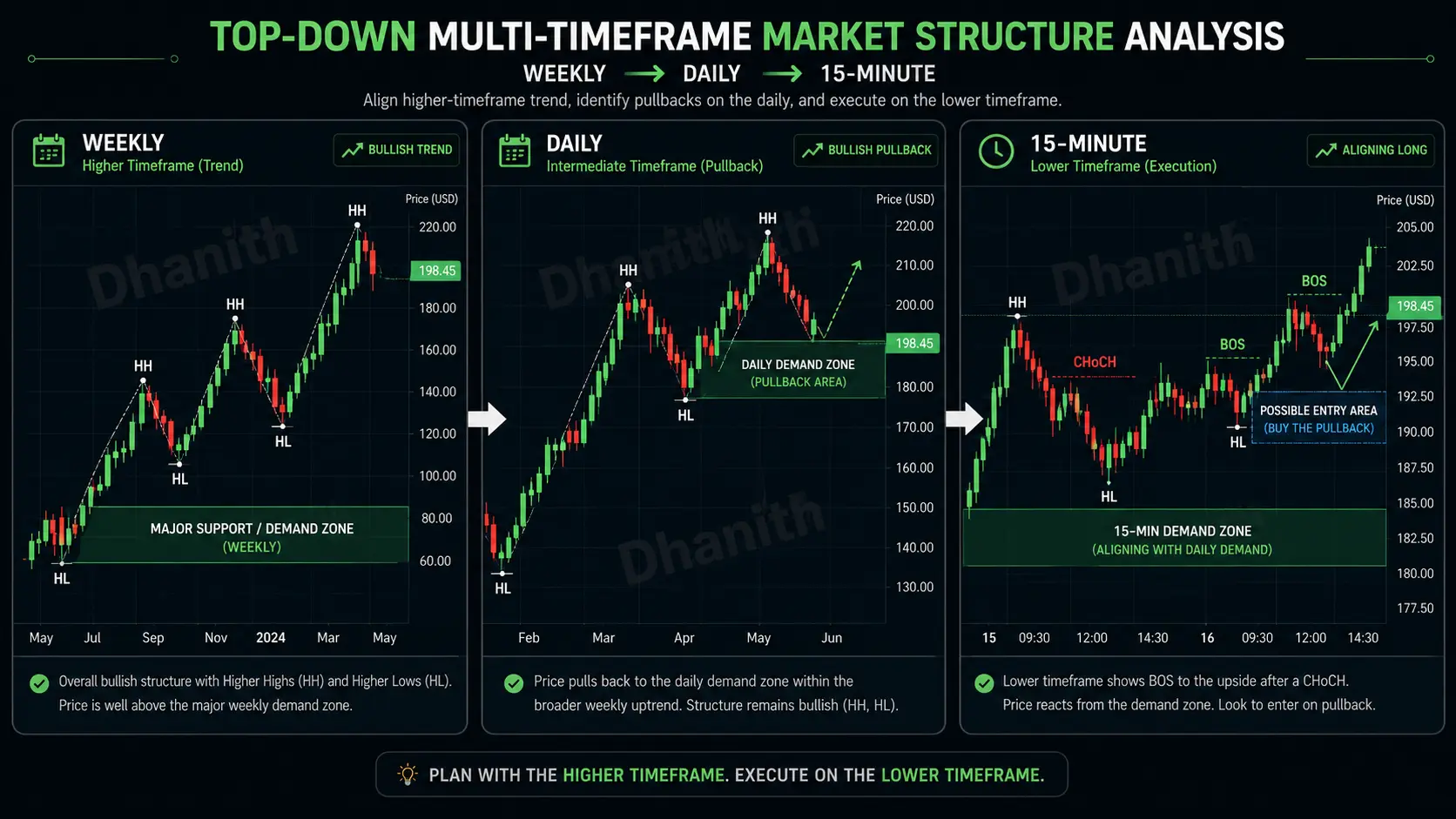
Structure isn't just about one chart — it's a filter that narrows as you go down.
| Timeframe | What it's telling you |
|---|---|
| Weekly | The multi-year story — where the levels that actually matter sit |
| Daily | Today's direction — your BOS/CHoCH read for the trade |
| 4-Hour | The specific zone price is heading toward |
| 15-Minute | Entry timing only, once price has already reached that zone |
The one rule that never bends: a lower timeframe shift never overrides a higher timeframe trend. If the daily is bearish, a bullish 15-minute CHoCH is a trap to watch out for, not a trade to take.
Common Mistakes
Marking every swing point. A chart covered in labels stops being useful. Only mark swings that caused a real directional change or a BOS/CHoCH.
Treating CHoCH as an entry signal. It's a pause button, not a trigger. Wait for a sweep and an MSS before acting on it.
Confusing a wick with a break. No candle close beyond the level, no BOS — it's probably a liquidity sweep.
Letting a lower timeframe override the daily. A "clean" setup on a small timeframe means nothing against a clear higher timeframe trend.
Reading trend into a range. If price is oscillating between two levels with no new highs or lows, it's a range — stop looking for HH/HL inside it and wait for a break.
How I Actually Read Structure
Forget the theory for a second — here's the real workflow, timeframe by timeframe.
Daily — set the bias. First and only question: is the daily printing HH/HL or LH/LL right now? If there's been a recent BOS, note the swing low or high that caused it — that's my strong level. If there's a CHoCH sitting unconfirmed, I treat the old bias as paused, not reversed, until proven otherwise.
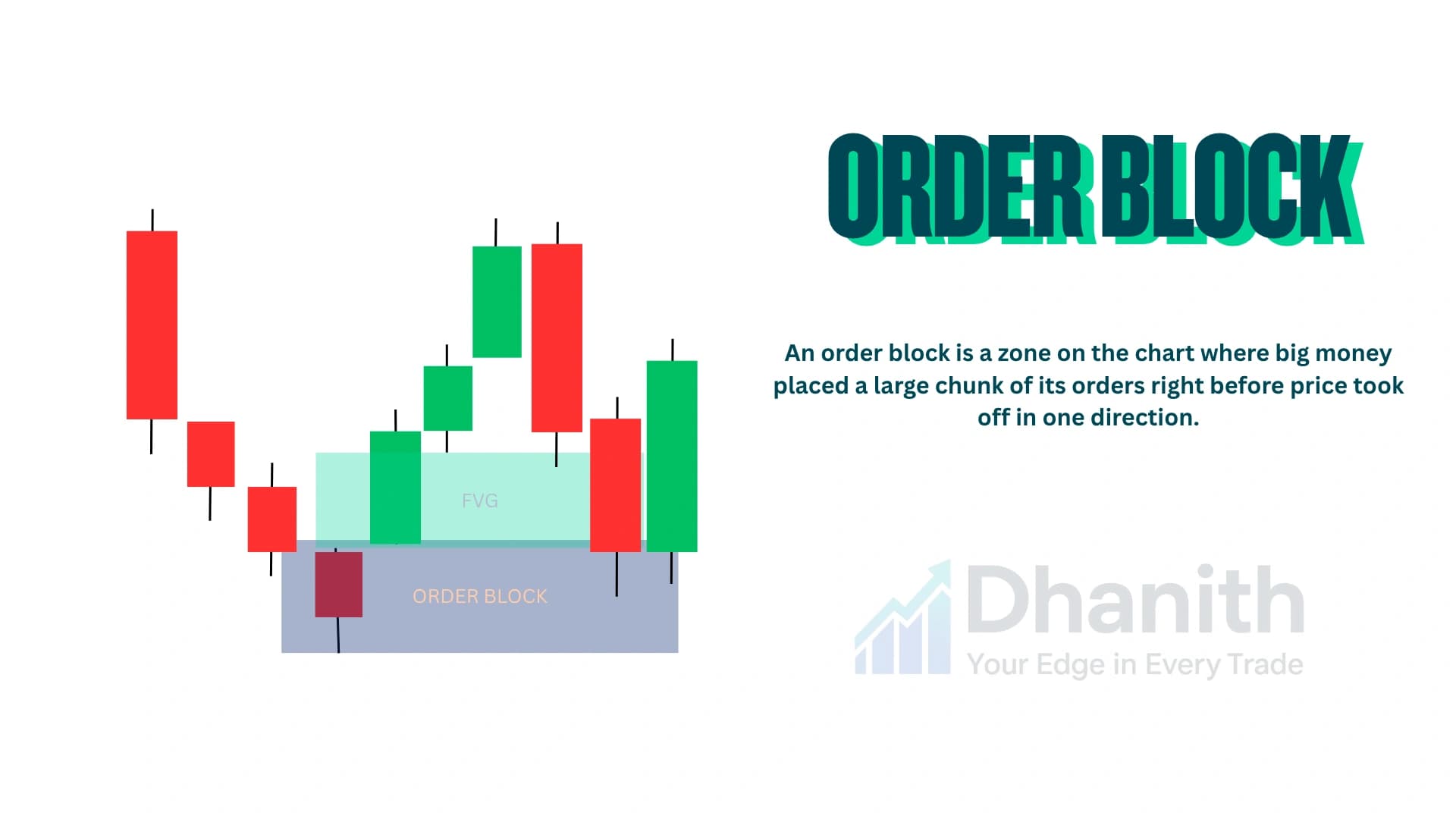
4-Hour — find the zone. With the daily bias set, I drop to the 4H and look for the order block or FVG that lines up with it — ideally both, overlapping. This is the zone I'm actually going to wait for. Nothing to do here except mark it and step back.
30-Minute — watch price arrive. I don't touch the 15-minute or 5-minute until price is actually inside my 4H zone. On the 30-minute, I'm watching for the first sign that the zone is reacting — a sweep of the nearby liquidity, a shift in the short-term structure, anything that tells me institutions are showing up here and not just passing through.
5-Minute — time the entry. Once the 30-minute confirms a reaction, the 5-minute is where I actually pull the trigger. I want a clean CHoCH on the 5-minute in the direction of my daily bias — that's the entry candle. Stop goes below/above the sweep, target is the next liquidity pool back on the 4H or daily.
The whole point of this cascade: every timeframe has exactly one job. Daily tells me direction. 4H tells me where. 30-minute tells me when to start paying attention. 5-minute tells me exactly when to click.
Conclusion
Market structure isn't the flashiest part of SMC, but it's the part everything else depends on.
Three things worth keeping: identify the state first — trend or range — before anything else. Know your BOS from your CHoCH, since one means continue and the other means pause. And remember not all levels are equal — strong levels hold, weak ones get swept.
Start with the daily chart, read the structure, and only then move down to find your entry.
Have a question about this article?
Comment on our latest Instagram post or send us a DM — we reply to every one.
@dhanith_officialWas this article helpful?
Click to rate
Founder, Dhanith Trading
7+ years trading Nifty, Bank Nifty, NSE stocks, and commodities — specializing in Smart Money Concepts (SMC) and ICT price action. Founder of Dhanith — a trading journal, intraday screener, and risk tools platform built for retail traders.
Dhanith Newsletter
Enjoyed this article? Get more like it.
New trading guides, candlestick patterns, SMC strategies, and tool updates — straight to your inbox. Free, for Indian traders.
No spam. Unsubscribe anytime.
Continue Reading