On this page
- Q: Expiry Day Normal Trading Day Se Alag Kyun Hai?
- Q: Expiry Day Ka Hour-by-Hour Plan Kya Hai?
- Q: STT Trap Kya Hai? Yeh Itna Important Kyun Hai?
- Q: Max Pain Strategy Expiry Day Pe Kaise Use Karein?
- Q: OI Analysis Expiry Day Pe Kaise Different Hoti Hai?
- OI Unwinding Signals
- Fresh OI Buildup Signals
- The Strongest Combined Signal
- 5 Best Expiry Day Options Trading Strategies
- Strategy 1: The 9:20 Straddle (Best for Beginners)
- Strategy 2: Directional CE or PE Buy (High Risk, High Reward)
- Strategy 3: Sell OTM Strangle — Theta Harvesting (Experienced Traders)
- Strategy 4: Max Pain Reversal Trade (Intermediate)
- Strategy 5: 2:30 PM Deep ITM Momentum Trade (Advanced Only)
- Q: SMC Ke Saath Expiry Day Trade Kaise Setup Karein?
- Expiry Day Complete Checklist
- Expiry Day Don'ts — The Mistakes That Cost Traders the Most
- Position Sizing for Expiry Day Trading
- FAQ
- Conclusion
- Ready to Log Your Expiry Day Trades?
Expiry Day Options Trading Strategy: NSE Guide 2026
Learn expiry day options trading strategy for Nifty & BankNifty — 5 strategies, STT trap warning, Max Pain, OI analysis & full checklist.
Expiry day — har Nifty trader ka Tuesday — ek aisa din hai jab paisa sabse tezi se banta bhi hai aur tabah bhi hota hai. Premium jo normal din mein ₹25 hilti hai, expiry day pe 150 point Nifty move pe ₹150 badh sakti hai. Theta jo normally ₹15 per day eat karta hai, expiry din ₹80 se ₹200 per day ban jaata hai.
Yahi reason hai ki expiry day options trading ko trading ka ek alag subject samjha jaata hai — same options, same chain, but completely different rules, completely different time management, and a completely different psychological demand compared to any other day of the week.
This guide covers everything you need to know about Nifty expiry day strategy, including the five most widely used setups, the hour-by-hour timeline of what actually happens on expiry day, the OI analysis techniques specific to expiry, the Max Pain strategy, and — most importantly — the STT trap that has cost thousands of Indian retail traders money they should never have lost.
Important: Expiry day options trading involves higher risk than normal session trading due to amplified Greeks, compressed time, and rapid premium swings. This guide is for educational purposes only. More than 90% of retail F&O traders lose money, as per SEBI data. Always paper trade any expiry day strategy before using real capital.
Q: Expiry Day Normal Trading Day Se Alag Kyun Hai?
Normal trading days aur expiry day ke Greeks mein zameen aasman ka fark hota hai:
Normal day:                    Expiry day:
-----------------------------------------------
Theta = ₹15 per day            Theta = ₹80-200 per day
Gamma = 0.002                  Gamma = 0.01-0.05
Premium stable                 Premium swings 50-300% in minutes
150-pt move = moderate gain    150-pt move = explosive gain/loss
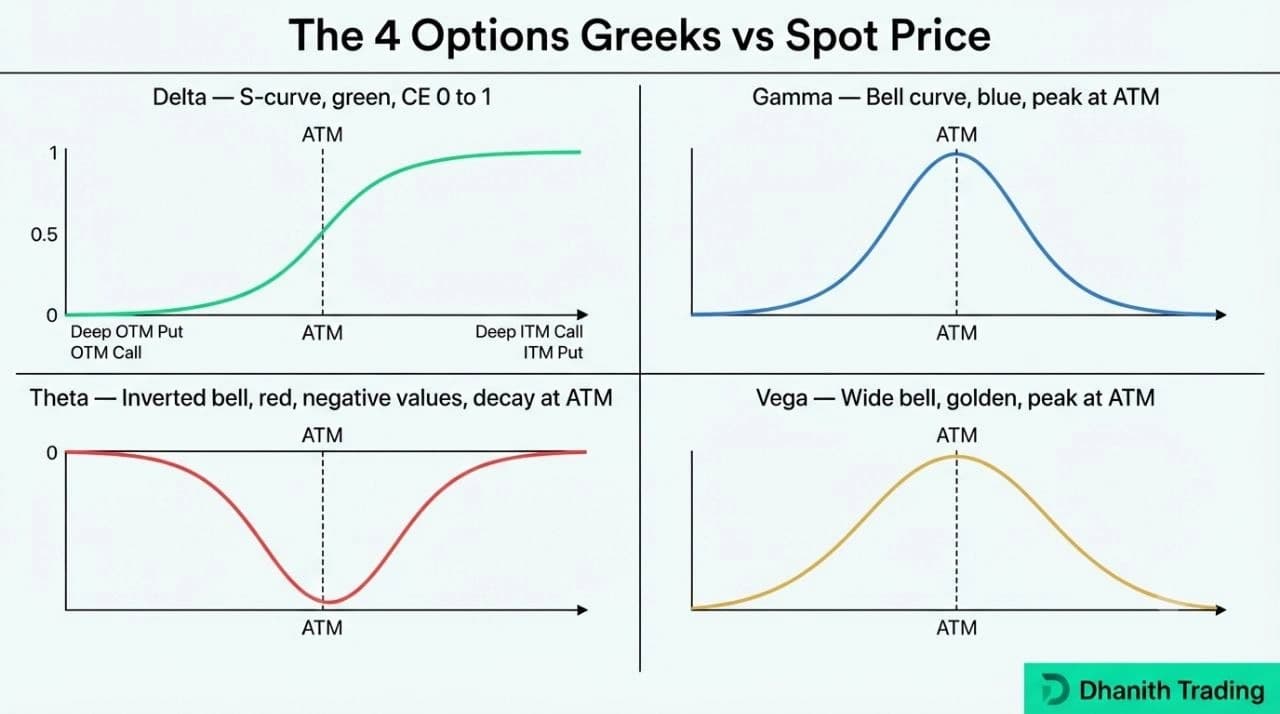
The reason is simple: as expiry approaches, all remaining time value must burn off by 3:30 PM. That means Theta is no longer spreading decay evenly across days — it is compressing a week's worth of decay into a single session. Gamma, which measures how fast Delta changes, is at its absolute maximum on expiry day — meaning even a small Nifty move can cause dramatic premium percentage changes.
This is why expiry day creates both the biggest opportunities and the biggest account losses for retail traders. The amplification works both ways.
Expiry Schedule for NSE:
- Nifty 50 — Weekly expiry every Tuesday + monthly, quarterly, half-yearly
- Bank Nifty — Monthly expiry only (weekly expiries discontinued)
- FinNifty, MidcpNifty, NiftyNxt50 — Monthly expiry only (weekly expiries discontinued)
- Stock options — Monthly expiry on the last Thursday of the month
Q: Expiry Day Ka Hour-by-Hour Plan Kya Hai?
The biggest mistake on expiry day is not having a time-based plan. Different windows behave fundamentally differently, and what works at 10:30 AM is actively dangerous at 3:15 PM.
TIME              WHAT HAPPENS                       WHAT TO DO
------------------------------------------------------------------
9:15 - 9:30 AM   Gap up/down opens, irrational       OBSERVE only
                 premiums, no real direction           No entry — wait

9:30 - 10:30 AM  Market finds initial direction       Watch OI buildup
                 First real institutional orders flow  Note Max Pain level
                 Support/resistance becomes visible    Identify your levels

10:30 - 12:00 PM Best trading window —               Execute planned trades
                 Direction usually established         15-min chart preferred
                 OI shifts confirm bias               Use tight stop loss

12:00 - 1:30 PM  Lunch hour — slow, choppy grinding  AVOID new trades
                 Low volume, Theta kills premium fast  Manage existing only

1:30 - 2:30 PM   Second opportunity window —         Momentum trades here
                 FII activity picks up again           OI unwinding = signal
                 Market makes its second directional   Confirm before entering
                 move

2:30 - 3:00 PM   Max Pain pull begins                Watch highest OI strike
                 Big reversals possible               Reduce position size
                 Market gravitates toward Max Pain     Dangerous for direction

3:00 - 3:15 PM   ⚠️ Last exit opportunity             COMPULSORY exit zone
                 Premiums collapsing rapidly           Close ALL positions

3:15 - 3:30 PM   ⛔ ABSOLUTE DANGER ZONE             NEVER hold options here
                 STT trap activates on ITM options     Exit before this window
                 Liquidity dries up completely         No exceptions
The two golden windows for trading are 10:30 AM–12:00 PM and 1:30 PM–2:30 PM. Everything outside these windows should be either observation or position management — not new entries.
Q: STT Trap Kya Hai? Yeh Itna Important Kyun Hai?
The STT trap is the single most unique and most expensive mistake that Indian retail traders make on expiry day — and it does not exist in most other global markets, which is why content from international trading educators rarely mentions it.
Standard STT (when you sell an option normally) = 0.05% of premium value
STT on exercise at expiry = 0.125% of INTRINSIC VALUE (not premium price)
That distinction — intrinsic value, not premium — is what makes it dangerous.
Real example:
You bought Nifty 24,000 CE for ₹10 (it was OTM when you bought)
Nifty later rallied and closed at 24,300 — Your CE is now ITM
Intrinsic value at expiry = 24,300 - 24,000 = ₹300

If you forget to close and it gets auto-exercised:
STT = 0.125% × 24,300 × 75 = ₹2,278 per lot

What you originally paid in premium = ₹10 × 75 = ₹750
STT alone on exercise = ₹2,278 — 3× more than your original cost
This means an ITM option that you technically "won" can still produce a net loss after STT if the intrinsic value margin is thin — or a much smaller profit than you were expecting.
The Non-Negotiable Rule: Close ALL ITM option positions before 3:15 PM on expiry day. No exceptions. Ever.
Q: Max Pain Strategy Expiry Day Pe Kaise Use Karein?
Max Pain is the strike price at which the maximum number of option buyers lose money at expiry. Since option sellers (primarily large institutions) are on the profitable side of this level, they have an active incentive to defend this price — and the market has a documented tendency to gravitate toward it as expiry approaches.
How to find Max Pain: Opstra.in offers a free Max Pain calculator updated in real time during market hours.
Using it as a directional bias:
Step 1: Find Max Pain level at 9:30 AM on Opstra
Step 2: Note current Nifty spot price
Step 3: Calculate the distance

Example:
Max Pain    = 24,000
Nifty at 10:00 AM = 24,200 (200 points ABOVE Max Pain)

Interpretation:
→ Sellers want market to come DOWN toward 24,000
→ Intraday bias is bearish
→ Strategy: Sell 24,300-24,400 CE, or Buy 24,200 PE
Max Pain works well when:            Works poorly when:
✓ No major news event that day       ✗ RBI policy or Budget day
✓ VIX is low, calm environment       ✗ Global crash / black swan event
✓ Market is already near Max Pain    ✗ Market is far from Max Pain
✓ After 1:30 PM (more reliable)      ✗ First 30 minutes (too irrational)

Accuracy on non-event days: ~65-70%
Q: OI Analysis Expiry Day Pe Kaise Different Hoti Hai?
On expiry day, you need to read OI differently from any other day — specifically, you need to distinguish between unwinding (existing positions being closed) and fresh buildup (new positions being added).
OI Unwinding Signals
CE OI DECREASING + Price rising  → Call sellers being squeezed (shorts covering)
                                   → Bullish signal, possible breakout above resistance

PE OI DECREASING + Price falling → Put sellers being squeezed (shorts covering)
                                   → Bearish signal, possible breakdown below support
Fresh OI Buildup Signals
CE OI INCREASING + Price falling → Fresh call selling = Resistance getting stronger
PE OI INCREASING + Price rising  → Fresh put selling  = Support getting stronger
The Strongest Combined Signal
BOTH CE OI unwinding + PE OI building simultaneously
→ Large directional move UPWARD is likely building

BOTH PE OI unwinding + CE OI building simultaneously
→ Large directional move DOWNWARD is likely building
This combined read — both sides of the chain shifting in the same directional implication — is one of the most reliable signals available on expiry day.
5 Best Expiry Day Options Trading Strategies
Strategy 1: The 9:20 Straddle (Best for Beginners)
Who it is for: Traders who cannot confidently predict market direction but know a large move is likely.
Setup: Buy ATM CE + Buy ATM PE at the same strike, entered between 9:20–9:25 AM after the first candle has closed.
Example — Nifty @ 24,000 (Tuesday expiry):
Buy 24,000 CE @ ₹80
Buy 24,000 PE @ ₹75
---------------------------------
Total Cost = ₹155 per unit = ₹11,625 per lot

Nifty moves UP 200 points:
  CE goes to ₹180 (+₹100), PE goes to ₹20 (-₹55)
  Net profit = +₹45 per unit = ₹3,375  ✓

Nifty moves DOWN 200 points:
  PE goes to ₹175 (+₹100), CE goes to ₹20 (-₹60)
  Net profit = +₹40 per unit = ₹3,000  ✓

Nifty stays FLAT:
  Both legs decay toward ₹20-30
  Loss = ₹100-115 per unit = ₹7,500-8,625  ✗
Exit rule: Exit immediately if Nifty moves 150+ points in one direction. Do not wait for more movement — Theta begins eating into the winning leg aggressively once the large move has occurred.
This is the most popular expiry day strategy for retail Nifty traders specifically because it does not require a directional call — only the expectation of significant movement.
Strategy 2: Directional CE or PE Buy (High Risk, High Reward)
Who it is for: Traders who can read market direction using OI analysis and SMC/price action.
Setup: Enter at 10:00–10:30 AM after direction is confirmed, buying ATM or very slightly OTM option in that direction.
Entry conditions required (ALL of these):
✓ OI data clearly confirms directional bias
✓ Price is above VWAP (bullish) or below VWAP (bearish)
✓ SMC structure supports: Break of Structure, demand or supply zone
✓ Trade entry only between 10:30 AM - 12:00 PM
✓ Never chase — wait for confirmation candle close

Exit rules:
→ Profit target: 50-80% premium gain
→ Stop loss: 30-40% premium loss, taken strictly with no averaging
→ Time stop: If not moved favorably by 1:30 PM, exit regardless
This is a genuinely high-risk, high-reward strategy. The stop loss discipline is non-negotiable — on expiry day, a losing directional bet can go from a 30% loss to a 90% loss faster than on any normal trading day.
Strategy 3: Sell OTM Strangle — Theta Harvesting (Experienced Traders)
Who it is for: Traders with experience in options selling and adequate capital for margin requirements.
Setup: Sell one strike OTM CE + sell one strike OTM PE at 9:30 AM, collecting premium from both sides.
Example — Nifty @ 24,000:
Sell 24,200 CE @ ₹35
Sell 23,800 PE @ ₹30
----------------------------
Total premium collected = ₹65 = ₹4,875 per lot

Profit zone: Nifty stays between 23,800-24,200
If Nifty closes anywhere in this range → Keep ₹4,875

Risk: Nifty breaks out of range → Loss accelerates quickly

Management rules:
→ If either leg doubles in premium, exit the full strangle
→ Do not hold for 100% of premium — exit at 60-70%
→ Close compulsorily by 2:30 PM regardless of P&L
→ Do not sell strangle on major news expiry days
This strategy benefits directly from the accelerated Theta decay that makes expiry day dangerous for buyers — you are on the selling side, so that decay works in your favor every minute.
Strategy 4: Max Pain Reversal Trade (Intermediate)
Who it is for: Traders who understand Max Pain and can fade short-term directional moves.
Logic: When the market moves significantly away from Max Pain, sellers have a strong incentive to pull it back. Trading toward Max Pain after an extended move away from it has a documented accuracy of approximately 65–70% on non-event expiry days.
Setup:
Step 1: Find Max Pain at 9:30 AM (Opstra)
Step 2: Wait for Nifty to move 150+ points away from Max Pain
Step 3: Enter a position toward Max Pain (fade the move)

Real example:
Max Pain = 24,000
Nifty at 11:00 AM = 24,250 (250 pts above Max Pain)

Trade: Buy 24,100 PE
Stop loss: Nifty sustains above 24,300 (25 points beyond)
Target: Nifty returns to 24,000-24,050

Accuracy: ~65-70% on non-event days
         Much lower on RBI/Budget/election expiry days
Strategy 5: 2:30 PM Deep ITM Momentum Trade (Advanced Only)
Who it is for: Experienced intraday traders comfortable with deep ITM options and strict time discipline.
Logic: At 2:30 PM, there is very little time premium left in any option. Deep ITM options at this point have a Delta of 0.80–0.90 — meaning they move almost 1:1 with Nifty, acting like a highly leveraged futures position, but with one key advantage: maximum loss is still capped at the premium paid.
Example:
Nifty at 2:30 PM = 24,150, moving upward strongly
Buy 23,800 CE (Deep ITM) @ ₹360 (Delta ≈ 0.85)

Nifty moves up 80 more points (to 24,230):
Delta gain = 0.85 × 80 = ₹68 per unit
Return on ₹360 premium = 19% in 30-40 minutes

⚠️ COMPULSORY EXIT: 3:10-3:15 PM absolute maximum
This strategy fails if not exited — STT trap activates
This strategy should never be attempted without an alarm or broker alert set for 3:10 PM. The single reason it fails catastrophically for beginners is not the trade idea — it is holding past 3:15 PM and triggering the STT trap.
Q: SMC Ke Saath Expiry Day Trade Kaise Setup Karein?
For traders using Smart Money Concepts alongside option chain analysis, expiry day offers some of the highest-confluence setups available in the entire trading calendar.
Setup 1 — Triple Bullish Confluence:
Demand zone on price chart
+ High PE OI at same strike level (options support)
+ Max Pain level is BELOW current price (sellers want price up)

→ Buy CE at or just above the demand zone
→ Tight stop loss below the zone
→ Target: next supply zone or Max Pain level above
→ Highest-probability bullish trade on expiry day
Setup 2 — Triple Bearish Confluence:
Supply zone on price chart
+ High CE OI at same strike level (options resistance)
+ Max Pain level is ABOVE current price (sellers want price down)

→ Buy PE at or just below the supply zone
→ Tight stop loss above the zone
→ Target: next demand zone or Max Pain level below
→ Highest-probability bearish trade on expiry day
Setup 3 — Break of Structure + OI Unwinding:
A Break of Structure (BOS) forms on the 5-minute chart
+ Simultaneously, OI data shows the opposing side unwinding

Example: Bullish BOS + CE OI unwinding (call sellers covering)
→ Confirms the break is genuine, not a false move
→ Buy ATM CE in the direction of the BOS
→ Enter after the BOS candle has fully closed
→ Tight stop below the BOS origin candle
Expiry Day Complete Checklist
Pre-Market (9:00–9:15 AM):
- Check Gift Nifty / SGX Nifty for gap indication
- Note Max Pain level from Opstra (write it down)
- Identify highest CE OI and PE OI strikes (support/resistance)
- Check India VIX — higher VIX = wider moves expected
- Any major news/event today? If yes, plan to reduce position size
Market Open (9:15–10:00 AM):
- Only observe — no trades in this window
- Note opening range high and low
- Watch OI buildup direction in first 15 minutes
- See whether the gap is being extended or filled
Trade Window (10:00 AM–12:00 PM):
- Has direction been confirmed by both OI and price structure?
- Is your chosen strategy appropriate for the day's conditions?
- Is your stop loss pre-decided (not to be changed after entry)?
- Is capital at risk maximum 2% of total account?
Mid-Day (12:00–1:30 PM):
- No new trades in this window
- Managing existing positions only
- Is your original thesis still valid? If not, exit
Afternoon Window (1:30–2:30 PM):
- Second entry opportunity — confirmed direction only
- Re-check Max Pain — is the market moving toward or away from it?
Exit Protocol (2:30–3:15 PM):
- Begin reducing positions from 2:30 PM
- All positions closed by 3:15 PM — no exceptions
- Zero ITM options held past 3:15 PM (STT trap)
- Log every trade in journal immediately after close
Expiry Day Don'ts — The Mistakes That Cost Traders the Most
✗ Trading the first 15 minutes — premiums are completely irrational
✗ Holding positions through the 12:00-1:30 PM window without reason
✗ Averaging down on a losing position on expiry day
✗ Buying deep OTM options expecting a lottery win
✗ Holding ANY ITM option past 3:15 PM (STT trap)
✗ Over-leveraging — start with 1-2 lots maximum
✗ Revenge trading after a losing expiry morning
✗ Entering without a pre-defined stop loss
Position Sizing for Expiry Day Trading
Expiry day risk should be sized more conservatively than normal trading days — because the rapid premium swings mean a losing trade can move against you far faster than on a normal session.
| Account Size | Max Risk Per Trade (2%) | Suggested Lots (Nifty) |
|---|---|---|
| ₹50,000 | ₹1,000 | 1 lot only |
| ₹1,00,000 | ₹2,000 | 1-2 lots |
| ₹2,00,000 | ₹4,000 | 2-3 lots |
| ₹5,00,000 | ₹10,000 | 4-5 lots |
The 2% rule ensures that even a complete wipeout of a single expiry day position — losing the full premium paid — does not meaningfully damage your account's ability to continue trading. One bad expiry should be a learning experience, not an account-ending event.
FAQ
Q: What is the best expiry day options trading strategy for beginners? The 9:20 AM Straddle is widely considered the most beginner-friendly expiry day strategy because it does not require a directional prediction — only the expectation of significant movement in either direction. Buy ATM CE and ATM PE at the same strike between 9:20–9:25 AM and exit immediately if the market moves 150+ points in one direction. The risk is clearly defined as the total premium paid.
Q: What is the STT trap in Nifty options? The STT (Securities Transaction Tax) trap is a unique Indian market issue. When an ITM option expires without being squared off, STT is charged at 0.125% of the intrinsic value (not the premium price), which can be dramatically higher than expected. Always close all ITM options before 3:15 PM on expiry day — this is non-negotiable.
Q: What is Max Pain in options trading and how accurate is it? Max Pain is the strike price where maximum option buyers lose money at expiry, and the market has a tendency to gravitate toward it as sellers defend this level. On non-event expiry days with low VIX, Max Pain has an accuracy of approximately 65–70% as a directional bias tool. It is less reliable on days with major news events like RBI policy or Budget announcements.
Q: What time should I trade Nifty options on expiry day? The two best windows are 10:30 AM–12:00 PM (primary window, after direction is established) and 1:30 PM–2:30 PM (secondary window). Avoid trading the first 15 minutes (premiums irrational), the lunch hour 12:00–1:30 PM (low volume, choppy), and never enter new positions after 2:30 PM. All positions must be closed by 3:15 PM.
Q: How do I read OI on expiry day? On expiry day, distinguish between OI unwinding (shorts covering — signals potential squeeze/reversal) and fresh OI buildup (new positions — confirms existing resistance or support). When CE OI is unwinding simultaneously while PE OI is building, that often signals a sustained upward move. The reverse signals a downward move. This cross-chain OI reading is particularly powerful during the 10:00 AM–12:00 PM window.
Q: Kitne lots se expiry day trading shuru karni chahiye? Start with 1 lot only — regardless of account size — until you have at least 10 paper-traded and 10 live-traded expiry sessions documented in your trading journal. The amplified Greeks on expiry day make even 1-lot positions move dramatically. Never risk more than 2% of total account capital on a single expiry day trade.
Conclusion
Expiry day is not a shortcut to fast profits. It is one of the most technically demanding, psychologically pressuring environments in all of retail trading — compressed time, amplified Greeks, irrational price action in the first and last 15 minutes, and the unique India-specific STT trap that forgives no mistakes after 3:15 PM.
But for traders who prepare properly — who understand the hour-by-hour dynamics, who use Max Pain and OI analysis to identify directional bias, who have SMC structure confluence to back their entries, and who execute strict time-based exits — expiry day can consistently offer the highest single-day reward opportunities in the weekly calendar.
The difference between profitable expiry day traders and losing ones is almost never strategy knowledge. It is almost always discipline: entering only in the confirmed windows, sizing correctly, stopping out when the trade invalidates, and — above everything else — closing every single position before 3:15 PM.
Further reading: Options Greeks Explained: Delta, Theta, Gamma, Vega | How to Analyse Option Chain | Options Trading Strategies with Calculator | Options Trade Adjustment Techniques | What is Account Flipping in Trading
Ready to Log Your Expiry Day Trades?
→ Track Every Expiry Trade in the Dhanith Journal — note your entry time, strategy used, Max Pain level, OI bias, and outcome so each expiry makes you a better trader
→ Calculate Your Lot Size Before Every Expiry Trade — know your exact max loss in rupees before the position is on
Disclaimer: This blog is for educational purposes only and is not investment advice. Options trading on expiry day involves exceptionally high risk due to amplified Greeks and accelerated premium decay. More than 90% of retail F&O traders lose money, as per a SEBI study. Always paper trade first, use only risk capital, and never trade without a pre-defined stop loss and exit plan.
Have a question about this article?
Comment on our latest Instagram post or send us a DM — we reply to every one.
@dhanith_officialWas this article helpful?
Click to rate
Founder, Dhanith Trading
7+ years trading Nifty, Bank Nifty, NSE stocks, and commodities — specializing in Smart Money Concepts (SMC) and ICT price action. Founder of Dhanith — a trading journal, intraday screener, and risk tools platform built for retail traders.
Dhanith Newsletter
Enjoyed this article? Get more like it.
New trading guides, candlestick patterns, SMC strategies, and tool updates — straight to your inbox. Free, for Indian traders.
No spam. Unsubscribe anytime.
Continue Reading