On this page
- Why Risk Management Beats Every Strategy
- The 25 Trading Risk Management Rules
- SECTION 1: CAPITAL PROTECTION (Rules 1–6)
- SECTION 2: TRADE QUALITY (Rules 7–12)
- SECTION 3: LOSS CONTROL (Rules 13–17)
- SECTION 4: EXECUTION DISCIPLINE (Rules 18–22)
- SECTION 5: LONG-TERM MINDSET (Rules 23–25)
- The Dhanith Trader's Daily Routine
- Quick Reference: All 25 Rules at a Glance
- Final Thoughts
- FAQ
Learn 25 trading risk management rules for consistent profitability — position sizing, stop loss, daily limits, SMC examples, journal tips, and daily trader routine.
Most traders spend 90% of their time looking for the perfect entry and almost no time thinking about what happens when they are wrong.
That imbalance is why most retail traders lose money — not because they cannot read charts, not because they do not understand Smart Money Concepts or ICT setups, but because they have no structured framework for managing risk when a trade goes against them. A perfect order block entry with no stop loss is not a trade. It is a bet.
This guide covers the complete framework: 25 trading risk management rules that apply to every strategy, every market, and every experience level — from the first trade to the thousandth. Whether you trade Nifty intraday, NSE swing setups, crypto, or US stocks, these rules form the foundation that separates the traders who survive from the traders who blow up.
Disclaimer: This article is for educational purposes only. Trading involves substantial risk of capital loss. None of the rules here constitute financial advice. Always consult a qualified financial advisor before trading with real capital.
Why Risk Management Beats Every Strategy
Before getting to the rules, understand this: risk management is not the boring part of trading. It is the only part that determines whether you are still trading one year from now. If you're still building your core trading strategy, start with our Smart Money Concepts guide — then apply every rule below to whatever setup you take.
According to a SSRN-published academic study tracking over 19,000 Brazilian futures day traders, 97% lost money, with only 0.4% earning more than a bank teller's salary. Separate research tracking over 450,000 traders found only 0.88% were consistently profitable over time.
Position sizing built around a fixed 1% risk rule is one of the most consistently recommended defenses against this — see Trade That Swing's breakdown of the 1% rule for a deeper look at how professional traders apply it.
The traders who make up the profitable minority are almost never the ones who found the best entry signal. They are the ones who manage risk so well that their losing trades are small and survivable, and their winning trades are large enough to more than compensate.
Risk management is what makes longevity possible. And longevity is what makes compounding possible. And compounding is what turns a modest trading edge into significant wealth over time.
The 25 Trading Risk Management Rules
SECTION 1: CAPITAL PROTECTION (Rules 1–6)
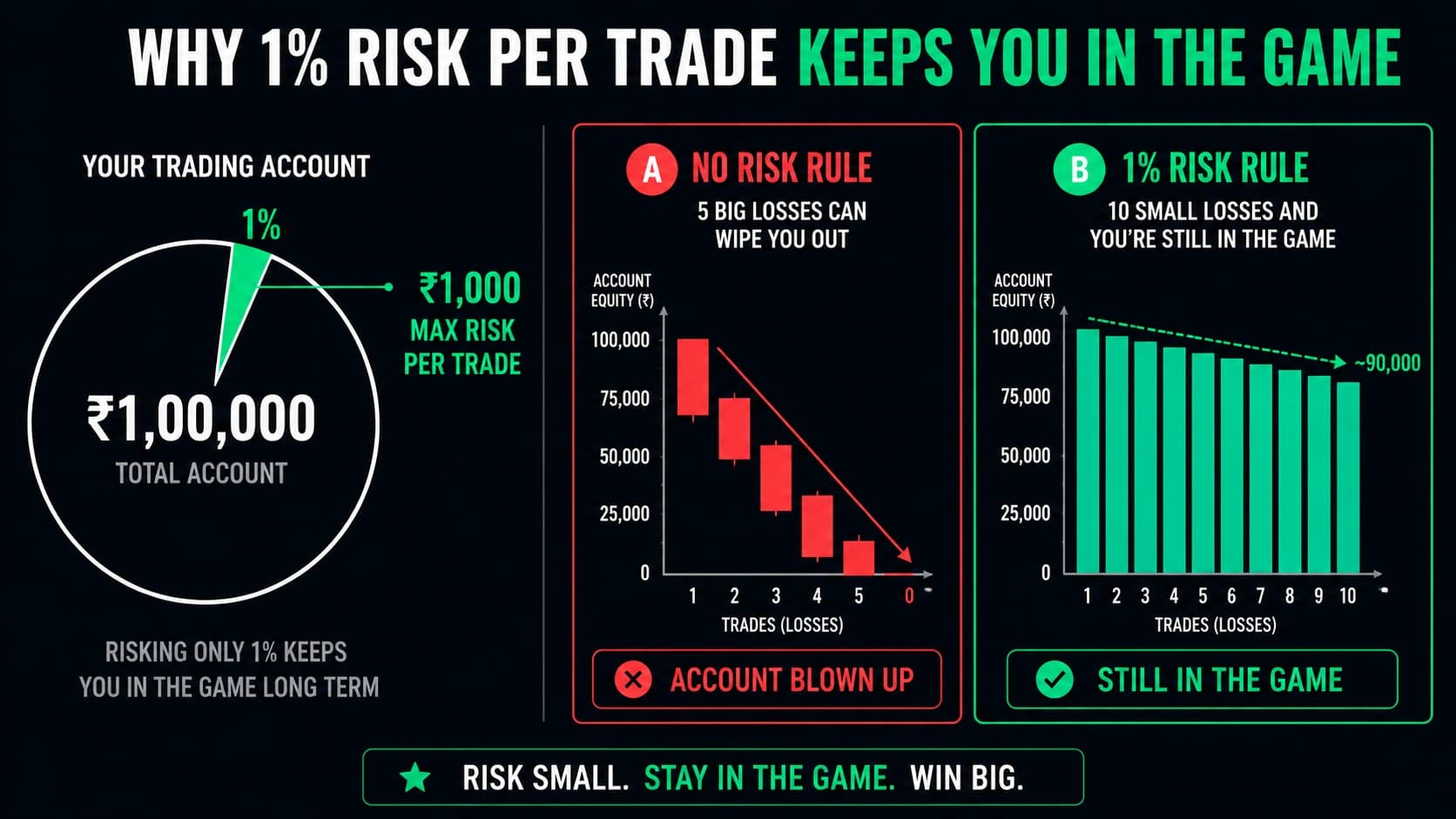
Rule 1: Risk Only 1–2% of Your Total Trading Capital on a Single Trade
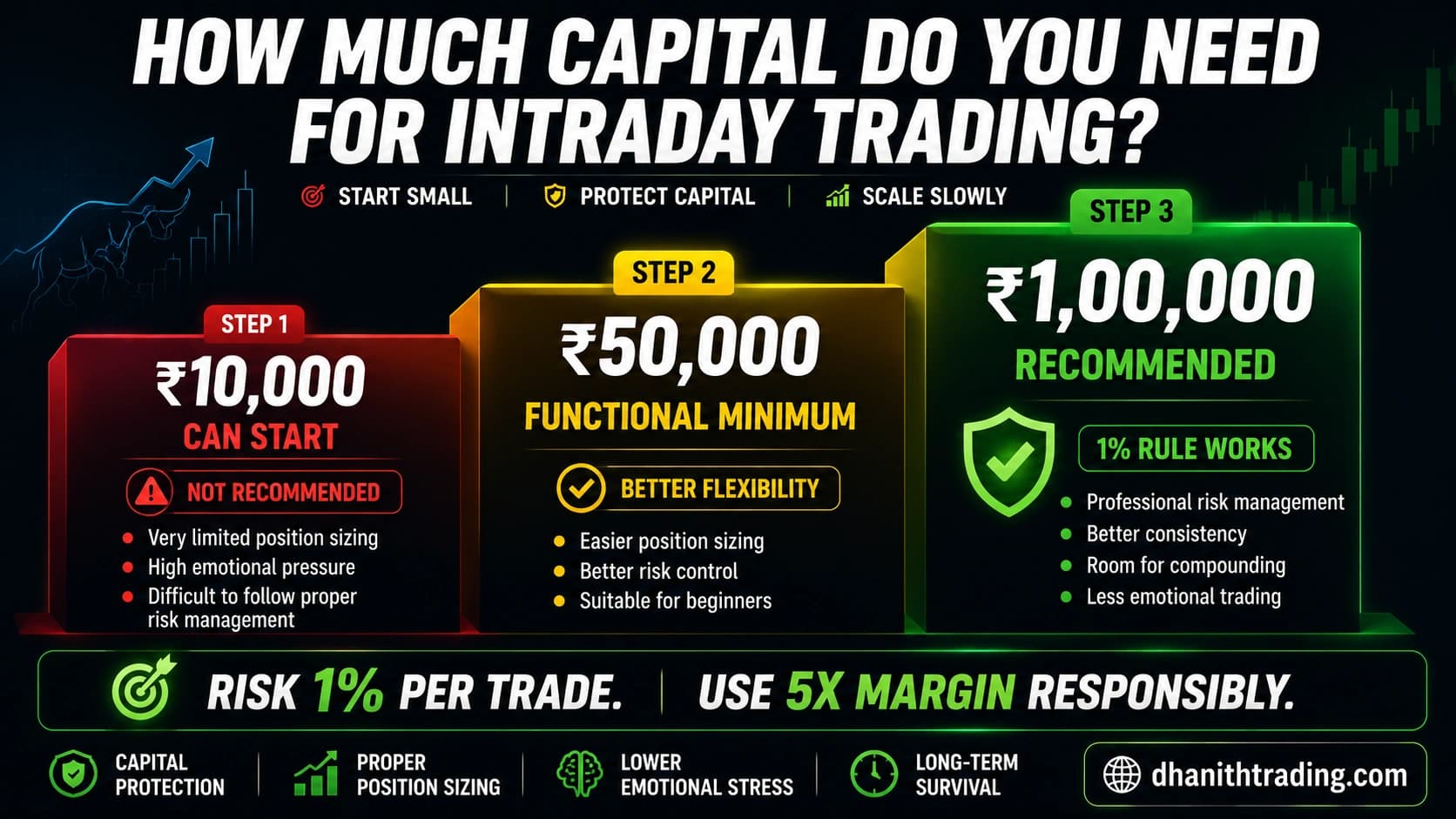
This is the foundation of every other rule. If you risk 1% of ₹1,00,000 per trade (₹1,000), even 10 consecutive losing trades only reduces your account to ₹90,000. You are still very much in the game.
Risk no more than 1% of your account value on any single trade. With a $50,000 account, that's $500 maximum risk per trade. The 1% rule ensures no single trade, or even a string of losses, can destroy your account. Ten consecutive losing trades only reduces your capital by 10%, leaving plenty to recover.
For Indian traders starting with smaller accounts (₹25,000–₹50,000), even a strict 1% rule is the difference between surviving the learning curve and blowing up in the first month.
Calculate your exact risk per trade before every entry using the Dhanith Risk Calculator. Enter your account size, risk percentage, entry, and stop — get your position size in seconds.
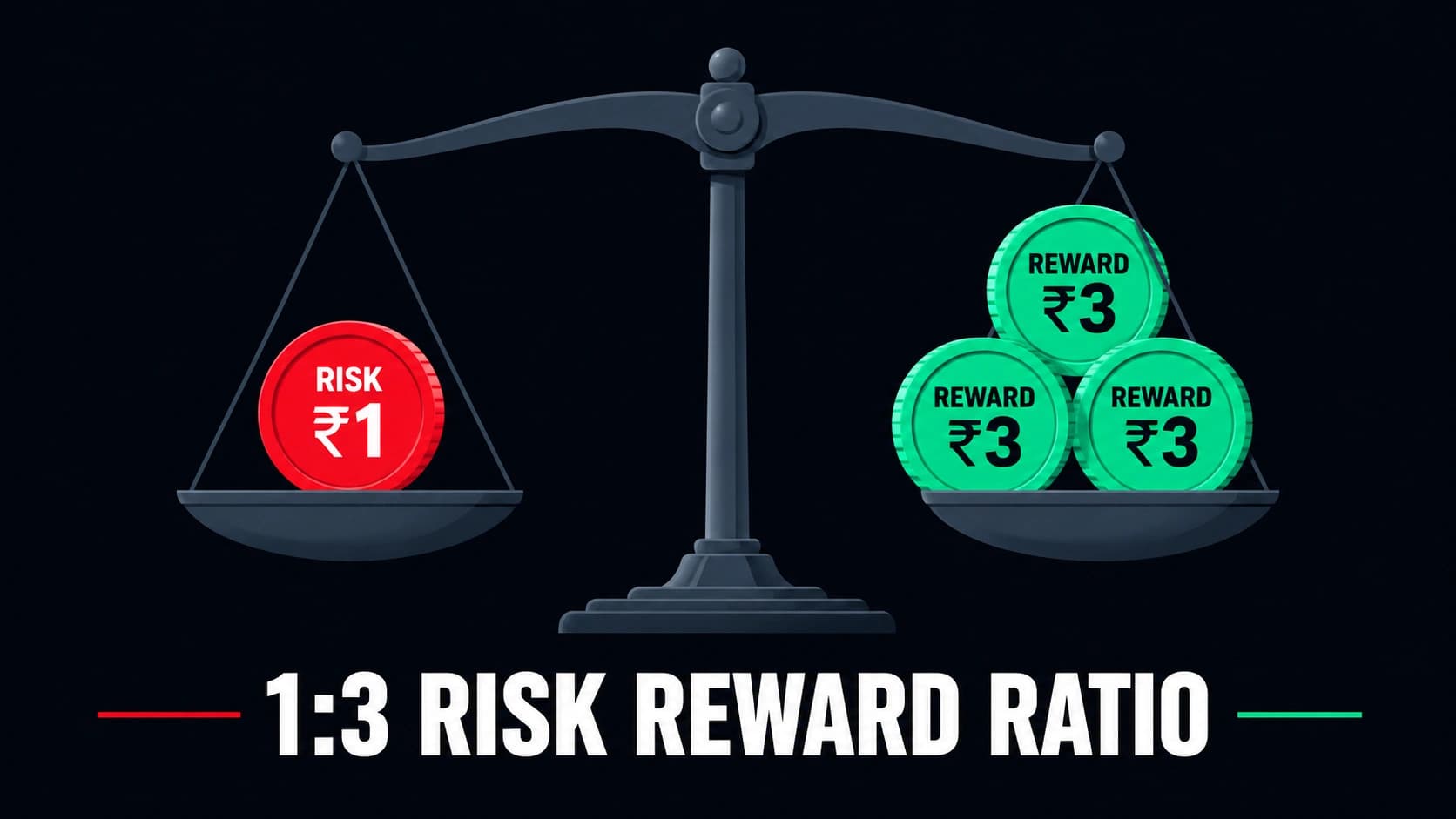
Rule 2: Maintain a Minimum Risk:Reward Ratio of 1:2 (1:3 is Ideal)
Before entering any trade, calculate the distance from your entry to your stop and from your entry to your target. If the target is not at least twice the distance of the stop, do not take the trade.
Practical example with an Order Block setup:
Stock: RPTECH
Order Block zone: ₹590–₹600
Entry:     ₹600
Stop Loss: ₹575 (below OB low)     → Risk  = ₹25
Target:    ₹675 (next supply zone) → Reward = ₹75

R:R = 1:3 → ✅ trade qualifies
A 1:3 R:R means you can lose 6 out of 10 trades and still be profitable. This single rule eliminates most of the impulsive, low-quality trades that destroy accounts.
Rule 3: Calculate Position Size (Lot Size) Before Entering Every Trade
Position sizing is not optional — it is the mechanical output of your risk rule. Never enter a trade without knowing exactly how many shares or lots you are taking.
Formula:
Position Size = Capital at Risk ÷ Risk per Unit

Example:
Account: ₹1,00,000
Risk %:  1% = ₹1,000
Entry:   ₹600
Stop:    ₹575
Risk per share: ₹25

Position Size = ₹1,000 ÷ ₹25 = 40 shares
Use the Dhanith Lot Size Calculator to calculate your exact position size for any NSE stock, Nifty contract, or options trade. Takes 10 seconds and eliminates the most common sizing mistakes.
Rule 4: Always Place a Stop Loss Based on Market Structure — Not Emotions
Your stop loss should go where the trade is definitively proven wrong — not where you feel comfortable with the loss amount, and not at an arbitrary percentage below entry.
SMC-based stop loss placement:
- Order Block trade: Stop below the OB's lowest wick
- Fair Value Gap trade: Stop below the FVG's bottom boundary
- Break of Structure trade: Stop below the most recent swing low (for longs)
- RSI divergence trade: Stop below the divergence low
The wrong way: "I will stop out if it drops 2%" — this places the stop based on your emotions, not the market's structure. Structure-based stops are logical invalidation points. Emotion-based stops are guesses.
Rule 5: Never Move Your Stop Loss Farther Away to Avoid Taking a Loss
This is the rule most retail traders break most often — and the one that turns a manageable loss into an account-destroying one.
When you move your stop farther away mid-trade, you are not "giving the trade more room." You are overriding your own pre-trade analysis because you cannot accept being wrong. The original stop was placed where the thesis was invalid. Moving it away means you are now holding a trade in which your thesis has already been invalidated.
The rule is absolute: Once a stop is placed, it can only move in the direction of the trade (trailing), never against it.
Rule 6: Risk a Fixed Amount Per Trade — Never Increase Risk After Losses
After a losing trade, the instinct is to trade larger on the next one to "recover faster." This is the path to blowing up an account. A sequence like this is how accounts end:
Trade 1: -₹1,000 (1% risk)
Trade 2: -₹2,000 (doubled risk to recover)
Trade 3: -₹4,000 (doubled again)
Trade 4: -₹8,000 (one more time)

4 losses = ₹15,000 gone = 15% of ₹1,00,000 account
Fixed risk per trade means a losing streak is a temporary setback, not a permanent disaster.
SECTION 2: TRADE QUALITY (Rules 7–12)
Rule 7: Wait Only for High-Probability Setups That Match Your Trading Plan
Every trade you take should match a specific, pre-defined pattern. Not "this looks like it might go up." A specific, nameable, tested setup.
High-probability SMC examples:
Setup A — OB + FVG Confluence:
1. Price sweeps liquidity below a swing low
2. Rallies and creates a bullish FVG during the displacement
3. A bullish Order Block sits below the FVG
4. Price retraces into the OB+FVG zone
5. 15-min MSS confirms upward direction
→ This is a trade. A random candle bouncing off "support" is not.
Setup B — BOS + RSI Divergence:
1. Price makes a lower low while RSI makes a higher low (bullish divergence)
2. Confirmed Break of Structure (BOS) to the upside
3. Entry on retracement to the BOS level
→ The divergence + structure break together = high-probability entry
Setup C — Breaker Block Retest:
1. Previous OB swept by liquidity raid
2. MSS confirms new direction
3. Price retests the breaker block zone
4. Entry at CE (50% of zone)
→ Classic SMC precision entry with tight stop
Rule 8: Avoid FOMO — Missing a Trade Is Better Than Taking a Bad Trade
Every time you chase a stock that has already moved 5% before your screener even showed it, you are entering at someone else's exit. The best trades are the ones you wait for, not the ones you chase.
The missed trade costs nothing. The impulsive trade can cost 1–3% of your account.
Dhanith Intraday Screener
Build your watchlist in 30 seconds.
Automatically scan NSE stocks by turnover, gap percentage, sector momentum, and volume — so your pre-market checklist is ready before 9:00 AM.
Rule 9: Never Revenge Trade After a Losing Trade
A revenge trade is a trade taken not because of a valid setup, but because of the emotional need to recover a loss. It is almost always taken without proper analysis, in a worse market condition, and with the subconscious goal of proving yourself right rather than making money.
The rule after every losing trade: Close the charts. Step away for at least 15–30 minutes. Return only when you are emotionally neutral and a valid setup has appeared.
Rule 10: Follow Your Trading Plan Without Exceptions
Your trading plan is the rulebook you wrote when you were calm, analytical, and thinking clearly. The market is the test you take when you are emotionally charged, impatient, and seeing things through confirmation bias.
The version of you who wrote the plan is smarter than the version of you making real-time decisions under pressure. Follow the plan.
Rule 11: Keep a Detailed Trading Journal With Screenshots, Entry, Exit, Emotions, and Lessons
A trading journal is the only way to know whether your strategy actually works, which setups produce the best results, and where your consistent mistakes are occurring.
What every journal entry must include:
- Screenshot of the chart at entry (and at exit)
- Entry price, stop loss, target, position size
- Setup name (OB+FVG, BOS, Breaker, RSI divergence, etc.)
- Emotional state at entry (calm / anxious / impatient / confident)
- Trade outcome and notes on what was done right or wrong
- Lesson for next time
Dhanith Trading Journal
Track every trade. Find your real edge.
Log your setups, grade your entries, and review your trading patterns — all in one place. The journal built for serious SMC traders.
Rule 12: Review Your Journal Weekly to Identify Mistakes and Improve
Logging trades without reviewing them is like collecting data and never reading it. The weekly review is where the real learning happens.
Weekly review checklist:
- Which setup had the best win rate this week?
- How many times did I move my stop (Rule 5 violation)?
- How many trades were revenge trades (Rule 9 violation)?
- Was my average R:R this week above 1:2?
- What is the one thing to fix next week?
SECTION 3: LOSS CONTROL (Rules 13–17)
Rule 13: Protect Your Capital First — Profits Come Second
This is the mindset shift that separates professional traders from gamblers. A professional's first question is "how much can I lose on this trade?" A gambler's first question is "how much can I make?"
Capital preservation is not a defensive posture — it is what keeps you in the game long enough to become profitable. You cannot compound returns on a blown-up account.
Rule 14: Stop Trading After Reaching Your Maximum Daily Loss Limit
Set a daily loss limit before the market opens and respect it unconditionally.
Recommended daily loss limits:
Conservative approach: Stop after 3 consecutive losses
Percentage approach:   Stop after 3% daily drawdown
Combined approach:     Stop after whichever comes first

Example on ₹1,00,000 account (1% risk per trade):
3 consecutive losses = -₹3,000 → Stop for the day
OR
3% drawdown = -₹3,000 → Stop for the day
When you have hit your daily limit, the market is not being kind to your strategy that day. Continuing to trade is not persistence — it is stubbornness. The market will open again tomorrow.
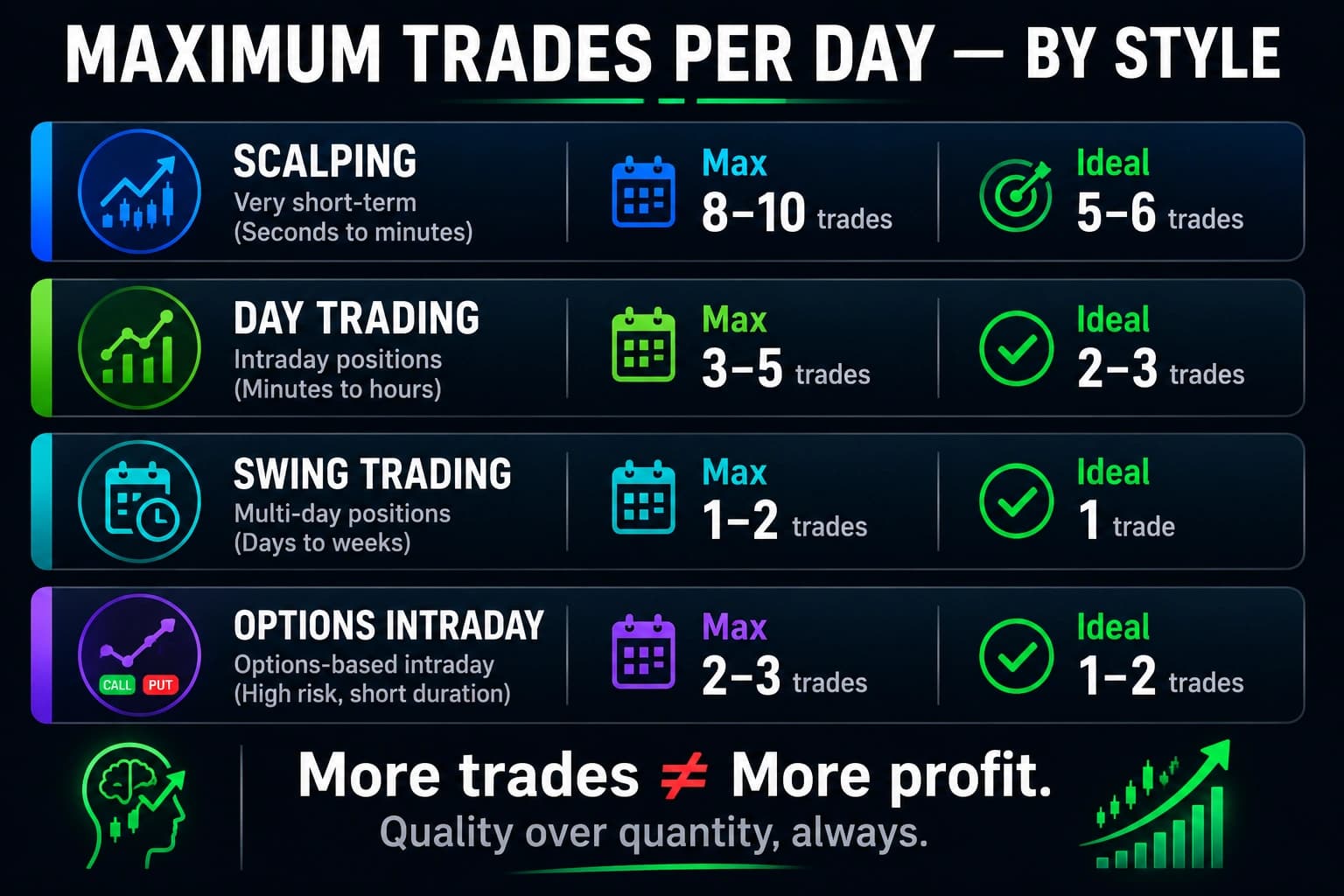
Rule 15: Do Not Overtrade — Quality Trades Outperform Quantity
Maximum recommended trades per day by style:
| Trading Style | Max Trades Per Day | Ideal Target |
|---|---|---|
| Scalping (NSE) | 8–10 | 5–6 high-quality |
| Intraday Day Trading | 3–5 | 2–3 setups only |
| Positional / Swing | 1–2 | 1 best setup |
| Options Intraday | 2–3 | 1–2 confirmed |
Maximum losses allowed per week:
Aggressive approach:  5 losing trades maximum per week
Conservative:         3% weekly drawdown maximum
Professional:         Either triggers a trading pause for reflection
More trades do not mean more profits. They mean more commissions, more cognitive fatigue, and more impulsive decisions. The best traders are often the ones who do the least.
Rule 16: Avoid Increasing Lot Size Just Because You're Confident
Confidence is not an edge. Data is an edge. A backtested setup with 65% win rate over 200 trades is an edge. Feeling confident about a trade is not.
Increasing lot size on a "confident" trade is a psychological trap — it means your next big loss will be disproportionately large, often wiping out several previous wins in a single trade.
Rule 17: Stay Emotionally Neutral After Both Wins and Losses
The dangerous emotional states in trading are not just fear and panic. Overconfidence after a winning streak is equally dangerous — it is what causes traders to suddenly double their position size just before a losing trade.
After a win: Log it, note what worked, return to neutral. Do not trade bigger immediately after.
After a loss: Log it, note what went wrong, step away briefly, return to neutral. Do not trade to recover.
Neutrality is the goal. Both extremes — elation after wins and despair after losses — lead to poor subsequent decisions.
SECTION 4: EXECUTION DISCIPLINE (Rules 18–22)
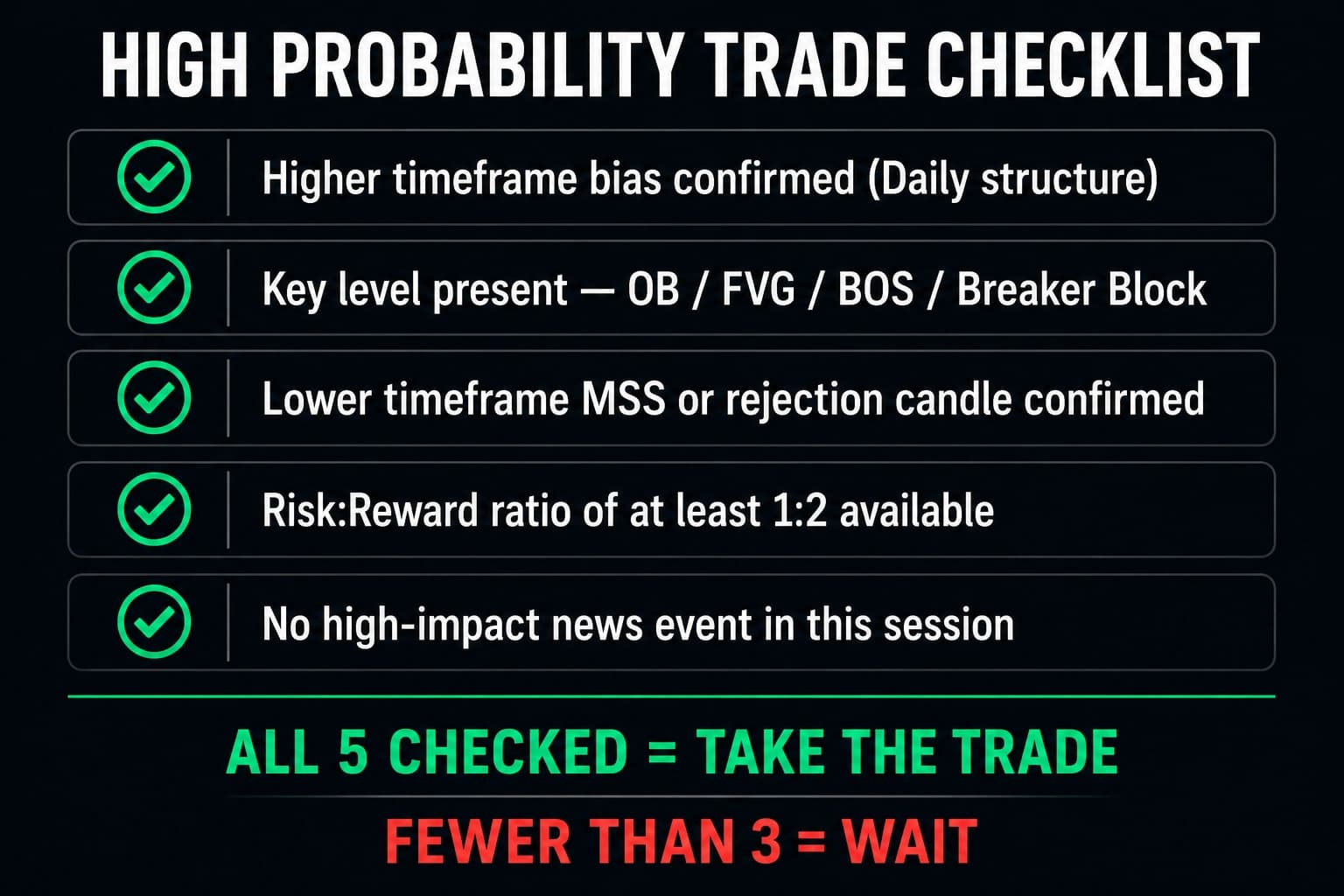
Rule 18: Trade Only When Your Strategy Gives Confirmation
A setup with one confirming signal is interesting. A setup with three confirming signals is a trade.
Confluence checklist before entry:
☐ Higher timeframe bias aligned (daily structure bullish/bearish)
☐ Key level present (OB, FVG, BOS, Breaker, RSI divergence)
☐ Lower timeframe entry confirmation (MSS, rejection candle, engulfing)
☐ R:R of at least 1:2 available
☐ Not in a high-impact news window
✅ All 5 checked = take the trade
❌ Fewer than 3 checked = wait
Rule 19: Be Patient — Let the Market Come to Your Setup
The market moves without you constantly. A price level you marked on a daily chart may not be reached for three sessions. That is normal. The discipline is to wait at the level rather than chasing price away from it.
OB retest example:
You mark a bullish OB at ₹590–₹600 on Monday.
Stock is at ₹640 on Monday. No trade.
Stock drops to ₹620 on Tuesday. No trade — wait.
Stock reaches ₹602 on Wednesday. Watch.
₹598 — inside the OB — confirmation candle forms. ENTER.
The patient trader who waits for price to come to the setup enters with a 4:1 R:R and a tight stop. The impatient trader who buys at ₹640 gets stopped out on the pullback before the real move.
Rule 20: Accept That Losses Are Part of Trading — Focus on Long-Term Consistency
Even the best traders in the world lose trades. A 60% win rate with a 1:3 R:R is elite-level performance — and it still means losing 40% of trades.
The goal is not to find a strategy that never loses. The goal is to find a strategy with positive expectancy over a large enough sample size, and to execute it consistently enough that the math plays out in your favor.
Single trade results are noise. 100-trade results are signal.
Rule 21: Avoid Trading During High-Impact News Unless It Is Part of Your Strategy
RBI policy decisions, Union Budget, US Fed rate decisions, GDP data releases — these events cause irrational, algorithm-driven moves that can stop out even technically perfect setups within seconds.
NSE high-impact events to avoid (unless you have a specific news strategy):
- RBI Monetary Policy Committee (MPC) announcements
- Union Budget Day
- US Fed rate decision sessions (impacts Bank Nifty significantly)
- Expiry day first 30 minutes (unless you have a specific expiry strategy)
- Any day with unexpectedly extreme India VIX readings (above 20)
Rule 22: Never Risk Money You Cannot Afford to Lose
This rule is not about trading strategy. It is about financial psychology. When you are trading with money you need for rent, EMI, or food, you cannot make rational decisions — because every loss feels existential rather than statistical.
Capital you can genuinely afford to lose is capital you can trade with detachment. Detachment produces better decisions. Better decisions produce better results. It is a self-reinforcing cycle in both directions.
SECTION 5: LONG-TERM MINDSET (Rules 23–25)
Rule 23: Aim for Consistent Execution — Not Constant Profits
Profitable months will follow months where you barely break even. Drawdown periods are normal, even for strategies with genuine edges. The question is not "am I making money every single day?" but "am I executing my strategy correctly every single day?"
If you execute correctly and consistently, the profitable results will follow over a large enough sample. Chasing daily profits leads to rule-breaking, which destroys the strategy's mathematical advantage.
Rule 24: Focus on Process Over Outcomes
A bad trade can make money if the market bails you out. A good trade can lose money if the market does something unexpected. Judging trades by outcome rather than process is what causes traders to reinforce bad habits (a lucky win on a revenge trade) and lose confidence in good ones (a valid setup that got stopped out by noise).
Judge every trade on whether you followed your rules — not on whether it made money.
Rule 25: Capital Preservation + Discipline = Long-Term Success
The traders who succeed long-term are not the ones who found the secret setup. They are the ones who protected their capital during bad periods and executed consistently during good ones. Capital preservation is what ensures you are still trading when your edge starts paying off. Discipline is what ensures the edge stays intact.
There is no shortcut. These 25 rules, applied consistently over months and years, are the shortcut.
The Dhanith Trader's Daily Routine
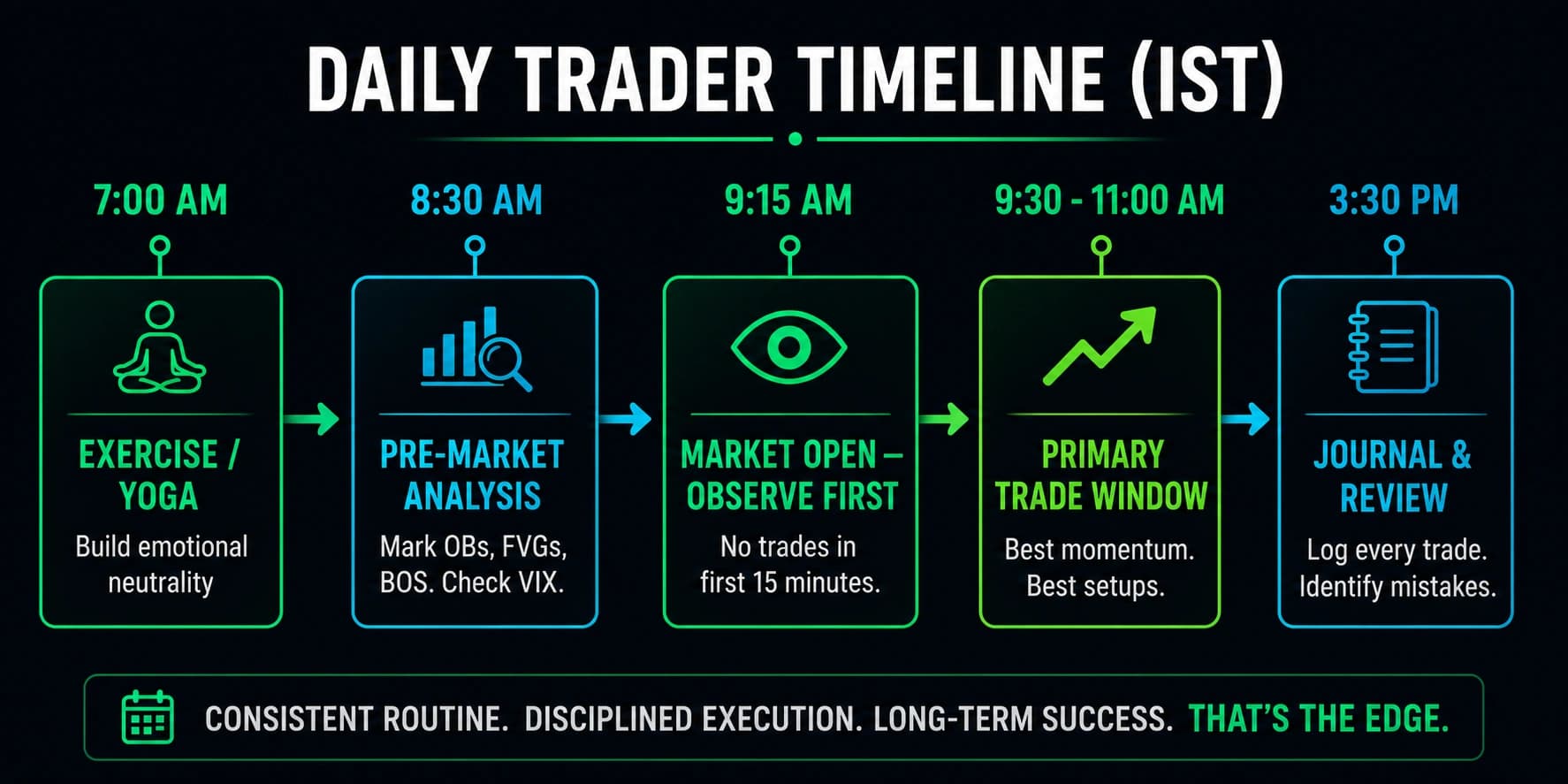
Risk management is not only about what happens during market hours. The mental and physical state you bring to the screen determines the quality of decisions you make there.
Pre-Market (7:00–9:00 AM IST):
Start with 20–30 minutes of physical movement — a walk, yoga, or light exercise. This is not optional wellness advice. Physical activity regulates cortisol (the stress hormone), improves prefrontal cortex function (the part of the brain responsible for impulse control), and reduces the likelihood of revenge trading, FOMO, and impulsive exits. The data on this is not ambiguous — traders who exercise before the market open make better decisions.
A simple 20-minute yoga or stretching routine at 7:00 AM followed by 10 minutes of breathwork or meditation creates the emotional neutrality that Rule 17 describes. You are building the physiological state for disciplined trading before the market even opens.
Pre-Market Analysis (8:30–9:15 AM IST):
☐ Check higher-timeframe structure (Daily chart first)
☐ Mark key OBs, FVGs, BOS levels on your watchlist
☐ Note any high-impact events (RBI, Fed, Budget)
☐ Check India VIX — above 18 = reduce position sizes
☐ Run Dhanith Screener for today's swing candidates
☐ Set your daily loss limit for the session
☐ Write your trading plan for the day (max 3 setups)
Dhanith Stock Screener — run it every morning before 9:15 AM to get your high-probability NSE swing and intraday candidates, pre-filtered for momentum and technical conditions.
Market Hours (9:15 AM–3:30 PM IST):
☐ First 15 minutes: OBSERVE only, no entries
☐ 9:30–11:00 AM: Primary trade window (best momentum)
☐ 12:00–1:30 PM: Reduce activity, manage open trades only
☐ 1:30–2:30 PM: Secondary window if setup is genuinely valid
☐ After 2:30 PM: No new entries
☐ Apply daily loss limit rule without exception
Post-Market (3:30–4:30 PM IST):
☐ Journal every trade taken (entry, exit, screenshot, emotion)
☐ Mark what you did right and what to improve
☐ Review any rule violations honestly
☐ Set up next-day watchlist
Dhanith Trading Journal — log today's trades in 5 minutes, not 30. Screenshot upload, setup tagging, emotion tracking, and P&L calculated automatically.
Quick Reference: All 25 Rules at a Glance
| # | Rule | Category |
|---|---|---|
| 1 | Risk only 1–2% per trade | Capital |
| 2 | Minimum 1:2 R:R (1:3 ideal) | Capital |
| 3 | Calculate position size before entry | Capital |
| 4 | Stop loss based on market structure | Capital |
| 5 | Never move stop farther away | Capital |
| 6 | Fixed risk per trade — no revenge sizing | Capital |
| 7 | Wait for high-probability setups only | Quality |
| 8 | Avoid FOMO | Quality |
| 9 | Never revenge trade | Quality |
| 10 | Follow your plan without exceptions | Quality |
| 11 | Detailed trading journal with screenshots | Quality |
| 12 | Weekly journal review | Quality |
| 13 | Protect capital first | Loss Control |
| 14 | Stop at daily loss limit | Loss Control |
| 15 | Max 3–5 intraday trades per day | Loss Control |
| 16 | No lot size increase on confidence | Loss Control |
| 17 | Emotional neutrality after wins and losses | Loss Control |
| 18 | Trade only with full confirmation | Execution |
| 19 | Let the market come to your setup | Execution |
| 20 | Accept losses as part of the process | Execution |
| 21 | Avoid trading during high-impact news | Execution |
| 22 | Never risk money you cannot afford to lose | Execution |
| 23 | Aim for consistent execution | Mindset |
| 24 | Process over outcomes | Mindset |
| 25 | Capital preservation + discipline = success | Mindset |
Final Thoughts
These 25 rules are not restrictions on your trading. They are the structure that makes your trading sustainable.
Every blown-up trading account in history had at least one of these rules broken repeatedly. Every consistently profitable trader in history follows most of them, most of the time. That is not a coincidence.
Start with rules 1, 2, 3, 4, and 11 — the position sizing, R:R, stop placement, and journaling rules. Get those five right consistently, and the other 20 become significantly easier to maintain.
The edge is not in the setup. The edge is in the execution. And execution is what these rules protect.
The complete Dhanith toolkit for risk management:
- Trading Journal — log every trade, review every mistake
- Risk Reward Calculator — calculate R:R before every entry
- Lot Size Calculator — size every position correctly
- Stock Screener — find high-probability setups before the move
Disclaimer: This blog post is for educational purposes only and does not constitute financial or investment advice. Trading in NSE stocks, derivatives, or any financial instrument involves substantial risk of capital loss. The rules described here are general guidelines, not guarantees of profitability. Always use proper risk management and consult a licensed financial advisor before trading with real capital. SEBI: Trading in F&O markets carries high risk of capital loss.
FAQ
Q: How much should I risk per trade as a beginner? Start with 0.5–1% of your total trading capital per trade. At ₹50,000, that means risking ₹250–₹500 maximum per trade. This feels small, but it ensures a losing streak does not end your trading. As you build consistency with your strategy over 50–100 trades, you can gradually move to 1–2%.
Q: What is the maximum number of trades I should take per day? For intraday day trading: maximum 3–5 trades, ideally 2–3 confirmed setups. For scalping: 5–8 high-quality trades. For swing trading: 1–2 per day, sometimes zero if no valid setup appears. More trades per day does not mean more profit — it typically means more commissions and more impulsive decisions.
Q: What should my daily loss limit be? A commonly used rule: stop trading after 3 consecutive losses OR after a 3% daily drawdown on your account — whichever comes first. On a ₹1,00,000 account risking 1% per trade, 3 losses = ₹3,000 = 3% drawdown. After this point, the session is over regardless of how many "great setups" you think you see.
Q: How is an order block stop loss different from a percentage stop? A percentage stop (e.g., "stop at 2% below entry") is placed based on your comfort level, not on where the trade is actually wrong. A market structure stop (below an OB zone, below a BOS level) is placed where your trade thesis is definitively invalidated. Structure-based stops are almost always more logical and produce better risk management over time.
Q: Should I exercise before trading? Yes — the evidence strongly supports it. Physical activity before market hours reduces cortisol, improves prefrontal cortex function (impulse control), and creates the emotional neutrality that disciplined trading requires. Even 20–30 minutes of walking, yoga, or light exercise at 7:00–7:30 AM IST measurably improves decision quality during the trading session.
Q: How many rules should I focus on as a beginner? Start with five: Rule 1 (1% risk per trade), Rule 2 (minimum 1:2 R:R), Rule 3 (calculate position size), Rule 4 (structure-based stop loss), and Rule 11 (trading journal). Get these five right consistently across 50 trades before expanding your focus to the remaining 20 rules.
Further reading: Intraday Trading Rules You Must Follow | How Much Capital Is Required for Intraday Trading? | How to Become a Successful Intraday Trader | Best Risk Reward Ratio for Day Trading | Order Blocks: The Complete Mastery Guide | Fair Value Gaps (FVG): The Complete Mastery Guide | SMC Market Structure | Expiry Day Options Trading Strategy | Best Online Trading Journal | What is Account Flipping in Trading | 5 Best Intraday Trading Strategies for NSE India
Have a question about this article?
Comment on our latest Instagram post or send us a DM — we reply to every one.
@dhanith_officialWas this article helpful?
Click to rate
Founder, Dhanith Trading
7+ years trading Nifty, Bank Nifty, NSE stocks, and commodities — specializing in Smart Money Concepts (SMC) and ICT price action. Founder of Dhanith — a trading journal, intraday screener, and risk tools platform built for retail traders.
Dhanith Newsletter
Enjoyed this article? Get more like it.
New trading guides, candlestick patterns, SMC strategies, and tool updates — straight to your inbox. Free, for Indian traders.
No spam. Unsubscribe anytime.
Continue Reading