On this page
- Why Most Traders Are Undisciplined (And It Is Not Their Fault)
- Habit 1: Trade One Strategy Only — For at Least 50–100 Trades
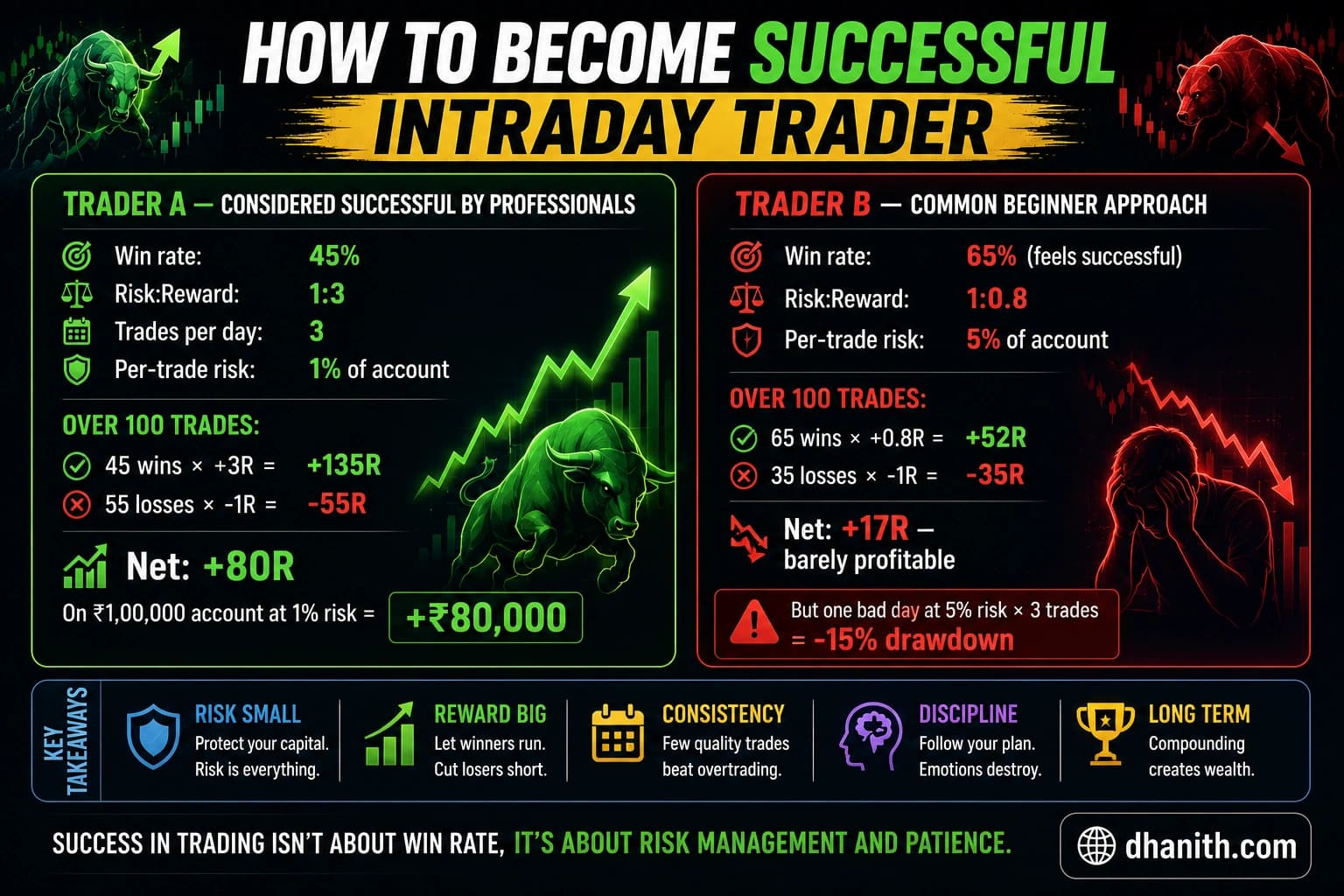
- Habit 2: Create a Written Trading Plan — Before the Market Opens
- Habit 3: Risk Small — 1% Maximum Per Trade
- Habit 4: Limit Daily Trades — Fewer Is Almost Always Better
- Habit 5: Journal Every Trade — With Screenshots and Emotions
- Habit 6: Accept That Losses Are Normal — And Expected
- Habit 7: Wait for Full Confirmation — Do Not Predict, React
- Habit 8: Remove Emotional Triggers From Your Environment
- Habit 9: Build a Pre-Market Routine and Execute It Every Day
- Habit 10: Review Weekly — Judge Process, Not Profit
- The 5-Second Rule: Before Every Single Trade
- The Daily Discipline Checklist
- The Mindset Shift That Changes Everything
- Final Thoughts
- FAQ
Learn how to become a disciplined trader — 10 habits, SMC examples, the 5-second rule, daily checklist, and the mindset shift that separates consistent traders.
Let me ask you something before we talk about charts, setups, or strategies.
What is your dream? Not your trading dream — your actual life dream.
Maybe it is financial independence. Maybe it is working from home and spending more time with your family. Maybe it is quitting a job you hate, buying a house, funding your child's education, or simply never having to check your bank balance with anxiety again.
Now think about the salary from your current job or career path. How long will it take you to get there at that pace?
Here is what most people do not realize about trading: a disciplined, consistently profitable trader — with an account of ₹5,00,000 to ₹10,00,000 — can realistically generate ₹30,000 to ₹70,000 per month in net returns through structured intraday and swing trading. With a ₹20,00,000 account and a proven system, that number can exceed ₹1,50,000 per month — more than the take-home salary of most senior professionals in India.
This is not a guarantee. It is a mathematical possibility that becomes a reality for traders who build one thing above everything else: discipline.
Not the best strategy. Not the most advanced indicator. Not access to institutional data. Discipline — the ability to follow a proven plan consistently, day after day, trade after trade, regardless of what happened on the last trade.
SEBI's own study found that roughly 7 out of 10 individual intraday traders lose money in the equity cash segment. Most traders fail not because they lack discipline — but because they don't trust their strategy enough to remain disciplined. When your system is backtested, consistent, and clear, you stop relying on emotion and start relying on expectancy.
This guide gives you the complete framework: 10 habits that build genuine trading discipline, the 5-Second Rule to use before every single trade, a daily checklist, and the mindset shift that changes everything.
Disclaimer: Trading involves substantial risk of capital loss. The income examples above represent mathematical possibilities based on percentage returns — not guaranteed outcomes. Always use proper risk management and consult a licensed financial advisor before trading with real capital.
Why Most Traders Are Undisciplined (And It Is Not Their Fault)
There are a lot of things no one tells you about trading for a living. Trading is mostly psychological. Being good at trading requires a lot of internal work — developing good habits and eliminating bad ones, controlling impulses, and creating beliefs that align with your trading goals.
The reason most traders are undisciplined is not laziness or lack of intelligence. It is that nobody teaches the psychological infrastructure of trading — only the technical setups. You learn about order blocks, fair value gaps, and break of structure in week one. Nobody tells you what to do when you are down ₹8,000 at 10:30 AM and you see what looks like a perfect setup on the chart and your hand is moving toward the buy button before your brain has even processed the thought.
That automatic, emotional response — that is the enemy. And discipline is the only thing that defeats it.
Trading discipline is the ability to follow a trading plan when the market, your emotions, and your recent results are trying to pull you away from it. It is not the same as being fearless. A disciplined trader can still feel pressure, frustration, or excitement — but the next decision is filtered through rules instead of impulse.
Here is what that looks like in practice across the 10 habits below.
Habit 1: Trade One Strategy Only — For at Least 50–100 Trades
Establish clear, objective entry criteria in your trading plan and commit to only executing trades that perfectly match these conditions — treating trading opportunities as rare rather than abundant.
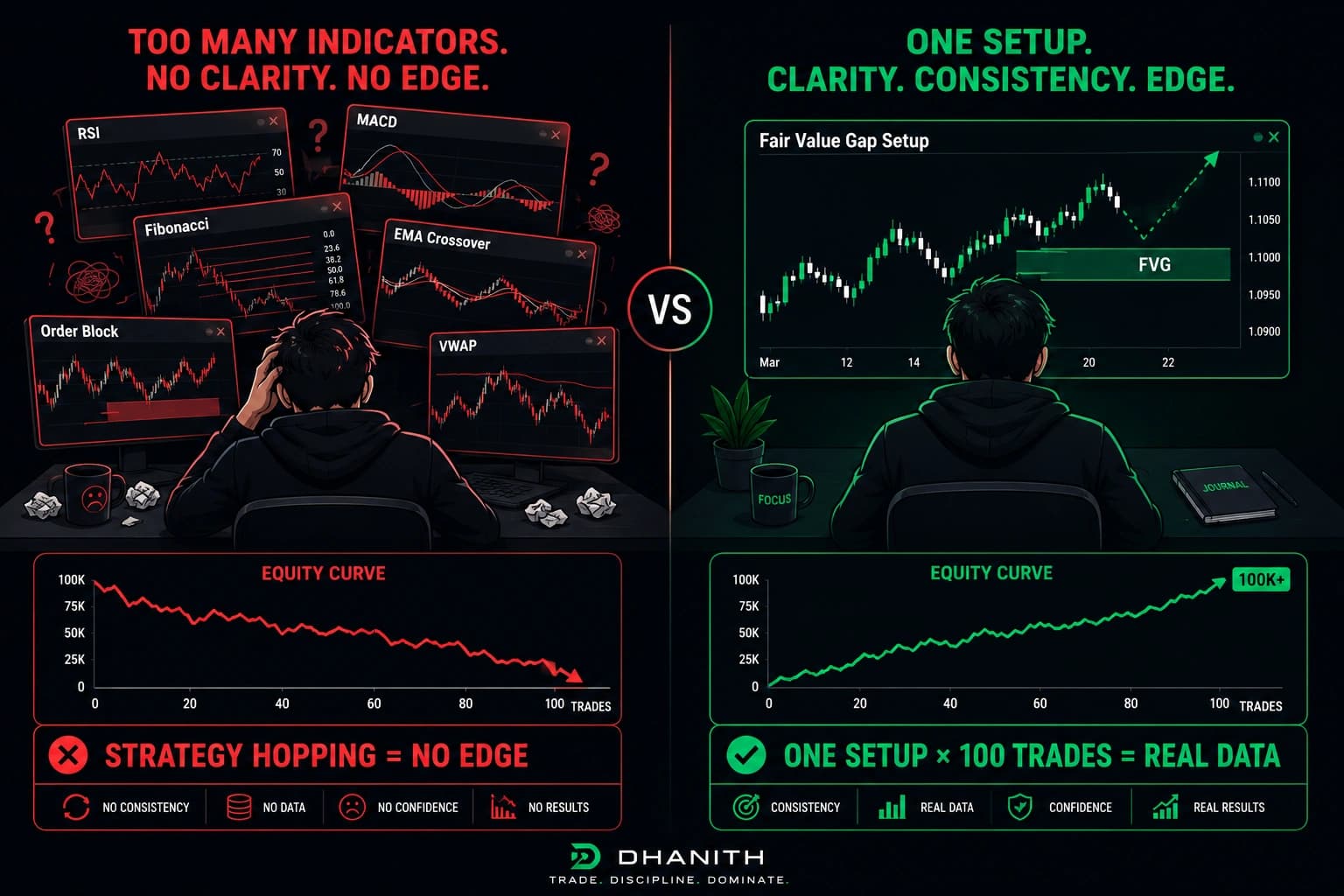
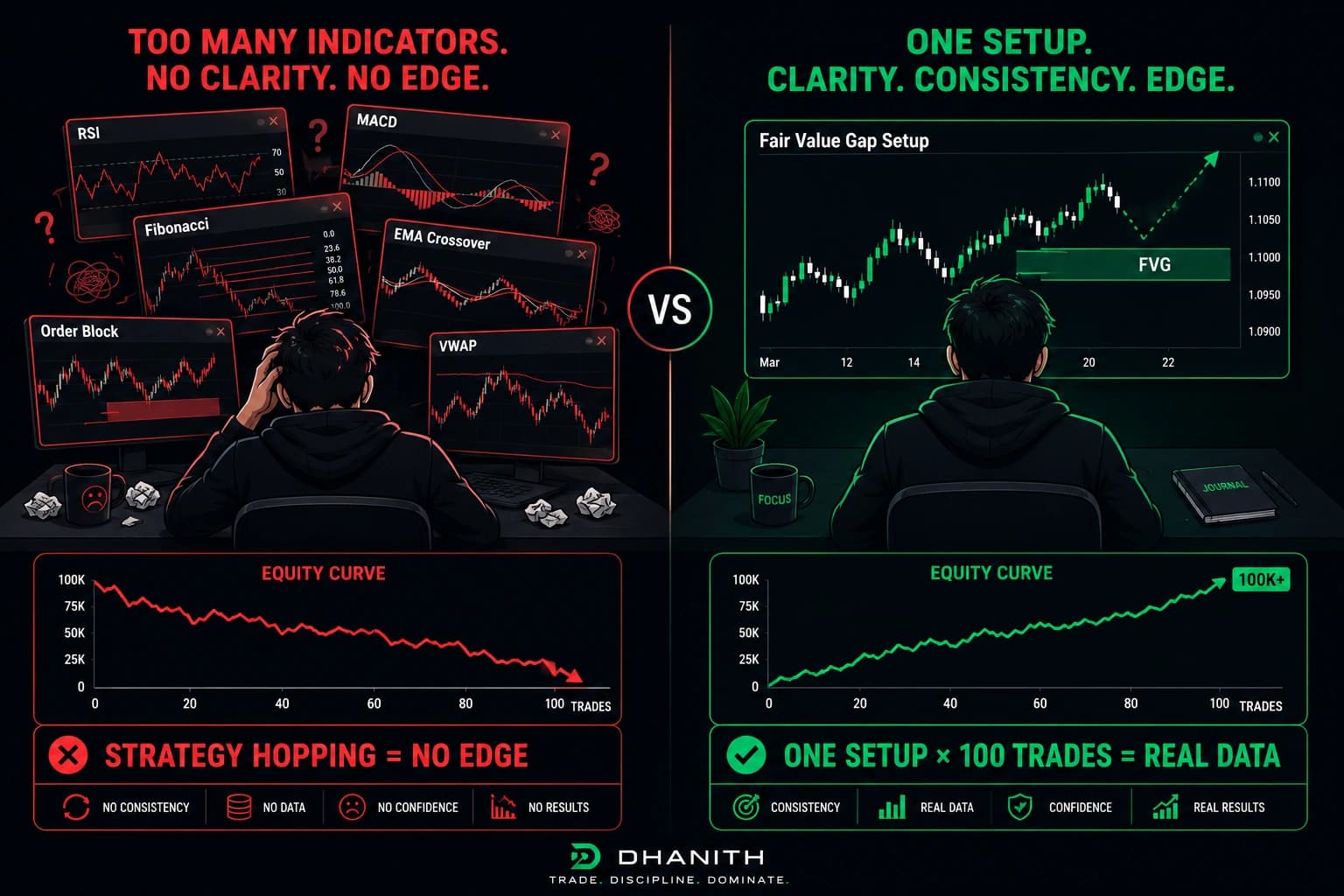
The most common discipline killer is strategy-hopping. A trader learns order blocks, takes 5 trades, has 3 losses, and decides "order blocks don't work." They switch to RSI divergence. Three more losses. Then Fibonacci. Then VWAP rejection. They are essentially starting from zero every two weeks, never building the statistical sample size to know whether any strategy actually has an edge.
The rule: Choose one setup and trade only that setup for a minimum of 50–100 trades before making any judgement about its performance.
Why 50–100 trades? Because anything fewer is statistical noise. A coin flip can land heads 7 times in a row. Your strategy can lose 7 times in a row without being broken. Only at 50–100 trades does the win rate begin to reflect reality rather than variance.
Example — SMC Fair Value Gap Setup (the only setup for 50 trades):
Setup definition:
☐ Daily structure is bullish (higher highs and higher lows)
☐ Price creates a bullish FVG on the 1-hour chart during a
   displacement move that also causes a Break of Structure
☐ Price retraces into the FVG zone
☐ Entry at the CE (50% of the FVG)
☐ Stop below the FVG's bottom boundary
☐ Target: next swing high / buy-side liquidity

That is the ONLY trade you take for 50 trades.
No order blocks unless they coincide with your FVG.
No RSI divergence. No moving average crossovers.
One setup. Full commitment. Real data.
After 50–100 trades of this single setup, you will know its real win rate, average R:R, best and worst timeframes, and which market conditions it fails in. That knowledge is worth more than 10 different setups you tried for a week each.
Habit 2: Create a Written Trading Plan — Before the Market Opens
The easiest way to make discipline practical is to write rules that remove decisions from stressful moments. A disciplined plan should answer: what to trade, when to trade, what confirms entry, where the stop goes, where the target is. Rules should be clear enough that another trader could read them and understand whether a trade was valid.
Your trading plan is the document you write when you are calm, analytical, and thinking clearly. The market is where you execute it when you are under pressure, emotionally charged, and seeing things through confirmation bias. The version of you that wrote the plan is smarter than the version of you making real-time decisions.
Complete written trading plan template:
DATE: ____________

MARKET: Nifty 50 / Bank Nifty / NSE Stock: _______
SESSION: 9:30 AM – 11:30 AM IST (primary window)

DAILY BIAS (from daily chart):
☐ Bullish   ☐ Bearish   ☐ Neutral — no trade today

KEY LEVELS MARKED:
Higher timeframe OB: ___________
FVG zone: ___________
BOS level: ___________
Liquidity pool above: ___________
Liquidity pool below: ___________

ENTRY CONDITIONS (all must be present):
☐ Price reaches key structural level
☐ Liquidity sweep occurs at that level
☐ MSS confirms on 5-min / 15-min chart
☐ FVG or OB entry zone is clean and unmitigated

STOP LOSS: Below OB low / Below FVG bottom (structure-based)
TARGET: Next liquidity pool / Next swing high or low
MINIMUM R:R: 1:2 (will not take any trade below this)

MAXIMUM TRADES TODAY: 3
DAILY LOSS LIMIT: ₹3,000 (3 × ₹1,000 risk per trade)
STOP TRADING IF: Daily loss limit hit OR 3 consecutive losses

IF A TRADE DOES NOT MATCH THIS PLAN: I WILL NOT TAKE IT.
Signed: ___________  Time: ___________
Signing the plan is not a formality. It is a psychological commitment device — it makes violating the plan feel like breaking a promise to yourself, which is meaningfully harder to do than ignoring a mental note.
Habit 3: Risk Small — 1% Maximum Per Trade
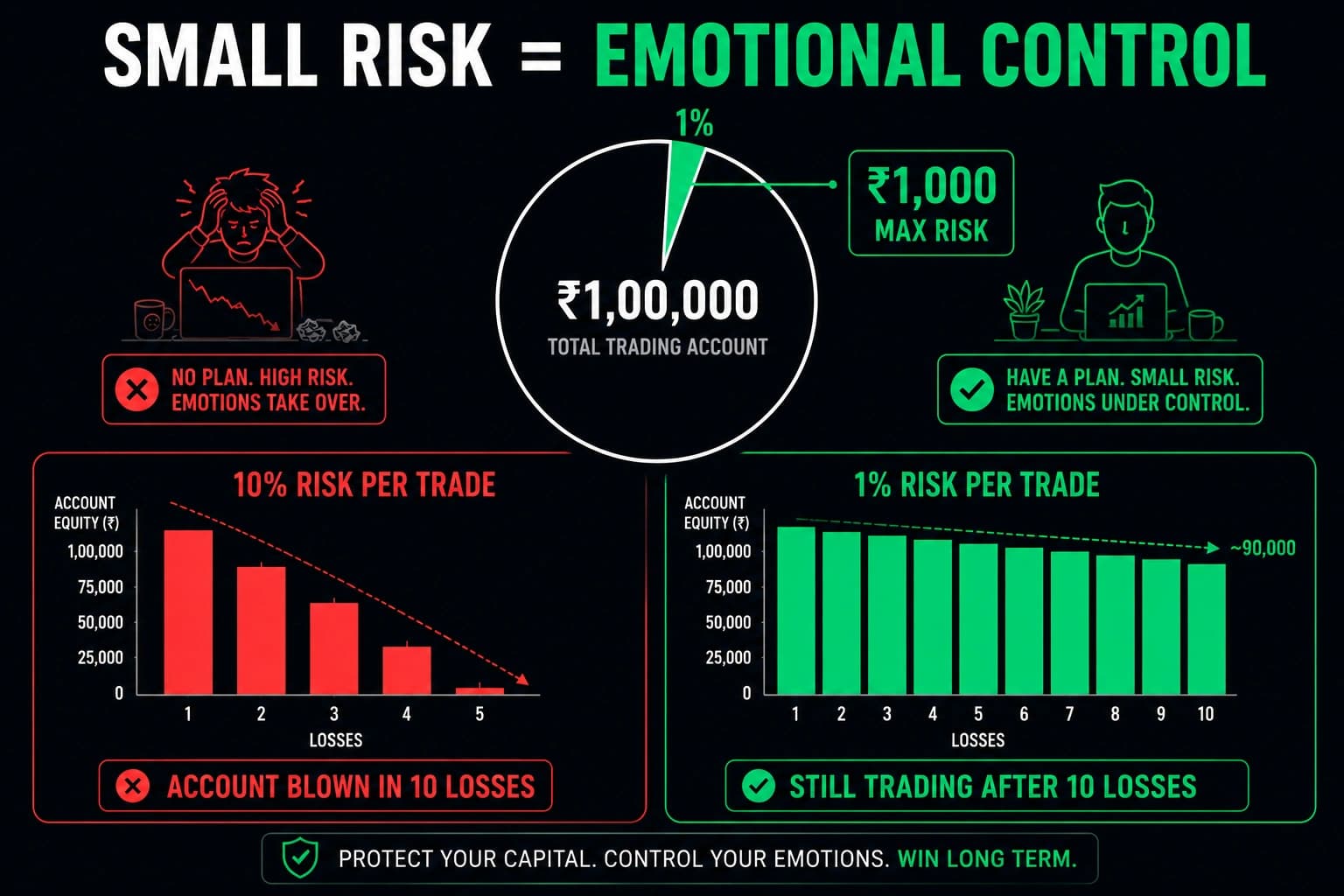
When you risk too much per trade, emotions take over. A ₹500 loss on a ₹50,000 account is a minor data point. A ₹5,000 loss on a ₹50,000 account is 10% of your capital — and it triggers fear, anger, and the urge to revenge trade. The position size determines the emotional intensity of the trade, not just the financial outcome.
This is the same principle behind Rule 1 of trading risk management — risk small enough that no single trade, or losing streak, can knock you out of the game.
The 1% rule in practice:
Account size:      ₹1,00,000
Risk per trade:    1% = ₹1,000
Entry:             ₹24,200 (Bank Nifty)
Stop Loss:         ₹24,100
Risk per unit:     ₹100

Position Size:     ₹1,000 ÷ ₹100 = 10 units
(or 10 units of Bank Nifty futures — check lot size accordingly)
At ₹1,000 risk, even 5 consecutive losses only costs ₹5,000 — 5% of the account. That is survivable. That is recoverable. That is the kind of loss you can log in your journal, review objectively, and come back from tomorrow without emotional damage.
Calculate your exact position size for every trade using the Dhanith Lot Size Calculator — enter your account size, risk %, entry, and stop loss to get your precise quantity in seconds.
Habit 4: Limit Daily Trades — Fewer Is Almost Always Better
Many traders discover their profitability increases dramatically when they trade less frequently but with greater selectivity. Implement mandatory cooling-off periods between trades or specific daily trade limits that prevent the psychological trap of feeling you need to be constantly active in markets.
Recommended daily trade limits:
Intraday day trading:    Maximum 3 trades per day
                         Stop after 2 consecutive losses
                         Stop after daily profit target is hit

Swing trading:           Maximum 1–2 new entries per day
                         Let existing positions breathe

Options trading:         Maximum 2 trades per day
                         Never add a new position after a loss
                         without reviewing the original thesis
Why stop after 2 consecutive losses?
Two consecutive losses usually signal one of three things: the market conditions are not matching your strategy that day, your execution is off, or your emotional state is compromised. None of these three situations improves by adding a third trade. They all improve by stepping away, reviewing, and returning with fresh perspective.
Real scenario:
Trade 1: Bullish FVG setup — Stopped out at ₹24,100
         Loss: −₹1,000

Trade 2: BOS retest — Stopped out at ₹24,050
         Loss: −₹1,000

→ STOP. The market is not behaving as expected today.
  Close charts. Revisit tomorrow.
  Total loss: ₹2,000 = 2% of ₹1,00,000 — manageable.

If you continue:
Trade 3: Revenge trade, oversized → −₹3,000
Trade 4: Doubled down to recover → −₹5,000
Total loss: ₹11,000 = 11% in one session — catastrophic.
The discipline to stop is the difference between a bad day and a blown account.
Habit 5: Journal Every Trade — With Screenshots and Emotions
Analyze both wins and losses in your trading journal to make continuous incremental improvements in real time. This builds lasting discipline. Judge your trading based on how well you follow your process, not necessarily short-term P&L. Outcomes will follow.
The trading journal is not a record-keeping chore. It is the feedback loop that converts experience into skill. Without it, you repeat the same mistake 50 times over two years. With it, you identify the mistake after 5 times and fix it permanently.
What every journal entry must include:
TRADE #: ___    DATE: ___    TIME: ___

SETUP: Fair Value Gap / Order Block / BOS / Breaker / RSI Divergence
INSTRUMENT: INOXINDIA   TIMEFRAME: 15-min

SCREENSHOT: [attached at entry]   [attached at exit]

Entry price:   ₹1,774
Stop loss:     ₹1,740 (below OB low)
Target:        ₹1,850 (prior swing high)
Risk:          ₹34 × 30 shares = ₹1,020
Reward:        ₹76 × 30 shares = ₹2,280
R:R:           1:2.2

EMOTIONAL STATE AT ENTRY:
☐ Calm and confident
☐ Anxious / rushed
☐ FOMO (felt like I was missing it)
☐ Revenge (trading after a loss)

DID I FOLLOW MY PLAN?  ☐ Yes   ☐ No

OUTCOME:   Win / Loss / Partial
P&L: +₹2,280

LESSON: Price swept the previous swing low before reversing
        — confirms the liquidity raid pattern from the daily.
        Wait for the sweep before entering next time.
Dhanith Trading Journal
Track every trade. Find your real edge.
Log your setups, grade your entries, and review your trading patterns — all in one place. The journal built for serious SMC traders.
Habit 6: Accept That Losses Are Normal — And Expected
Discipline, like any muscle, needs to be built. A disciplined trader is not someone who eliminates emotion — but someone who stops being controlled by it.
Even the best traders in the world lose trades. Even the best strategies in the world produce losing periods. A 60% win rate at 1:3 R:R is genuinely elite performance — and it still means losing 40 out of every 100 trades.
The mental reframe:
Instead of thinking: "I lost. My strategy is broken. I need to change something."
Think: "I executed my setup correctly. This trade was one data point in a 100-trade sequence. My edge plays out over many trades, not on any single one. What matters is whether I followed my rules — not whether this trade made money."
Practical example:
Scenario: You take a perfect Breaker Block setup.
Nifty sweeps the prior low (liquidity raid ✅).
CHoCH confirmed on 15-min (MSS ✅).
You enter at the CE of the Breaker zone.
Stop below the zone.
R:R: 1:3.

Trade gets stopped out. Nifty continues lower.

Wrong response: "Breaker blocks don't work. I need a new strategy."
Right response:  "The setup was valid. Execution was correct.
                  The stop was placed at the logical invalidation point.
                  This is one trade in a 100-trade sequence.
                  My win rate handles this loss mathematically."
One of the most important sentences a disciplined trader learns to say is: "That was a good loss."
Habit 7: Wait for Full Confirmation — Do Not Predict, React
Consider adopting a structured routine of predetermined market analysis times followed by execution windows, which prevents the endless chart-watching that often leads to seeing patterns that aren't truly there.
Undisciplined traders predict. Disciplined traders react. The difference is everything.
Complete SMC confirmation sequence before entry:
Step 1: LIQUIDITY SWEEP
        Price pushes beyond a prior swing high/low,
        sweeping stop-losses at that level.
        → Without this, no trade.

Step 2: MARKET STRUCTURE SHIFT (MSS)
        Price breaks a significant opposing swing on
        the entry timeframe (5-min or 15-min).
        → Without this, no trade.

Step 3: STRONG DISPLACEMENT
        The MSS candle is a large, aggressive engulfing
        or displacement candle — not a small doji.
        Creates a Fair Value Gap in its leg.
        → Without this, no trade.

Step 4: ENTRY SIGNAL
        Price retraces into the FVG or OB zone.
        CE (50% of FVG) reached.
        A confirming candle (hammer, engulfing, pin bar)
        forms at the entry zone on the entry timeframe.
        → NOW you enter.
This sequence draws directly on liquidity sweeps, market structure shifts, order blocks, and fair value gaps — the full SMC toolkit covered elsewhere on this blog.
Real example — Bank Nifty 15-min (bullish setup):
9:42 AM: Bank Nifty sweeps the 51,800 prior low → Step 1 ✅
9:48 AM: MSS confirmed — breaks above 51,940 swing → Step 2 ✅
9:48 AM: Large 3-candle displacement creates FVG
         between 51,860 and 51,920 → Step 3 ✅
10:05 AM: Price retraces to 51,890 (inside FVG).
          Bullish hammer forms at 51,885 → Step 4 ✅

ENTRY: ₹51,890
STOP:  ₹51,795 (below liquidity sweep low)
TARGET: ₹52,180 (next swing high)
R:R: 1:3.1 → TAKE THE TRADE
If any one of the four steps is missing, the trade does not exist yet. You wait.
Habit 8: Remove Emotional Triggers From Your Environment
Your trading environment determines your trading behavior more than most traders realize. Emotional triggers are not just internal — they come from the environment around you.
Triggers to actively remove:
Stop watching your P&L in real time. Close the P&L display while a trade is open. Watching ₹2,300 become ₹1,800 become ₹2,600 in real time triggers unnecessary emotional responses. Set your stop and target, then watch price, not money.
Stop following social media trading calls. The moment you see someone post "BANKNIFTY LONG NOW" and feel the urge to enter without checking your own plan, that is FOMO at work. Those calls have no stop loss, no defined R:R, and no accountability. Your plan has all three.
Do not increase position size after a loss. This is the single most common way traders destroy accounts. The market does not know or care how much you lost yesterday. Adding extra size today does not change yesterday's P&L — it only adds extra risk to today's trade.
Do not check your account balance mid-trade. Seeing a floating loss of ₹3,500 when your stop allows for ₹1,500 more movement is irrelevant — unless the price has hit your stop, the trade is still within your defined risk. Account balance checks during market hours serve no function except to generate anxiety.
Habit 9: Build a Pre-Market Routine and Execute It Every Day
Establishing a routine is one of the best ways to build discipline in your trading habits — routines provide structure so that you are able to approach trading with the same seriousness and consistency as any other professional endeavor.
The disciplined trader's day does not start at 9:15 AM. It starts at 7:00 AM — with a routine that builds the physiological and psychological state required for disciplined execution.
Complete Dhanith Pre-Market Routine:
7:00 AM  PHYSICAL MOVEMENT (20–30 minutes)
         Walk, yoga, stretching, or gym.
         This is not optional.
         Exercise lowers cortisol, improves impulse control,
         and creates the emotional neutrality that disciplined
         trading requires. The trader who exercised at 7 AM
         makes measurably better decisions at 10 AM than the
         trader who rolled out of bed at 9:00.

7:30 AM  MINDSET RESET (10 minutes)
         Breathwork or meditation.
         5 minutes of slow, deep breathing activates
         the parasympathetic nervous system — the calm,
         rational state you need for structured decision-making.
         Not the sympathetic "fight or flight" state you will
         be in if you check Twitter first thing in the morning.

8:00 AM  MARKET PREPARATION (45 minutes)
         ☐ Daily chart: mark structure (HH, HL, LH, LL)
         ☐ Mark key OBs, FVGs, BOS levels on watchlist
         ☐ Identify liquidity pools above and below
         ☐ Check India VIX — above 18 = reduce position sizes
         ☐ Check for any high-impact news (RBI, Fed, Budget)
         ☐ Run Dhanith Screener for swing candidates
         ☐ Write today's trading plan (see Habit 2 template)
         ☐ Set daily loss limit for the session

9:00 AM  FINAL PREPARATION (15 minutes)
         ☐ Review watchlist one more time
         ☐ Set price alerts at key levels
         ☐ Confirm bias — has anything changed overnight?
         ☐ Place no trades in the first 15 minutes after open

9:15 AM  MARKET OPENS — OBSERVE FIRST
Dhanith Intraday Screener
Build your watchlist in 30 seconds.
Automatically scan NSE stocks by turnover, gap percentage, sector momentum, and volume — so your pre-market checklist is ready before 9:00 AM.
Habit 10: Review Weekly — Judge Process, Not Profit
Without a journal, the same problem repeats quietly. The trader may blame the market, but the real issue could be time of day, oversized positions, poor exits, or trading after emotional events.
The weekly review is where a good week becomes a great month and a bad week becomes a permanent lesson. It takes 20–30 minutes every Sunday and it is one of the highest-ROI activities in all of trading.
The weekly review framework:
WEEK OF: _______________

TOTAL TRADES:    ___
WINNING TRADES:  ___  (___%)
LOSING TRADES:   ___
AVERAGE R:R:     ___

RULE VIOLATIONS THIS WEEK:
☐ Moved stop farther away (how many times?): ___
☐ Took a revenge trade: ___
☐ Exceeded daily trade limit: ___
☐ Took a trade that did not match my plan: ___
☐ Increased size after a loss: ___

BEST SETUP THIS WEEK: _______________
WORST MISTAKE THIS WEEK: _______________

ONE THING TO IMPROVE NEXT WEEK: _______________
The key question to ask each week is not "Did I make money?"
The key question is: "Did I follow my rules?"
A losing trade taken with perfect execution is a success. A winning trade taken impulsively without a valid setup is a failure — one that reinforces dangerous behavior, because the market bailed you out and you learned the wrong lesson.
The 5-Second Rule: Before Every Single Trade
Before clicking buy or sell on any trade — without exception — pause for 5 seconds and run through these five questions in your head:
1. Does this trade match my setup exactly?
   (Not "kind of" — exactly)

2. Is my risk predefined and within 1% of my account?

3. Is my stop loss placed at a structurally valid level?

4. Is the Risk:Reward ratio at least 1:2?

5. Would I take this trade if my trading mentor or a
   senior trader at Dhanith were watching my screen?
If the answer to any single question is No — do not trade.
Close the order ticket. Step away from the screen for 5 minutes. Return with fresh eyes. If the setup is still valid after 5 minutes, it will still be there. A trade that disappears because you waited 5 seconds was not worth taking.
A disciplined trader is not someone who eliminates emotion — but someone who stops being controlled by it. The system gives discipline something to stand on.
The Daily Discipline Checklist
Print this. Put it next to your screen. Check every box before, during, and after every session:
PRE-MARKET:
☐ Completed exercise / yoga / stretching
☐ Completed pre-market analysis (daily chart, key levels)
☐ Written trading plan for today's session
☐ Checked India VIX and any high-impact news
☐ Set daily loss limit and max trades for today

DURING MARKET:
☐ Observed first 15 minutes before taking any trade
☐ Applied the 5-Second Rule before every entry
☐ Took only planned setups — no impulsive entries
☐ Risked no more than 1% per trade
☐ Placed stop loss based on market structure
☐ No revenge trading after any loss
☐ Stayed within daily trade and loss limits
☐ Did not watch P&L continuously

POST-MARKET:
☐ Recorded every trade in the journal (screenshot + emotion)
☐ Reviewed rule compliance honestly
☐ Noted one thing done well today
☐ Noted one thing to improve tomorrow
The Mindset Shift That Changes Everything
The success rate of traders who try is 4%. The main reasons: the market is a hierarchy where bottom traders feed those who are better; people are unable to overcome profit-killing impulses; and most people don't know how to practice and learn effectively.
The traders who make it to the profitable 4% share one specific mental model: they think of themselves as the manager of a trading business — not as someone trying to win today's trade.
Here is what that means in practice:
A gambler asks: "Will this trade make me money?"
A trader asks: "Does this trade meet my criteria? If yes, I take it. The outcome is irrelevant to my decision — I only control the process."
Your trading business has:
- A product (your trading strategy)
- A risk management policy (1% per trade, defined stops)
- A quality control system (the trading plan)
- A performance review process (the weekly journal review)
- A customer (the market — you give it good setups, it pays you over time)
The income possibility is real. A disciplined trader managing a ₹5,00,000 account with a 1:3 R:R, 40% win rate, risking 1% per trade across 20 trades per month generates:
Winning trades:  8 × ₹15,000 (3R on ₹5,000 risk) = ₹1,20,000
Losing trades:   12 × ₹5,000 (1R loss)             = ₹60,000
                                                      ─────────
Net per month:                                       ₹60,000
₹60,000 per month. From a ₹5,00,000 account. Tax implications apply, and real results vary — but the math is real. That number exceeds the monthly salary of most professionals in India. And it is available to any trader disciplined enough to execute consistently across those 20 trades without breaking the rules.
The dream you thought about at the beginning of this article — the financial independence, the freedom, the time — it is not as far as you think. The only thing between you and it is the discipline to execute a proven process, trade after trade, without exception.
That discipline starts with habit 1. It is reinforced by habits 2 through 10. It is protected by the 5-Second Rule. And it is measured, every week, in your trading journal.
Final Thoughts
It's not the chart patterns or trade setups that will transform your trading — it's this. Discipline is the ultimate unlock.
The best setup in the world executed undisciplined produces losses. An average setup executed with complete discipline produces consistent, compounding returns over time. This is the only true edge in trading — not a secret indicator, not an AI algorithm, not access to institutional order flow. Just the discipline to do the right thing, every time, regardless of what happened on the last trade.
Start with Habit 1. Pick one setup. Commit to 50 trades. Write the plan before tomorrow's session. Apply the 5-Second Rule to every single entry this week. Review Sunday.
The rest follows from those first steps.
The complete Dhanith toolkit for disciplined trading:
- Trading Journal — log every trade, review weekly, track rule compliance
- Risk Reward Calculator — calculate R:R before every entry
- Lot Size Calculator — never overtrade a position again
- Stock Screener — find high-probability setups before they move
Disclaimer: This blog post is for educational purposes only and does not constitute financial or investment advice. The income examples presented are mathematical illustrations based on percentage returns and assumed consistency — not guaranteed results. Trading involves substantial risk of capital loss. Always use proper risk management and consult a licensed financial advisor before trading with real capital. SEBI: Trading in F&O and equity markets carries significant risk.
FAQ
Q: How long does it take to become a disciplined trader? Trading discipline isn't achieved overnight but developed through deliberate practice and reinforcement until proper trading habits become second nature. Most traders begin to see genuine behavioral improvement after 3–6 months of journaling every trade and reviewing weekly. Full internalization of disciplined habits — where they feel automatic rather than forced — typically takes 12–18 months of consistent practice.
Q: What is the single most important discipline habit to start with? The trading journal. Without recording what you actually did and why, you cannot identify what to fix. Most traders think they know their patterns — they do not. The journal makes the invisible visible. Start there, and the other habits become significantly easier to build because you have data to guide you.
Q: Is it normal to break discipline rules even after months of trading? Yes — and it is important to know this in advance. The internal change is important. Making surface-level changes may work as long as you keep doing them. But the goal is to reach the point where sticking to your rules is simply part of who you are as a trader — not something you have to consciously enforce each day. Rule violations decrease with journaling, weekly review, and time. They rarely disappear completely in the first year.
Q: How do I stop revenge trading after a loss? The most effective structural solution: set a mandatory 15–30 minute "cooling off" period after any loss before you are allowed to look at a new setup. Use a timer. During that time, do not look at charts. Log the trade in your journal instead. By the time the timer ends, the emotional impulse to revenge trade has typically dissipated, and you can evaluate the next setup from a neutral state.
Q: Does the 5-Second Rule actually help? Yes — because the act of pausing and consciously running through five specific questions interrupts the automatic, emotional decision-making process that produces impulsive trades. It takes the decision from the emotional brain (amygdala) and routes it back through the rational brain (prefrontal cortex). Five seconds is enough to make that neurological shift.
Q: Can I be profitable with only 2–3 trades per day? Absolutely — and for most traders, 2–3 high-quality trades per day outperforms 8–10 low-quality ones significantly. Many traders discover their profitability increases dramatically when they trade less frequently but with greater selectivity. Fewer trades means lower commissions, lower cognitive fatigue, and higher average quality per trade — all of which compound into better performance over time.
Further reading: How to Become a Successful Intraday Trader | Intraday Trading Rules You Must Follow | 25 Trading Risk Management Rules Every Trader Must Follow | Best Risk Reward Ratio for Day Trading | Order Blocks: The Complete Mastery Guide | Fair Value Gaps (FVG): The Complete Mastery Guide | Expiry Day Options Trading Strategy | Best Online Trading Journal | AMD Trading Strategy for NY Open | What is Account Flipping in Trading
Have a question about this article?
Comment on our latest Instagram post or send us a DM — we reply to every one.
@dhanith_officialWas this article helpful?
Click to rate
Founder, Dhanith Trading
7+ years trading Nifty, Bank Nifty, NSE stocks, and commodities — specializing in Smart Money Concepts (SMC) and ICT price action. Founder of Dhanith — a trading journal, intraday screener, and risk tools platform built for retail traders.
Dhanith Newsletter
Enjoyed this article? Get more like it.
New trading guides, candlestick patterns, SMC strategies, and tool updates — straight to your inbox. Free, for Indian traders.
No spam. Unsubscribe anytime.
Continue Reading