On this page
- What the Screener Data Actually Shows
- The Top Performing Stocks: June–July 2026
- The Most Consistently Active Stocks
- The Best Time to Trade Intraday — What the Data Says
- The Best Intraday Stocks Trading Strategy for India (Step by Step)
- Step 1 — Run the Screener Before Market Opens (9:00–9:15 AM IST)
- Step 2 — Let the First 15 Minutes Settle (9:15–9:30 AM IST)
- Step 3 — Identify the Structure (9:30–10:00 AM IST)
- Step 4 — Enter With a Pre-Defined Stop Loss
- Step 5 — Take Profits in Stages, Never Hold to the End of Day
- Understanding the Gain Distribution: What to Realistically Expect
- The Stocks Worth Watching (Based on Screener Frequency)
- Final Thoughts: Why Most Intraday Traders Fail (and How to Fix It)
- FAQ
- Ready to Start? Here's Your Next Step
Best Intraday Stocks Trading Strategy India: 921 Intraday Stocks Analysis in June (2026)
Discover the best intraday stocks trading strategy for Indian markets. Real screener data from 920 trades, top movers, entry timing, and how to find stocks daily.
Most intraday traders in India operate on instinct — a tip from a Telegram group, a stock someone mentioned on YouTube, or a gut feeling about what "looks strong" on the chart. And most of them, eventually, lose money.
The traders who consistently make money intraday do something different. They use a repeatable stock selection process — a screener that surfaces stocks with the right conditions at the right time — and then apply a structured trading strategy on those selected stocks instead of randomly picking names from the NSE universe.
This article is built on real data. The Dhanith Intraday Stocks Screener tracked and logged 920 signals across 299 unique NSE stocks over a period from 3 June 2026 to 7 July 2026. The data reveals exactly which stocks moved the most, what time the best moves happened, and what the average intraday gain looks like when a stock is selected using a structured screener approach — not a random pick.
Disclaimer: This article is for educational purposes only. Intraday trading in stocks involves significant risk of capital loss. Past screener performance does not guarantee future returns. Always use proper stop losses and risk management. This is not financial advice.
What the Screener Data Actually Shows
Before getting into strategy, here are the raw facts from the dataset:
| Metric | Number |
|---|---|
| Total signals generated | 920 |
| Unique stocks surfaced | 299 |
| Date range | 3 Jun – 7 Jul 2026 |
| Average intraday % gain | 2.06% |
| Highest single-day gain | 15.71% (PANAMAPET, 19 Jun) |
| Signals with 3%+ gain | 203 |
| Signals with 5%+ gain | 83 |
An average of 2.06% per signal across 920 trades is significant. For a trader risking ₹50,000 per trade, a 2% average move translates to ₹1,000 profit per trade — before accounting for those 83 signals that moved more than 5%.
The data tells you two things immediately: the screener is surfacing stocks that genuinely move, and the selection filter is doing real work that random stock picking cannot replicate.
The Top Performing Stocks: June–July 2026
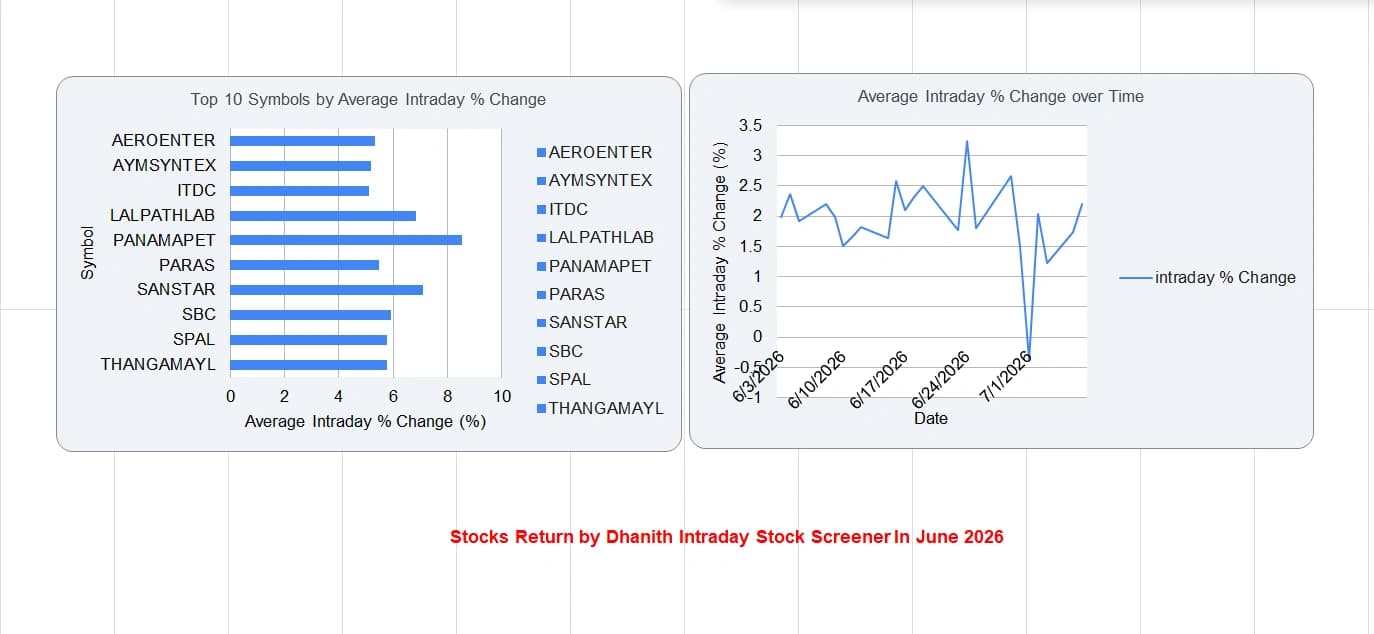
Here are the top 15 intraday movers surfaced by the Dhanith screener during this period — all real trades, real prices, real dates:
| Stock | LTP (₹) | Day High (₹) | Intraday Gain | Date | Signal Time |
|---|---|---|---|---|---|
| PANAMAPET | 423.40 | 489.90 | 15.71% | 19 Jun 2026 | 9:23 AM |
| PARAS | 1,131.55 | 1,302.00 | 15.06% | 17 Jun 2026 | 11:59 AM |
| THANGAMAYL | 4,945.00 | 5,649.00 | 14.24% | 04 Jun 2026 | 9:26 AM |
| IOLCP | 152.62 | 173.35 | 13.58% | 07 Jul 2026 | 9:20 AM |
| RAMCOSYS | 738.15 | 836.90 | 13.38% | 29 Jun 2026 | 9:25 AM |
| RPTECH | 594.60 | 673.50 | 13.27% | 16 Jun 2026 | 9:21 AM |
| ICIL | 363.65 | 410.50 | 12.88% | 18 Jun 2026 | 2:19 PM |
| NRBBEARING | 401.40 | 451.00 | 12.36% | 08 Jun 2026 | 9:16 AM |
| INDOBORAX | 378.00 | 423.10 | 11.93% | 23 Jun 2026 | 10:05 AM |
| AEGISLOG | 857.75 | 960.00 | 11.92% | 11 Jun 2026 | 10:04 AM |
| INOXINDIA | 1,774.30 | 1,980.00 | 11.59% | 10 Jun 2026 | 9:18 AM |
| SPAL | 1,022.55 | 1,136.00 | 11.09% | 24 Jun 2026 | 9:55 AM |
| SPAL | 977.10 | 1,084.00 | 10.94% | 19 Jun 2026 | 9:21 AM |
| PAISALO | 64.07 | 70.92 | 10.69% | 01 Jul 2026 | 9:20 AM |
| SANSTAR | 124.26 | 137.49 | 10.65% | 24 Jun 2026 | 10:05 AM |
Notice something important about this list: 10 out of 15 top movers generated their signals before 10:00 AM IST. This is not a coincidence — it is the single most important timing insight in intraday trading.
This table shows only the top 15 movers — want the complete dataset behind this article?
Free Download
Download the Full Intraday Screener Dataset
Get all 920 signals across 299 NSE stocks — stock names, prices, gains, dates, and signal times — in one free Excel sheet. No subscription.
No spam. Unsubscribe anytime. Your email is only used to send you the download and occasional trading tips.
The Most Consistently Active Stocks
These stocks appeared in the screener most frequently during the June–July 2026 period — meaning the screener kept surfacing them across multiple sessions because they repeatedly showed the right momentum conditions:
| Stock | Times Surfaced |
|---|---|
| INDSWFTLAB | 11 |
| INOXINDIA | 10 |
| CUPID | 9 |
| SYRMA | 9 |
| AEGISLOG | 9 |
| RAMCOSYS | 9 |
| RPTECH | 8 |
| XPROINDIA | 8 |
| UFBL | 8 |
| ASTRAMICRO | 8 |
Stocks like INOXINDIA, RPTECH, and AEGISLOG appeared 8–10 times in a single month — and when you cross-reference with the top movers table, these same stocks also produced some of the biggest individual percentage gains. This is exactly what a good screener does: it surfaces the same high-momentum names repeatedly, giving you multiple opportunities across a month rather than a one-time lucky pick.
The Best Time to Trade Intraday — What the Data Says
This is the part most intraday traders get wrong. They either trade all day (which leads to overtrading and fatigue) or they miss the best windows entirely. The screener data across 920 signals tells a clear story:
| Hour | Signals | Average Gain |
|---|---|---|
| 9:15–10:00 AM | 352 | 2.68% |
| 10:00–11:00 AM | 176 | 1.81% |
| 11:00–12:00 PM | 126 | 2.14% |
| 12:00–1:00 PM | 70 | 1.66% |
| 1:00–2:00 PM | 49 | 2.03% |
| 2:00–3:00 PM | 74 | 1.27% |
| 3:00–3:30 PM | 67 | 0.64% |
Two clear conclusions from this data:
1. The 9:15–10:00 AM window is the highest-value window. With 352 signals and the highest average gain of 2.68%, the first hour after NSE opens is where most of the best intraday moves are available. The momentum is fresh, institutional order flow is active, and liquidity is at its peak.
2. The 3:00–3:30 PM window produces the weakest average gains (0.64%). Trading in the final 30 minutes of the session — chasing momentum when most institutional players are already flat — produces the worst average results in the dataset. This is exactly when most beginners make their worst trades.
The practical conclusion: focus your energy and capital on the 9:15–11:00 AM IST window, reduce activity significantly after 2:00 PM, and consider avoiding the final 30 minutes entirely.
The Best Intraday Stocks Trading Strategy for India (Step by Step)
Based on the screener data and the patterns it reveals, here is the complete intraday trading strategy framework for NSE stocks:
Step 1 — Run the Screener Before Market Opens (9:00–9:15 AM IST)
The single biggest mistake intraday traders make is not having a watchlist ready before the market opens. Instead, they watch the market open, see a stock moving, and chase it at a bad price with no plan.
The right approach: have your watchlist of 5–8 screened stocks ready before 9:15 AM so that when the session opens, you are executing a pre-planned entry, not making a real-time decision under pressure.
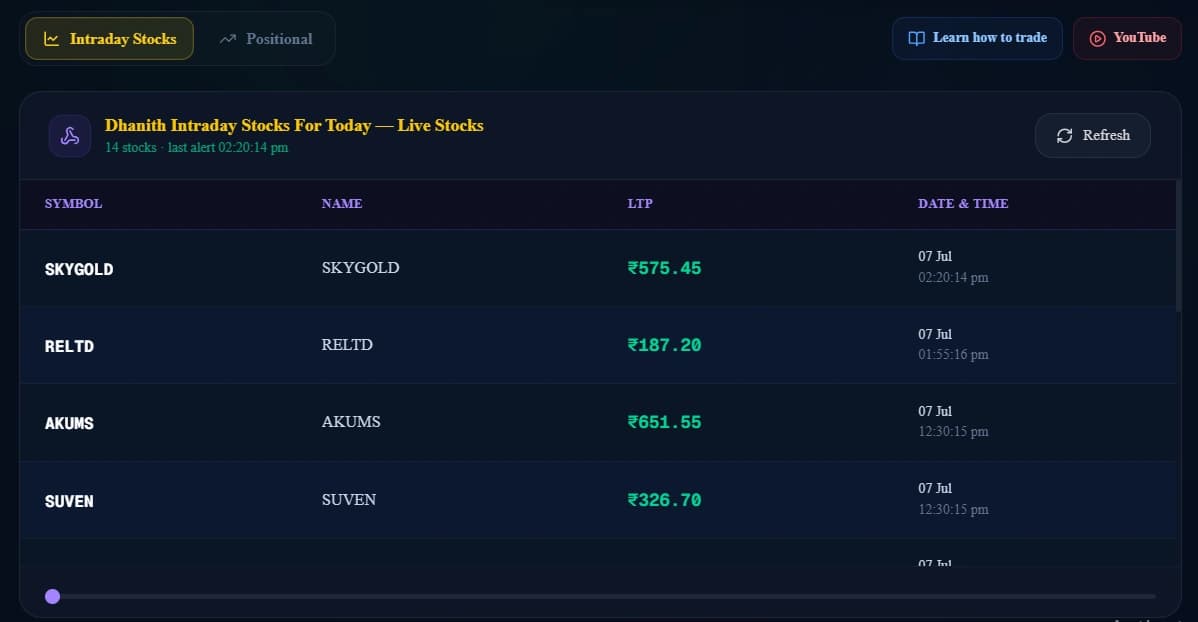
The Dhanith Intraday Stocks Screener surfaces stocks showing early momentum conditions — volume buildup, price approaching key levels, and technical signals aligning — so your pre-market preparation is structured rather than guesswork.
Pro Tip: Build your daily watchlist from the Dhanith Intraday Stocks Screener before 9:15 AM. The screener has surfaced 299 unique stocks across the June–July 2026 period with an average intraday gain of 2.06% per signal — giving you a data-backed starting point for every session.
Dhanith Intraday Screener
Build your watchlist in 30 seconds.
Automatically scan NSE stocks by turnover, gap percentage, sector momentum, and volume — so your pre-market checklist is ready before 9:00 AM.
Step 2 — Let the First 15 Minutes Settle (9:15–9:30 AM IST)
The first 15 minutes after NSE opens are the most irrational period of the entire session. Gap-ups get sold, gap-downs get bought, and algos chase noise in both directions. Never enter a trade in the first 15 minutes.
Instead, watch how your screened stocks are behaving. Are they holding above a key level? Is volume confirming the direction? Is the broader Nifty giving a clear directional bias?
Use these 15 minutes to observe, not to trade.
Step 3 — Identify the Structure (9:30–10:00 AM IST)
This is where you look for your actual entry. The best intraday setups during the 9:30–10:00 AM window share three characteristics:
Volume confirmation: The stock's volume in the first 30–45 minutes is visibly above its average. A stock moving on thin volume is a trap; a stock moving on heavy volume has genuine momentum behind it.
Clear direction above/below VWAP: Bullish setups trade above VWAP and hold it on minor pullbacks. Bearish setups trade below VWAP and fail to reclaim it on bounces. VWAP is the single most useful intraday reference line because it represents the true average price where institutional and retail participants have traded throughout the session.
Price action at a key level: A breakout from the opening range high, a bounce from a prior day's support, or a move through a key resistance zone identified on the daily chart — the stock needs a specific, identifiable technical reason to be moving, not just "looks strong."
Step 4 — Enter With a Pre-Defined Stop Loss
This is non-negotiable. Enter every intraday trade with a stop loss already placed in your broker platform — not "I'll stop out if it goes against me by 1%" in your head, but an actual order placed immediately after entry.
A useful rule from the screener data: if a stock is selected from the screener with an average expected move of ~2%, your stop should be no wider than 0.5–0.8% below your entry. This gives a minimum 2.5:1 to 4:1 reward-to-risk ratio — meaning even if you only capture 50% of the expected move, you still have a favorable R:R.
Step 5 — Take Profits in Stages, Never Hold to the End of Day
The data shows the 3:00–3:30 PM window produces only 0.64% average gain — barely a third of the 9:00–10:00 AM average. Holding positions all the way to 3:20 PM "hoping for more" is one of the most consistent ways to give back intraday gains.
A structured exit approach: take 50–60% of the position at the first target (50–70% of the expected move), move the stop to breakeven on the remainder, and let the rest run until 2:30 PM maximum. After 2:30 PM, close everything.
Understanding the Gain Distribution: What to Realistically Expect
The dataset of 920 signals breaks down like this:
| Gain Range | Number of Signals | % of Total |
|---|---|---|
| Under 1% | 384 | 41.7% |
| 1%–3% | 327 | 35.5% |
| 3%–5% | 120 | 13.0% |
| Above 5% | 83 | 9.0% |
The honest read: About 42% of signals produce under 1% gain — these are the sessions where the screener fires but the stock does not deliver meaningful momentum for that particular entry timing. This is why position sizing discipline matters: sizing these small-gain trades the same as the big-momentum ones means the 42% of flat signals don't damage your account.
The 9% of signals producing 5%+ gains — the PANAMAPET +15%, PARAS +15%, THANGAMAYL +14% setups — are what transforms a good intraday trading month. These outlier moves are almost impossible to find without a structured screener, because they require identifying the right stock at the right moment before the big move happens.
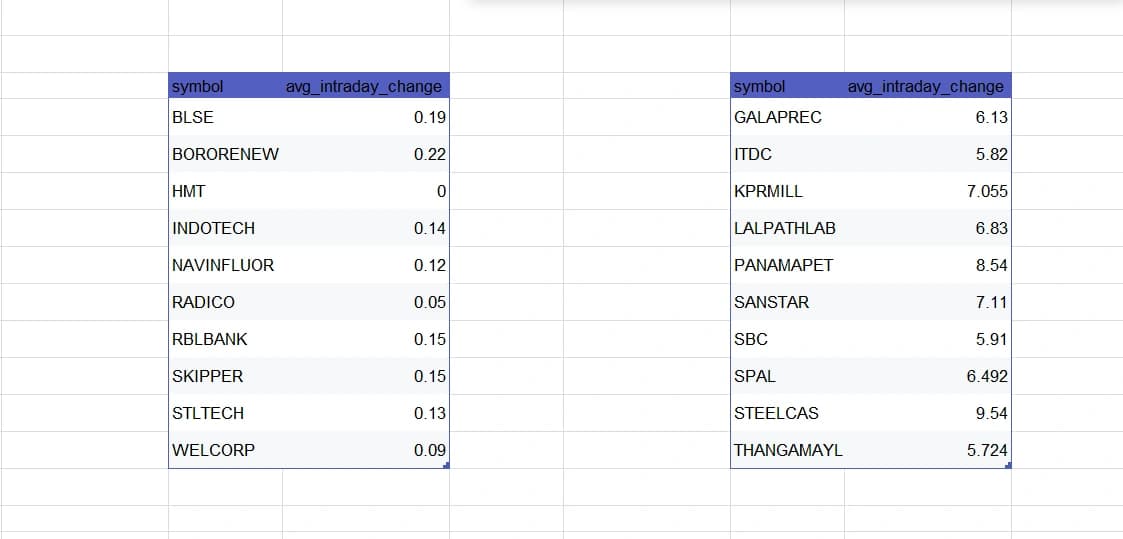
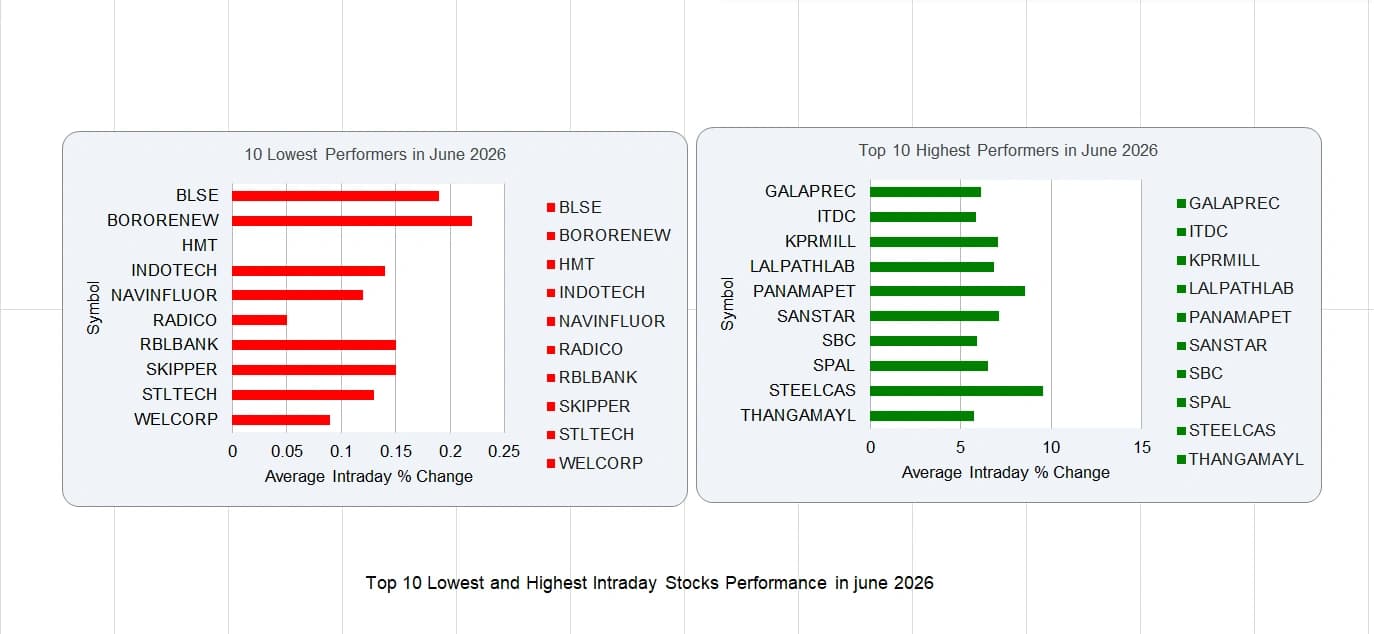
Pro Tip: The Dhanith Intraday Stocks Screener is built to surface exactly these high-momentum setups. By scanning the NSE universe and flagging stocks showing early momentum conditions, it gives you the opportunity to be positioned before the big move happens — not chasing it after a 10% move has already occurred.
The Stocks Worth Watching (Based on Screener Frequency)
If you are building a monthly watchlist of recurring momentum names based on the June–July 2026 screener data, these are the stocks that showed up most consistently:
INDSWFTLAB (11 appearances) — A recurring momentum name across the full period. When it shows up on the screener, it has historically been worth watching for follow-through.
INOXINDIA (10 appearances) — Also appeared in the top 15 movers list with an 11.59% single-day gain. Consistent screener presence combined with demonstrated big-move capability makes this a priority watchlist name.
AEGISLOG (9 appearances) — Another name combining high frequency in the screener with a top-15 appearance (11.92% gain). These are the kinds of stocks that are worth studying in depth — understanding their sector, their news drivers, and their typical technical behavior on momentum days.
RAMCOSYS (9 appearances, 13.38% max gain) — One of the standout momentum names of the period, surfacing repeatedly and delivering a 13%+ gain on its best day.
This is what good intraday stock selection looks like in practice: a small, focused watchlist of recurring momentum names that you understand deeply, rather than a different random stock every single day.
Final Thoughts: Why Most Intraday Traders Fail (and How to Fix It)
The NSE has over 2,000 actively traded stocks. Trying to monitor, analyze, and trade this universe manually — without a structured screener — is the single biggest structural disadvantage most retail intraday traders operate under. It's a big part of why SEBI's own study found that roughly 7 out of 10 individual intraday traders lose money in the equity cash segment — stock selection without structure is a large, avoidable part of that gap.
The data from the Dhanith screener tells a specific, evidence-based story: 299 unique NSE stocks produced meaningful intraday moves during the June–July 2026 period. The best moves concentrated in the 9:00–10:00 AM window. A handful of recurring names — INOXINDIA, AEGISLOG, RAMCOSYS, RPTECH — showed up again and again with above-average momentum.
None of this is accessible without a screener doing the filtration work before the market opens.
Strategy matters. Price action matters. Risk management matters. But without the right intraday stock selection process, you are applying all of that skill to the wrong stocks, at the wrong time, wondering why it does not work consistently.
Disclaimer: This blog post is for educational purposes only and does not constitute financial or investment advice. Intraday trading in NSE-listed stocks involves significant risk of capital loss. The screener data presented reflects historical signals and does not guarantee future returns. Always use proper risk management including stop-loss orders before entering any intraday trade. SEBI: Trading in equity markets carries risk — read all documents carefully before investing.
FAQ
Q: What is the best time to trade intraday stocks in India? Based on 920 screener signals from June–July 2026, the 9:15–10:00 AM IST window produced the highest average intraday gain of 2.68% — significantly better than any other hour. The 3:00–3:30 PM window produced the lowest average of 0.64%. For most intraday traders, focusing capital and energy on the first 1–2 hours of the NSE session and reducing activity significantly after 2:00 PM produces the best results.
Q: How do I find the best intraday stocks for today? The most reliable approach is using a structured screener that filters the NSE universe for specific momentum conditions before the market opens. The Dhanith Intraday Stocks Screener surfaces stocks showing volume buildup, technical breakout conditions, and momentum signals — giving you a pre-built watchlist of 5–8 high-probability names before 9:15 AM each session.
Q: What is a realistic intraday gain per trade? Based on the Dhanith screener data across 920 signals, the average intraday gain was 2.06% per signal. The gain distribution shows approximately 42% of signals produced under 1%, 35.5% produced 1–3%, 13% produced 3–5%, and 9% produced above 5%. Setting a target of 1.5–2% per trade with a stop loss of 0.5–0.8% produces a favorable risk-reward ratio aligned with the historical data.
Q: Which NSE stocks move the most intraday? Based on June–July 2026 screener data, the top single-day movers included PANAMAPET (+15.71%), PARAS (+15.06%), THANGAMAYL (+14.24%), IOLCP (+13.58%), and RAMCOSYS (+13.38%). The most consistently active names — appearing in the screener 8–11 times in a single month — included INDSWFTLAB, INOXINDIA, CUPID, SYRMA, AEGISLOG, and RAMCOSYS.
Q: Should I trade intraday in the last 30 minutes of the NSE session? The data suggests avoiding new trades in the 3:00–3:30 PM window. With an average gain of only 0.64% — less than a quarter of the 9:00–10:00 AM average — and thin end-of-day liquidity, this window produces the weakest results in the dataset. Most experienced intraday traders exit all positions before 3:15 PM.
Ready to Start? Here's Your Next Step
→ Open the Dhanith Intraday Screener — See today's high-momentum stocks before 9:15 AM
→ Calculate Your Position Size on the Risk Management Page — Know your exact share quantity before you enter
→ Log Today's Trades in the Dhanith Journal — Track your performance and improve with every session
Further reading: Intraday Trading Rules You Must Follow | How Much Capital Is Required for Intraday Trading? | How to Trade Intraday Stocks in India: The Complete Guide | How to Trade Dhanith Intraday Screener Stocks | Volume Analysis: The Complete Trading Guide | Best Online Trading Journal | AMD Trading Strategy for NY Open | 5 Best Intraday Trading Strategies for NSE India
Have a question about this article?
Comment on our latest Instagram post or send us a DM — we reply to every one.
@dhanith_officialWas this article helpful?
Click to rate
Founder, Dhanith Trading
7+ years trading Nifty, Bank Nifty, NSE stocks, and commodities — specializing in Smart Money Concepts (SMC) and ICT price action. Founder of Dhanith — a trading journal, intraday screener, and risk tools platform built for retail traders.
Dhanith Newsletter
Enjoyed this article? Get more like it.
New trading guides, candlestick patterns, SMC strategies, and tool updates — straight to your inbox. Free, for Indian traders.
No spam. Unsubscribe anytime.
Continue Reading