On this page
- Introduction
- Part 1: What the Dhanith Intraday Screener Is Showing You
- Part 2: Before You Enter Any Trade — Risk Management First
- How to Use the Dhanith Risk Management Page
- Why This Matters More Than the Entry
- Part 3: Setting Up Your Charts — The Dhanith 5-Minute Setup
- The Three Indicators You Need
- Part 4: The Three Entry Conditions — The Core of the Dhanith System
- Entry Condition 1 — VWAP Crossover (The Breakout Entry)
- Entry Condition 2 — VWAP Pullback Bounce (The Re-Entry)
- Entry Condition 3 — Bullish Engulfing Below VWAP (The Reversal Entry)
- Part 5: The 3:1 Risk-Reward Rule — No Exceptions
- Part 6: Complete Trade Execution — From Screener to Exit
- Part 7: The Dhanith Trading Journal — How to Track and Improve
- Why Journal Every Trade?
- Part 8: The Best Time Windows for Dhanith Screener Stocks
- High Probability Window — 9:30 AM to 11:00 AM
- Caution Window — 11:30 AM to 1:30 PM
- Secondary Window — 1:30 PM to 3:00 PM
- Common Mistakes to Avoid
- Mistake 1 — Entering Without a Condition Match
- Mistake 2 — Skipping the Risk Management Calculation
- Mistake 3 — Moving the Stop Loss to Avoid Being Stopped Out
- Mistake 4 — Exiting at 1:1 Instead of Holding to 3:1 Target
- Mistake 5 — Not Using the Journal
- FAQ
- Conclusion
- Ready to Start? Here's Your Next Step
Learn exactly how to trade stocks from the Dhanith Intraday Screener. Master the 3 VWAP-based entry conditions, calculate risk properly, set 3:1 targets, and track every trade with the Dhanith Journal.
Introduction
You opened the Dhanith Intraday Screener and a list of stocks appeared.
Now what?
This is the exact question most traders ask after they see the screener for the first time. The stocks are there — pre-filtered, momentum-confirmed, high-volume — but without a clear process for how to trade them, even the best screener in the world becomes just a list.
This guide solves that completely.
The Dhanith Intraday Screener uses a proprietary strategy to surface only the highest-momentum, volume-breakout stocks on NSE every day. These are not random picks. They are stocks that have passed specific institutional-grade filters for volume surge, price momentum, and technical setup quality. Your job is not to find the stocks — the screener does that. Your job is to wait for the right entry condition, manage your risk precisely, and execute with discipline.
By the end of this guide you will know exactly:
- What the screener is showing you and why these stocks were selected
- The exact three entry conditions that qualify a trade — and how to spot each one on a 5-minute chart
- How to calculate your position size using the Dhanith Risk Management tool
- How to set your stop loss and target every time (3:1, no exceptions)
- How to track and improve using the Dhanith Trading Journal
This is the complete playbook for trading Dhanith screener stocks from start to finish.
TL;DR — Key Takeaways
- Dhanith Intraday Screener shows high-momentum, volume-breakout stocks pre-filtered by the Dhanith trading strategy — you do not need to scan the market yourself
- Add screener stocks to your watchlist immediately — then wait; do not enter immediately
- Calculate your position size from the Dhanith Risk Management page before any entry — never risk more than 5% of your total capital in a single day
- Only three entry conditions are valid: (1) VWAP crossover entry, (2) VWAP pullback bounce entry, (3) Bullish engulfing below VWAP entry
- All trades use a 3:1 risk-reward ratio — if your stop is 1%, your target is always 3%
- Best timeframe: 5-minute chart only
- Best indicators: VWAP + Volume + RSI
- Every trade must be logged in the Dhanith Trading Journal — this is how you improve
Part 1: What the Dhanith Intraday Screener Is Showing You
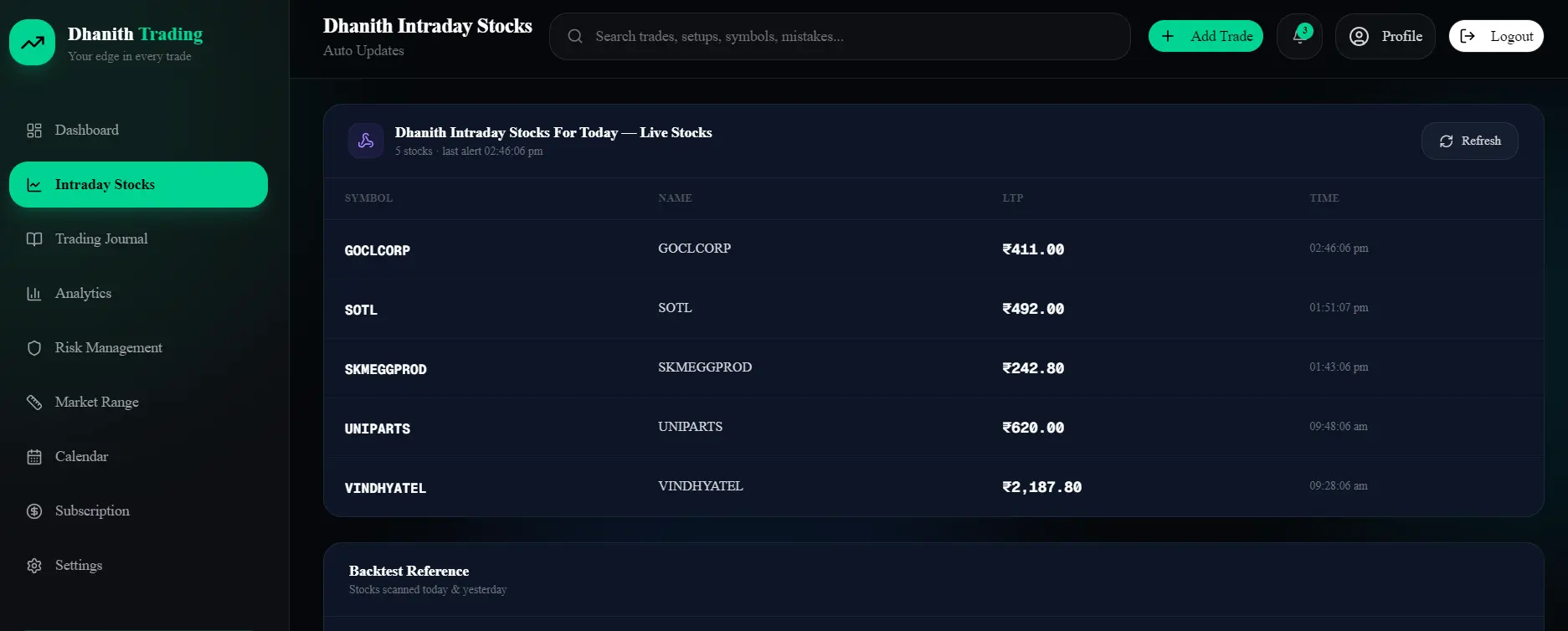
When you open the Dhanith Intraday Screener and see a list of stocks, those stocks did not appear randomly. Every stock on that page has passed through the Dhanith trading strategy filter — a multi-layered screening process that identifies stocks with three specific characteristics simultaneously:
1. High Momentum: The stock is moving with directional conviction. Price is trending, not chopping sideways. Momentum stocks produce clean, sustained moves that give intraday traders enough range to enter, hold, and exit profitably.
2. Volume Breakout: Trading volume has surged above its normal level — often 2x, 3x, or more above the stock's average daily volume. Volume is the truth detector of every price move. When price breaks out on high volume, institutions are participating. When volume is absent, the move is retail noise that reverses quickly.
3. Technical Setup: The price structure meets the Dhanith strategy's specific technical criteria — not just any moving stock, but one in a configuration that aligns with the three entry conditions you will learn below.
What this means for you: You do not need to scan 1,500+ NSE stocks every morning. You do not need to build your own screener or apply filters manually. The Dhanith screener has already done that work. When you open the page, your first job is simple:
Add every stock on the screener to your watchlist. Then stop. Wait. Do not enter.
The screener identifies candidates. Your entry discipline separates profitable trades from random ones.
Pro Tip: Add the screener stocks to your watchlist before 9:30 AM. Set price alerts at the VWAP level for each stock. When the alert triggers, you will know it is time to watch the 5-minute chart closely for one of the three entry conditions.
Dhanith Intraday Screener
Build your watchlist in 30 seconds.
Automatically scan NSE stocks by turnover, gap percentage, sector momentum, and volume — so your pre-market checklist is ready before 9:00 AM.
Part 2: Before You Enter Any Trade — Risk Management First
This step is non-negotiable. Before you look at a single chart, before you identify a single entry condition, you must calculate your position size for today.
The Dhanith rule: Never risk more than 5% of your total capital in a single trading day.
This is not a suggestion. It is the structural protection that keeps you trading tomorrow even when today goes wrong. A 5% daily loss limit means even your worst possible day — if you hit maximum risk and stop — only costs you 5%. You can recover from 5%. You cannot recover from 40%.
How to Use the Dhanith Risk Management Page
Go to the Dhanith Risk Management page and enter three values:
1. Your total trading capital (e.g., ₹1,00,000) 2. Your entry price (the price at which you plan to enter the trade) 3. Your stop loss price (the price at which your trade is wrong and you exit)
The calculator will show you exactly how many shares to buy.
Here is the math behind it:
Daily Risk Limit = Capital × 5% = ₹1,00,000 × 5% = ₹5,000

Risk per share = Entry Price − Stop Loss Price

Position Size = Daily Risk Limit ÷ Risk per Share

Example:
Entry Price: ₹500
Stop Loss: ₹490
Risk per share: ₹10

Position Size = ₹5,000 ÷ ₹10 = 500 shares
Total position value = 500 × ₹500 = ₹2,50,000
This means you buy exactly 500 shares — no more, no less. The number is mathematical, not emotional.
Why This Matters More Than the Entry
Most traders spend 90% of their time finding the perfect entry and 0% calculating position size. This is backwards. A great entry with wrong position sizing destroys your account. A mediocre entry with correct position sizing and strict stop loss is survivable.
The Dhanith Risk Management page makes this calculation instant and removes all guesswork. Use it before every single trade, without exception.
Warning: If you skip the risk management calculation and "estimate" your position size based on gut feel, you are not following the Dhanith strategy. The full system — screener, entry conditions, risk management, journal — works as a complete unit. Removing any one piece reduces its effectiveness significantly.
Part 3: Setting Up Your Charts — The Dhanith 5-Minute Setup
Every Dhanith screener trade is executed on the 5-minute chart. Not the 1-minute (too noisy). Not the 15-minute (too slow). The 5-minute chart gives you the perfect balance of enough data to confirm the entry condition and enough speed to capture the intraday momentum move.
The Three Indicators You Need
Indicator 1 — VWAP (Volume Weighted Average Price)
VWAP is the single most important indicator in the Dhanith system. It is the line that divides the entire strategy into its three entry conditions. Everything revolves around price's relationship to VWAP.
Add VWAP to your 5-minute chart (it is a built-in indicator on TradingView, Zerodha Kite, and Upstox Pro — search "VWAP" in the indicator list).
VWAP resets every morning at 9:15 AM. It builds through the session based on the volume-weighted average price of all trades. When a high-momentum breakout stock from the Dhanith screener is trading above VWAP, institutional buyers are in control. Below VWAP, sellers have the edge. At VWAP, a decision point is forming.
Indicator 2 — Volume
Add the standard Volume bars at the bottom of your chart. Every entry condition in the Dhanith system requires volume confirmation. A breakout without volume is a trap. A bounce without volume is a false signal. Volume is the confirmation that turns a pattern into a trade.
You are looking for the entry candle to have visibly larger volume bars than the surrounding candles. On TradingView, the volume bar for the breakout or bounce candle should stand clearly taller than the previous 3–5 bars.
Indicator 3 — RSI (Relative Strength Index)
Add RSI to your chart with the default 14-period setting. RSI confirms momentum direction:
- RSI above 50: bullish momentum — confirms long entry conditions
- RSI below 50: bearish momentum — caution on long entries
- RSI above 60 during a VWAP breakout: strong confirmation of real momentum move
- RSI below 40 before a bullish engulfing: oversold condition setting up for a bounce
RSI does not trigger entries alone. It is a confirmation layer that filters low-probability signals.
Quick Chart Setup Summary:
Chart: 5-minute timeframe
Indicator 1: VWAP (session anchor, auto-reset 9:15 AM)
Indicator 2: Volume (standard bars, visible at bottom)
Indicator 3: RSI (14-period, separate panel below)
Part 4: The Three Entry Conditions — The Core of the Dhanith System
This is the most important section of this guide. Read it carefully. Every trade you take from the Dhanith screener must match one of these three conditions exactly. If none of the three conditions are present, you do not enter. There are no exceptions.
Entry Condition 1 — VWAP Crossover (The Breakout Entry)
What it is: Price was trading below VWAP and has just crossed above it with a strong, purposeful candle.
What it looks like on the 5-minute chart:
- The previous candle closed below VWAP
- The current candle opens and pushes above the VWAP line
- The candle closes above VWAP with a visible body (not just a wick above VWAP)
- Volume on this candle is clearly higher than the preceding 3–5 candles
How to enter: Wait for the crossover candle to close completely. Do not enter mid-candle. Once the 5-minute candle closes above VWAP, your entry is at the high of that candle.
Place a buy order at the high of the crossover candle. This entry style confirms the breakout before you enter — you are not predicting the cross, you are confirming it has happened.
Stop loss: Below the low of the crossover candle (or below VWAP if the candle's low is very close to VWAP).
Target: 3x your stop loss distance above your entry.
Confirmation checklist for Entry 1:
- Previous candle was below VWAP
- Current candle crosses and closes above VWAP
- Candle has a real body (not just a wick)
- Volume is higher than surrounding candles
- RSI is above 50 (or moving upward toward 50)
- Stock is from the Dhanith screener (high momentum, volume breakout)
Real example: A Dhanith screener stock is at ₹480. VWAP is at ₹482. The 10:15 AM 5-minute candle opens at ₹481, pushes to ₹485 by close, crossing VWAP. Volume on this candle is 3x the previous candle.
- Entry: ₹485 (high of the crossover candle)
- Stop: ₹480 (low of the crossover candle)
- Risk per share: ₹5
- Target (3:1): ₹485 + (3 × ₹5) = ₹500
Pro Tip: The VWAP crossover is the most powerful entry condition because it signals a potential shift in the entire session's direction. When a high-momentum stock from the Dhanith screener crosses VWAP with volume, the probability of a sustained move is highest. The best crossover setups happen between 9:30 AM and 11:00 AM when institutional volume is at its peak.
Entry Condition 2 — VWAP Pullback Bounce (The Re-Entry)
What it is: Price is already above VWAP (bullish session confirmed), pulls back to touch VWAP, and bounces back upward. This is a re-entry with the trend — a second chance to enter a stock that has already demonstrated bullish momentum.
What it looks like on the 5-minute chart:
- Price has been trading above VWAP for at least 30–60 minutes
- Price pulls back toward VWAP on declining volume
- Price touches VWAP (or briefly wicks below it)
- A rejection candle forms — a Hammer, Bullish Engulfing, or Doji at VWAP
- Volume increases as the rejection candle forms — buyers defending VWAP
How to enter: Wait for the rejection candle to close. Do not enter on the wick — wait for the full candle close. Once the candle closes and is visibly bouncing off VWAP (closing back above or at VWAP), enter immediately.
Entry is at the close of the bounce candle, or above the high of the bounce candle if you want an additional confirmation.
Stop loss: Below the low of the rejection/bounce candle (the low that touched or wicked below VWAP).
Target: 3x your stop loss distance above your entry.
Confirmation checklist for Entry 2:
- Price has been above VWAP for at least 3–4 candles before the pullback
- Pullback volume is lower than the preceding upward candles (weak selling)
- A clear rejection candle forms at VWAP (Hammer, small body, or Bullish Engulfing)
- Volume increases on the rejection candle (buyers stepping in)
- RSI above 50 (confirming overall bullish momentum)
- Stock is from the Dhanith screener
Real example: A Dhanith screener stock rallied from ₹200 to ₹212 (above VWAP at ₹205). It pulls back to ₹205 on 3 light-volume candles. At ₹205, a Hammer forms with the wick touching ₹203. Volume on the Hammer is 2x the pullback candles.
- Entry: ₹207 (close of the bounce candle / above Hammer high)
- Stop: ₹203 (low of the Hammer wick)
- Risk per share: ₹4
- Target (3:1): ₹207 + (3 × ₹4) = ₹219
Pro Tip: The VWAP pullback bounce is the cleanest, highest-probability entry in the entire Dhanith system for one reason — the trend has already been confirmed above VWAP, and you are entering at the best available price within that confirmed trend. You are not predicting a breakout; you are joining a proven move. When you see this setup forming on a Dhanith screener stock, treat it as a priority.
Entry Condition 3 — Bullish Engulfing Below VWAP (The Reversal Entry)
What it is: Price is below VWAP (currently in a bearish zone) but forms a Bullish Engulfing candlestick pattern — a powerful two-candle reversal signal showing that buyers have completely overwhelmed sellers.
This is the most aggressive of the three entries because you are entering below VWAP, which means the session bias has not yet flipped bullish. The Bullish Engulfing pattern gives you a reason to believe that flip is about to happen — but it requires more caution and tight stop loss discipline.
What a Bullish Engulfing looks like:
- Candle 1: A bearish (red) candle — sellers are in control
- Candle 2: A bullish (green) candle that opens below Candle 1's close AND closes above Candle 1's open — completely engulfing the previous candle's body
- The Candle 2 body must be larger than Candle 1's body
- Volume on Candle 2 must be significantly higher than Candle 1 — buyers are overwhelming sellers decisively
How to enter: Wait for Candle 2 (the bullish engulfing candle) to close completely. The entry is at the close of the engulfing candle. This is important — you are waiting for the full candle to complete, not entering on an intrabar prediction.
Stop loss: Below the low of Candle 1 (the bearish candle) — this is the level that, if reached, tells you buyers failed to take control and the bearish pressure is resuming.
Target: 3x your stop loss distance above your entry. The target should be at or above the VWAP level — you are anticipating price to recover above VWAP.
Confirmation checklist for Entry 3:
- Price is below VWAP (bearish zone)
- A genuine two-candle Bullish Engulfing forms (Candle 2 body exceeds Candle 1 body completely)
- Volume on the engulfing candle is higher than the bearish candle
- RSI is below 50 but turning upward (from oversold toward neutral)
- VWAP is within a reasonable distance above entry (3:1 target is achievable before VWAP becomes resistance)
- Stock is from the Dhanith screener
Real example: A Dhanith screener stock is at ₹150 with VWAP at ₹156. A bearish candle closes at ₹148 (opened at ₹152, closed at ₹148). The next 5-minute candle opens at ₹147, pushes to ₹154, and closes at ₹153 — completely engulfing the previous bearish candle on high volume.
- Entry: ₹153 (close of engulfing candle)
- Stop: ₹146 (below the low of Candle 1 at ₹147, with buffer)
- Risk per share: ₹7
- Target (3:1): ₹153 + (3 × ₹7) = ₹174
Warning: Entry Condition 3 is the riskiest of the three because you are entering against the current session bias (price below VWAP). Only take this entry when the engulfing candle is unmistakable — clearly larger body than the bearish candle, clearly higher volume. A weak or ambiguous engulfing should be skipped. When in doubt, wait for Entry Condition 1 or 2.
Part 5: The 3:1 Risk-Reward Rule — No Exceptions
Every single trade from the Dhanith system uses a 3:1 risk-reward ratio. This is not optional. This is the mathematical engine that makes the system profitable over time.
What 3:1 means:
If your stop loss is ₹10 away from your entry, your target must be ₹30 away from your entry. Always. If your stop is 1% of the stock price, your target is 3% of the stock price.
Why 3:1 creates long-term profitability:
Imagine you take 10 trades. Your win rate is 40% (you win 4, lose 6). At 3:1:
- 4 winning trades × ₹3,000 profit each = ₹12,000 profit
- 6 losing trades × ₹1,000 loss each = ₹6,000 loss
- Net result: +₹6,000 profit
You were wrong 60% of the time and still made money. This is the power of 3:1. The ratio does not require you to be right most of the time — it requires you to be disciplined with position sizing and stop losses every time.
How to calculate your target:
Stop Distance = Entry Price − Stop Loss Price

Target = Entry Price + (3 × Stop Distance)

Example:
Entry: ₹500
Stop: ₹495
Stop Distance: ₹5
Target: ₹500 + (3 × ₹5) = ₹515
Set this as your target the moment you enter the trade. Do not move the target upward mid-trade. Do not exit early because "it looks like it's stalling." Let the trade run to target or stop — no exceptions.
Pro Tip: Before entering any trade, calculate both your stop price and your target price. Write them down. Only enter if the target is realistically achievable — meaning there is no major resistance level between your entry and target that would block the move. If a key resistance sits between your entry and target, either skip the trade or reduce your target to that resistance level and recalculate whether the reduced target still gives you 2:1 minimum.
Part 6: Complete Trade Execution — From Screener to Exit
Here is the full step-by-step process from opening the Dhanith screener to closing your trade:
Step 1 — Open the Dhanith Intraday Screener (Pre-market or at open) Review today's list of stocks. These are your candidates for the session.
Step 2 — Add all screener stocks to your watchlist On TradingView or your broker platform, add every screener stock. You will not trade all of them — but you need to watch all of them for entry conditions.
Step 3 — Open the Dhanith Risk Management Page Before looking at a single chart, go to the risk management page. Know your daily risk limit (5% of capital). Have it ready so that when a setup appears, you can calculate position size in 30 seconds.
Step 4 — Set up your 5-minute charts For each watchlist stock, open the 5-minute chart with VWAP, Volume, and RSI.
Step 5 — Wait for an entry condition (9:15 AM – 3:00 PM) Watch your watchlist. Do not force a trade. Wait for one of the three conditions:
- Entry 1: VWAP crossover — price crosses above VWAP and closes
- Entry 2: VWAP pullback bounce — price above VWAP, pulls back, bounces
- Entry 3: Bullish Engulfing below VWAP
When a condition appears, run through the confirmation checklist before acting.
Step 6 — Calculate position size Go to the Dhanith Risk Management page. Enter:
- Your capital
- Entry price (the high of the breakout candle, or the close of the bounce/engulfing candle)
- Stop loss price (below candle low) The page tells you how many shares to buy.
Step 7 — Enter the trade Place your buy order at the specified entry level. Simultaneously place your stop loss order.
Step 8 — Set your target order Place a sell limit order at your 3:1 target price. This ensures you capture the profit even if you step away from the screen.
Step 9 — Manage the trade (do not interfere) Let the trade run to stop or target. Do not move your stop further away if the trade goes against you. Do not exit early if the trade is going for you. The rules were set pre-entry — honour them post-entry.
Step 10 — Log the trade in the Dhanith Trading Journal immediately after closing Whether you won or lost, log it. This step is what separates traders who improve from those who repeat the same mistakes.
Part 7: The Dhanith Trading Journal — How to Track and Improve
The Dhanith Trading Journal is not a formality. It is the tool that converts your daily trading experience into measurable improvement over time.
Every trade you take from the Dhanith screener should be logged with the following information:
| Field | What to Record |
|---|---|
| Date | Today's date |
| Stock | The NSE symbol |
| Entry Condition | Which of the 3 conditions triggered (1, 2, or 3) |
| Entry Price | Price at which you entered |
| Stop Loss | Your stop loss price |
| Target Price | Your 3:1 target price |
| Position Size | Number of shares (from Risk Management page) |
| Exit Price | Price at which you actually exited |
| Result (₹) | Profit or loss in rupees |
| Result (R) | Profit or loss in R-multiples (1R = risk amount) |
| Entry Condition Met? | Did you follow all the checklist points? Yes/No |
| What I Did Well | One specific thing that worked |
| What to Improve | One specific thing to do differently |
Why Journal Every Trade?
After 30 days of journaling, your data will tell you things your memory never could:
- Which entry condition is most profitable for you? Maybe Entry 2 (VWAP pullback bounce) produces 70% of your profits while Entry 3 (Bullish Engulfing) is your biggest source of losses.
- What time of day are your best trades? Most traders discover their highest win-rate trades happen between 9:45 AM and 11:00 AM.
- Are you following your rules? If you have 10 losing trades and 8 of them have "Entry Condition Met? = No," your losses are not from the strategy — they are from deviation.
- Is your 3:1 target being reached? If your trades are hitting stop before target consistently, your entry is too early (before conditions are fully confirmed).
The most successful Dhanith strategy traders are not those who take the most trades — they are those who have the most complete journals. Your journal is your coach, your analyst, and your accountability partner all in one.
Dhanith Trading Journal
Track every trade. Find your real edge.
Log your setups, grade your entries, and review your trading patterns — all in one place. The journal built for serious SMC traders.
Part 8: The Best Time Windows for Dhanith Screener Stocks
Not all hours of the trading session produce equal results for momentum screener stocks. Understanding when to trade aggressively and when to step back dramatically improves your win rate.
High Probability Window — 9:30 AM to 11:00 AM
This is the primary trading window for Dhanith screener stocks. Volume is highest, momentum is strongest, and the three entry conditions produce the cleanest signals during this period.
- 9:15–9:30 AM: Observe only. Let the opening range establish. Watch where the screener stocks open relative to VWAP.
- 9:30–10:00 AM: First entry window. VWAP crossover setups (Entry 1) are most likely here as stocks that gapped up establish direction.
- 10:00–11:00 AM: Prime VWAP pullback bounce window (Entry 2). Stocks that made strong opening moves pull back to VWAP for re-entry.
- 11:00–11:30 AM: Transition. Quality starts declining. Take only the clearest setups.
Caution Window — 11:30 AM to 1:30 PM
The midday session has lower volume, less institutional activity, and more false signals. The same entry condition that would work at 10:00 AM fails more frequently at 12:30 PM simply because the volume to sustain the move is not present.
During this window: Reduce to watching only. If you entered a morning trade, manage it. Do not initiate new positions from the screener between 11:30 AM and 1:30 PM.
Secondary Window — 1:30 PM to 3:00 PM
Volume returns in the afternoon session. A second round of Dhanith screener trades can appear, particularly Entry 2 (VWAP pullback) setups on stocks that trended strongly in the morning. Quality is lower than the morning but acceptable.
3:00 PM absolute deadline: No new intraday entries after 3:00 PM. You need time to exit before the 3:20 PM broker auto-square-off begins.
Common Mistakes to Avoid
Mistake 1 — Entering Without a Condition Match
"The stock looks good and it's moving — I should enter." Without a specific, confirmed entry condition, this is not a trade. It is a guess. Apply the checklist every time. If you cannot check all the boxes, you do not enter.
The fix: Before entering any trade, say aloud which of the three conditions is present and which items on the checklist are confirmed. This 30-second verbal check eliminates 80% of impulsive entries.
Mistake 2 — Skipping the Risk Management Calculation
Entering "100 shares" because it "feels like the right amount" instead of calculating proper position size.
The fix: The Dhanith Risk Management page takes 60 seconds to use. Use it before every trade. The number it gives you is the only number that keeps your 5% daily risk limit intact.
Mistake 3 — Moving the Stop Loss to Avoid Being Stopped Out
The trade hits your stop loss price. Instead of exiting, you move the stop down because "the stock will recover." This converts a defined-risk trade into an undefined-risk trade.
The fix: The stop loss is your exit. When it is hit, exit. Immediately. No discussion, no hope, no waiting. The 3:1 system only works when losses are consistently held to 1R.
Mistake 4 — Exiting at 1:1 Instead of Holding to 3:1 Target
The trade moves to 1:1 (your stop distance in profit). Fear of giving it back causes you to exit early. Over 30 trades, this transforms what should be a profitable system into a break-even or losing one.
The fix: Set your target order the moment you enter. Letting a limit order work automatically removes the emotional temptation to exit early. The system is designed for 3:1 — let it work.
Mistake 5 — Not Using the Journal
Trading for two months, making the same mistakes, never improving — because nothing is being tracked.
The fix: Log every trade in the Dhanith Trading Journal immediately after it closes. It takes 3 minutes. Those 3 minutes produce more improvement than 3 hours of chart study.
FAQ
Q: How many stocks does the Dhanith screener typically show each day? The number varies depending on market conditions. On high-volume trending days, more stocks pass the screener's filters. On flat or news-driven days, fewer stocks appear. The screener's selectivity is a feature — it only shows stocks that meet all criteria simultaneously. On any given day you may see 3–8 stocks, sometimes more during momentum surges.
Q: Can I trade all three entry conditions on the same stock in the same day? Yes. If a stock shows Entry 1 (VWAP crossover) in the morning and later pulls back for Entry 2 (VWAP bounce), both are valid setups to consider. Treat each as a separate trade with its own risk calculation and position size.
Q: What if none of the three conditions appear on any screener stock all day? This is a completely valid outcome — and on some days, the right call is zero trades. The screener identifies candidates; the entry conditions confirm readiness. If no condition triggers, the session's result is zero trades and zero losses. This is a professional outcome, not a failure.
Q: Can I use the Dhanith strategy on stocks not in the screener? The three entry conditions — VWAP crossover, VWAP bounce, Bullish Engulfing below VWAP — work on any liquid stock. But the Dhanith screener adds a pre-filter layer that specifically identifies high-momentum, volume-breakout stocks, which produce the cleanest signals. Trading the conditions on random stocks without this pre-filter produces lower-quality setups.
Q: What if my target is not hit by 3:00 PM? Exit the trade. All intraday positions must close by 3:00 PM to avoid broker auto-square-off. If the trade has not reached target by 3:00 PM, exit at market and log the result as a partial outcome. Never carry an intraday position overnight to "let it work."
Q: How soon will I see consistent results from this strategy? Most traders need 30–60 sessions of disciplined, journaled trading before they see consistent results. The first 30 sessions are largely learning — learning to recognize the entry conditions accurately, learning to hold to 3:1 without exiting early, and learning which conditions work best for your execution style. Journal every trade. Review weekly. Improvement is visible in the data.
Conclusion
The Dhanith Intraday Screener has done the hard work of finding the right stocks. Your job is to trade them correctly — and that means three things done consistently:
1. Wait for the condition. Not every screener stock gives you a valid entry every day. The three conditions — VWAP crossover, VWAP bounce, Bullish Engulfing below VWAP — are your gate. If the gate does not open, you do not enter. Patience is the most underrated edge in intraday trading.
2. Size every trade with the Risk Management page. The 5% daily limit and precise position sizing are what protect your capital on losing days. The Dhanith system produces winners — but not 100% of the time. Proper sizing ensures the losing trades are small enough that the winning trades more than compensate.
3. Log every trade in the Journal. The screener finds the stocks. The entry conditions time the trades. The Risk Management page sizes them. And the Journal is what makes you better with every session you complete. Traders who journal improve. Traders who don't repeat.
The system works when all four parts work together. Use the screener. Apply the conditions. Manage the risk. Log the journal.
Ready to Start? Here's Your Next Step
→ Open the Dhanith Intraday Screener — See today's high-momentum breakout stocks
→ Calculate Your Position Size on the Risk Management Page — Know your exact share quantity before you enter
→ Log Today's Trades in the Dhanith Journal — Track your performance and improve with every session
Further reading: Intraday Trading Rules You Must Follow | How Much Capital Is Required for Intraday Trading? | How to Trade Intraday Stocks in India: The Complete Guide | RSI Trading Strategy: Complete Guide | Support and Resistance: The Complete Trading Guide | Volume Analysis Trading Strategy | Bollinger Bands Trading Strategy | Important Candlestick Patterns: The Complete Guide | Technical Analysis Mastery: The Complete Guide | Smart Money Concepts: The Complete Mastery Guide | 5 Best Intraday Trading Strategies for NSE India
Disclaimer: This article is for educational purposes only and does not constitute financial or investment advice. Intraday trading involves significant risk of capital loss. Past performance does not guarantee future results. Always use proper stop losses and risk management. The Dhanith screener identifies momentum setups — it does not guarantee profitable trades. Trade responsibly.
Have a question about this article?
Comment on our latest Instagram post or send us a DM — we reply to every one.
@dhanith_officialWas this article helpful?
Click to rate
Founder, Dhanith Trading
7+ years trading Nifty, Bank Nifty, NSE stocks, and commodities — specializing in Smart Money Concepts (SMC) and ICT price action. Founder of Dhanith — a trading journal, intraday screener, and risk tools platform built for retail traders.
Dhanith Newsletter
Enjoyed this article? Get more like it.
New trading guides, candlestick patterns, SMC strategies, and tool updates — straight to your inbox. Free, for Indian traders.
No spam. Unsubscribe anytime.
Continue Reading