On this page
- Introduction
- Part 1: How Indian Intraday Markets Work — The Foundation
- The Two Exchanges — NSE and BSE
- Trading Session Structure
- The Auto Square-Off Rule
- Circuit Breakers and Price Bands
- Part 2: SEBI Rules and Margin Requirements — What Every Intraday Trader Must Know
- The 20% Margin Rule
- Peak Margin Reporting
- Institutional Restriction
- Part 3: Intraday Charges in India — The Real Cost of Trading
- The Complete Charge Structure
- Real Cost Example
- Part 4: Intraday Tax Treatment in India — Speculative Business Income
- The Fundamental Tax Classification
- Calculating Intraday Turnover
- Allowable Deductions
- Advance Tax Obligation
- Part 5: Stock Selection for Intraday Trading — The NSE Framework
- The Five-Point Stock Selection Checklist
- The Pre-Open Analysis Sequence
- Part 6: The Five Best Intraday Trading Strategies for Indian Markets
- Strategy 1 — Opening Range Breakout (ORB)
- Strategy 2 — VWAP Bounce (Mean Reversion)
- Strategy 3 — EMA Crossover Momentum
- Strategy 4 — Support and Resistance Reversal
- Strategy 5 — Momentum Scalping (First Hour)
- Part 7: The Highest-Probability Time Windows in Indian Markets
- Session Quality Map
- The First Hour (9:15–10:30 AM)
- The Closing Hour (2:30–3:20 PM)
- Part 8: Risk Management for Indian Intraday Traders
- The Non-Negotiable Rules
- Part 9: Intraday Trading Tools — Platforms and Resources
- Trading Platforms for Indian Intraday Traders
- Essential Daily Resources
- Part 10: The Complete Daily Intraday Trading Routine
- Before the Market Opens (8:30 AM – 9:15 AM)
- The Trading Session (9:15 AM – 3:15 PM)
- After the Market Closes (3:30 PM – 5:00 PM)
- Part 11: Common Intraday Trading Mistakes in India — And How to Fix Them
- Mistake 1 — Trading the First 5 Minutes
- Mistake 2 — Trading Without a Daily Bias
- Mistake 3 — Averaging Down on Losing Intraday Positions
- Mistake 4 — Ignoring Charges in Small-Capital Trading
- Mistake 5 — Trading Without a Stop Loss
- Mistake 6 — Over-Leveraging on a Single Stock
- Mistake 7 — Chasing Stocks After They've Already Moved
- FAQ
- Conclusion
Master intraday stock trading in India in 2026. Learn NSE/BSE rules, SEBI margins, top strategies (ORB, VWAP, momentum), stock selection, tax treatment, charges breakdown, and a complete daily routine for Indian day traders.
Introduction
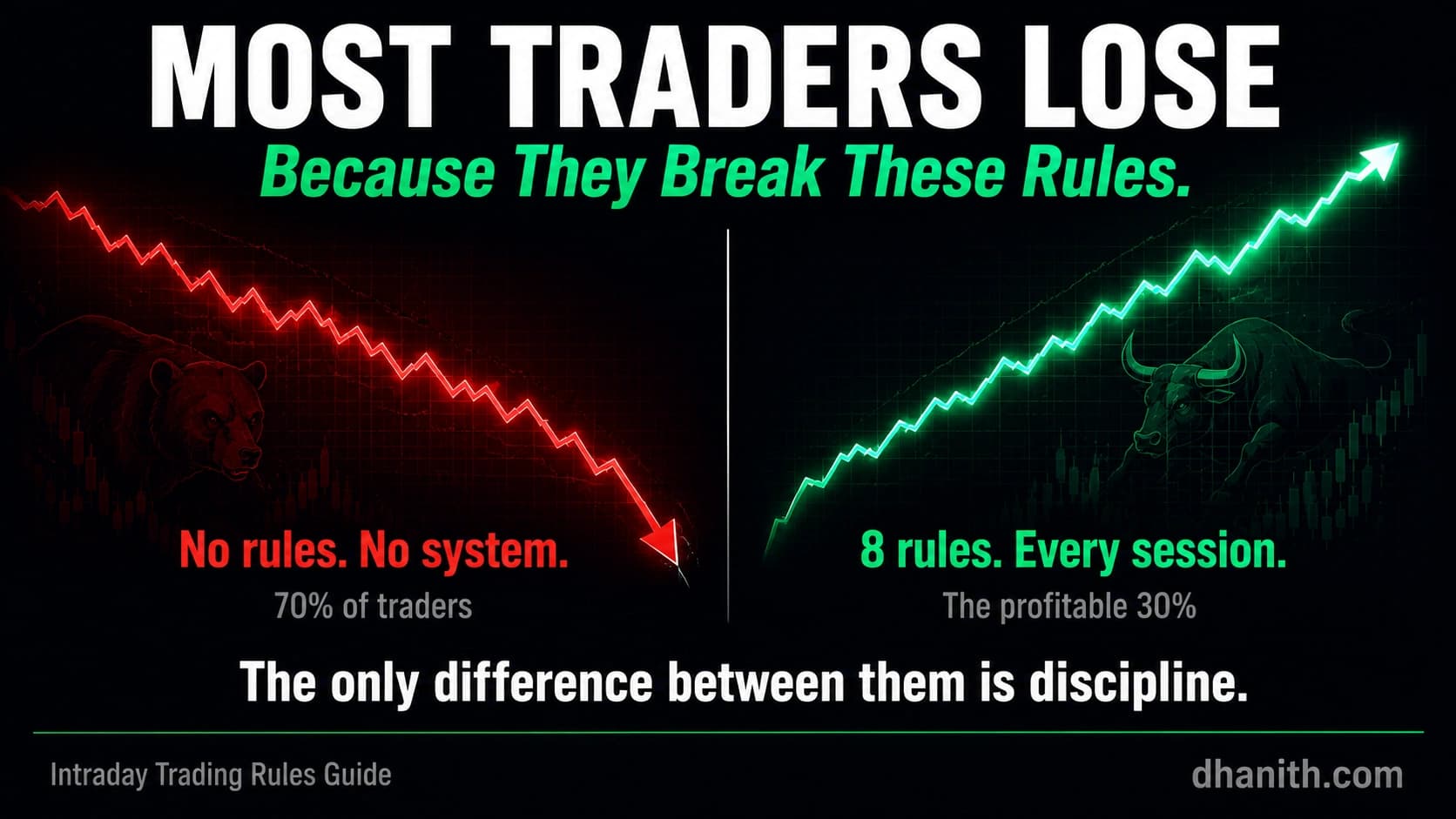
A SEBI study released in 2024 revealed a stark, uncomfortable truth: 7 out of 10 individual intraday traders in India lost money in the equity cash segment during FY23. For traders under 30, the loss rate was even higher — 76%.
That number is not an indictment of intraday trading. It is an indictment of underprepared intraday trading.
The traders who lost money were not unlucky. They were uneducated — trading without a defined strategy, without risk management, without understanding how Indian markets actually work, and without knowing the regulatory framework that governs every single trade they place on NSE and BSE.
The traders in the profitable 30% are not smarter. They simply know what this guide is about to teach you.
Intraday trading in India — buying and selling stocks within the same 9:15 AM to 3:30 PM session on NSE or BSE — is one of the most demanding and potentially rewarding forms of active market participation available to Indian retail traders. It offers daily opportunities to profit from price movements without overnight risk exposure. It provides leverage that magnifies both gains and losses. And it operates within a specific regulatory framework that, if misunderstood, will cost you money in charges, penalties, and missed positions.
This complete guide covers everything: how Indian intraday markets work, the SEBI rules you must know, the five most effective strategies for NSE intraday traders, a precise stock selection framework, the charges and tax treatment that affect your real profitability, and a full daily routine you can implement from tomorrow's session.
By the end, you will understand intraday trading in India at a depth that puts you solidly in the profitable minority.
TL;DR — Key Takeaways
- Indian intraday trading occurs between 9:15 AM and 3:30 PM on NSE and BSE; all positions must close by 3:30 PM or brokers auto square-off from ~3:20 PM
- SEBI mandates a 20% minimum margin (maximum 5x leverage) for intraday equity trades; VaR and Extreme Loss Margin must be maintained throughout the day
- Intraday profits are classified as speculative business income under Section 43(5) of the Income Tax Act — taxed at slab rates, not as capital gains
- STT on intraday equity trades is 0.025% on the sell side only; total charges (brokerage + STT + GST + exchange charges) typically run 0.05–0.10% per round trip
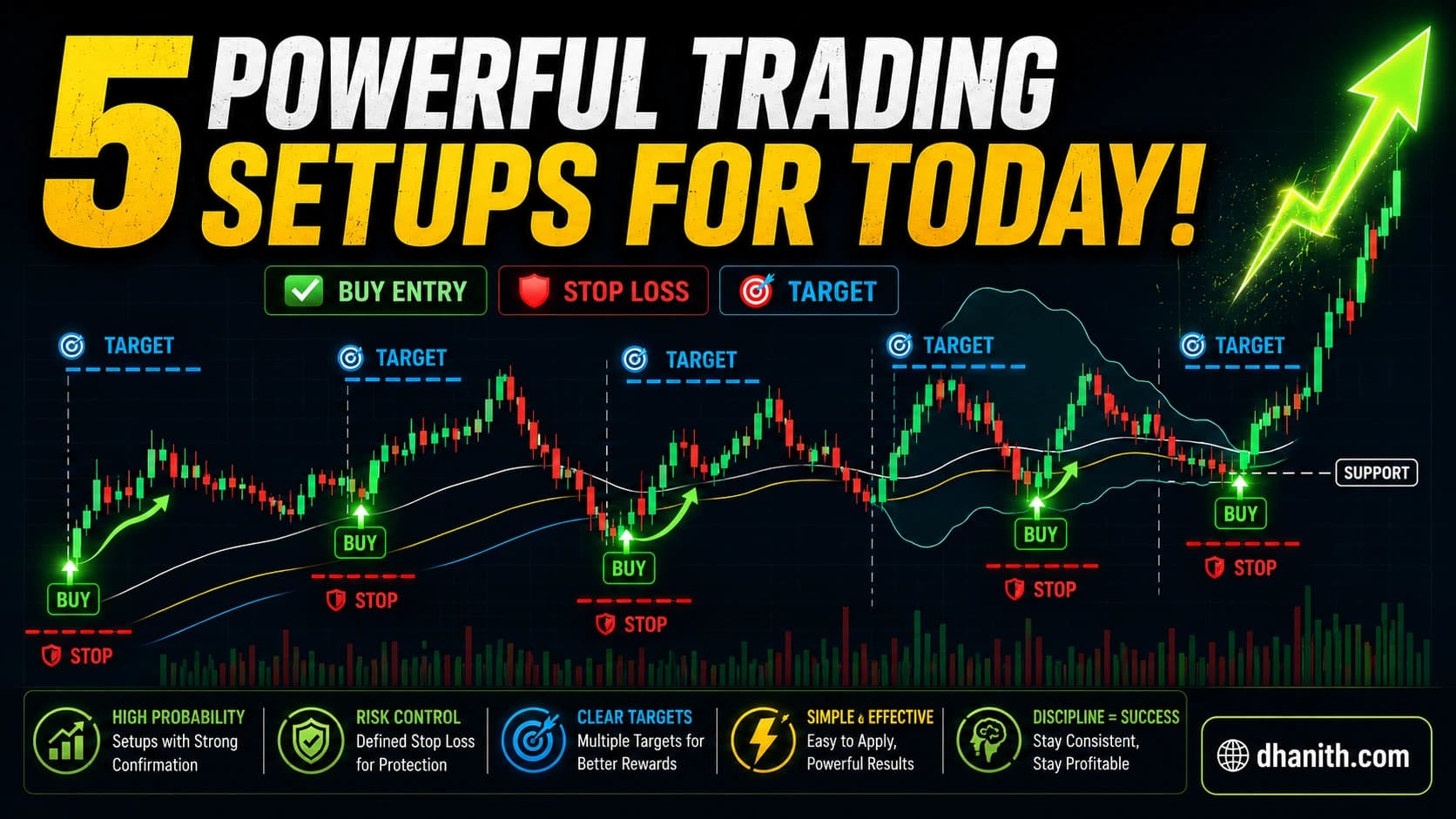
- The five most effective strategies for NSE intraday traders: Opening Range Breakout (ORB), VWAP bounce, momentum scalping, EMA crossover, and support/resistance reversal
- The highest-probability intraday window for Indian markets is 9:15–10:30 AM (first hour) and 2:30–3:20 PM (last hour)
- Stock selection fundamentals: minimum ₹500 crore daily turnover, Nifty 50 / Bank Nifty constituents preferred, active sector alignment mandatory
- A 50–60% win rate with a minimum 1:2 risk-reward ratio produces consistent profitability even if nearly half your trades lose
Part 1: How Indian Intraday Markets Work — The Foundation
The Two Exchanges — NSE and BSE
India has two primary stock exchanges where intraday trading occurs:
NSE (National Stock Exchange): The National Stock Exchange dominates derivatives and index trading volume in India. NSE is where the vast majority of intraday equity and derivatives volume concentrates. The benchmark Nifty 50 index — tracking the 50 largest Indian companies — is the primary reference point for intraday traders. Bank Nifty (12 banking sector stocks) is the most actively traded derivative instrument in the world by contract volume.
BSE (Bombay Stock Exchange): The world's oldest exchange, running parallel to NSE on identical timing. The BSE stock market timing becomes particularly relevant in SME listings and selective mid-cap counters where order depth varies. For large-cap intraday trading, NSE offers superior liquidity and tighter spreads in most cases.
Practical rule for intraday traders: Trade equities on NSE for most large-cap stocks. Check both NSE and BSE prices for mid-cap stocks to ensure you're executing at the better liquidity point.
Trading Session Structure
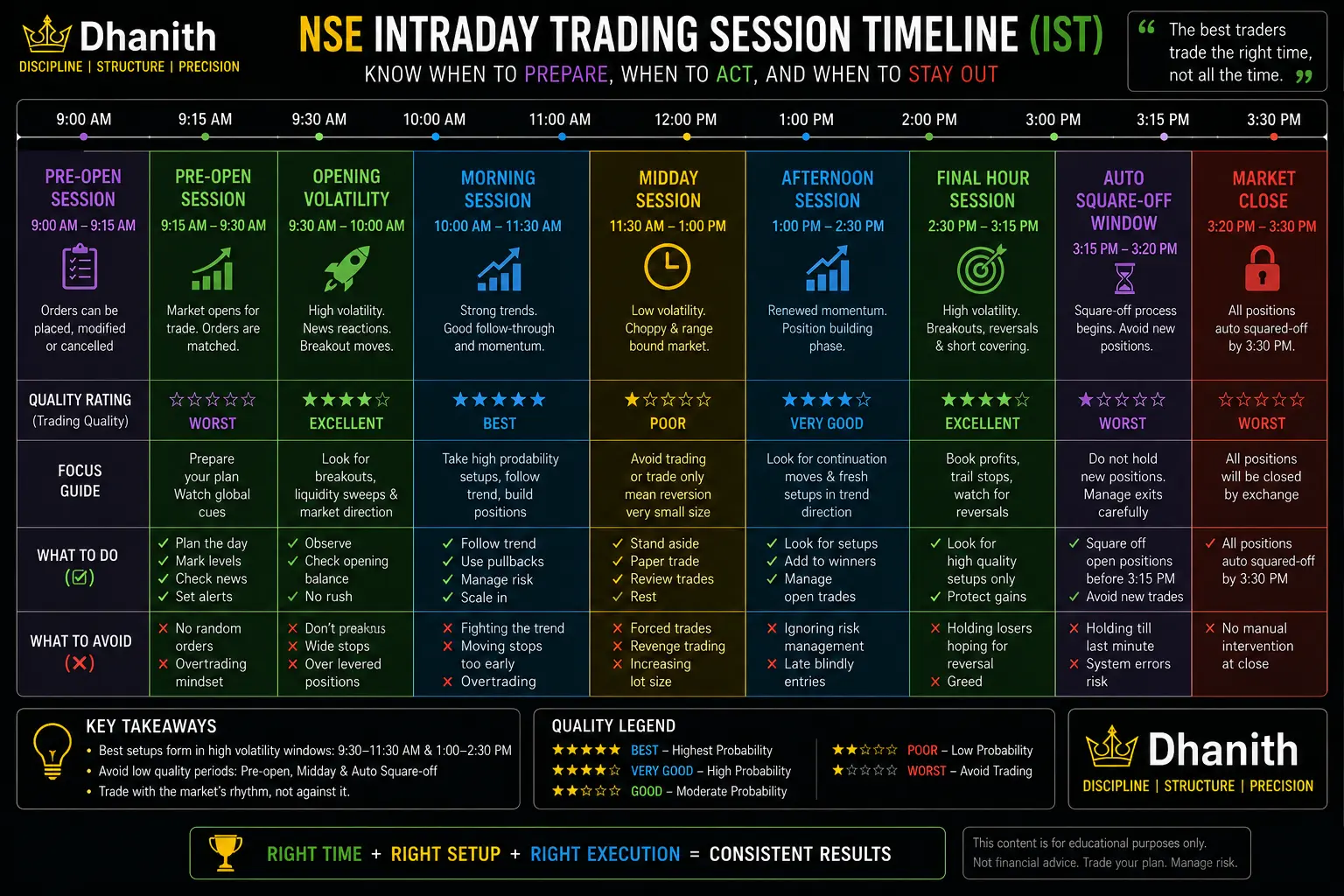
Indian stock markets operate from 9:15 AM to 3:30 PM on weekdays (Monday to Friday) for both NSE and BSE. A pre-opening session runs from 9:00 AM to 9:15 AM for price discovery.
The full daily schedule for intraday traders:
| Session | Time (IST) | What Happens |
|---|---|---|
| Pre-Open | 9:00 AM – 9:15 AM | Order collection and price discovery; no execution |
| Regular Session | 9:15 AM – 3:30 PM | Active intraday trading; all positions must close here |
| Auto Square-Off Window | ~3:20 PM – 3:30 PM | Brokers begin closing unclosed intraday positions |
| Post-Market Session | 3:40 PM – 4:00 PM | Closing price determination |
The pre-open session (9:00–9:15 AM) is critical for intraday traders. Use this time to observe where stocks are expected to open — the pre-open call auction determines the opening price. Significant gaps from the previous close reveal overnight sentiment and set up the day's first major strategy.
The Auto Square-Off Rule
The compulsory auto square off rule mandates brokers to automatically close all open intraday positions starting at 3:20 PM on NSE and BSE. This prevents overnight holdings and ensures T+1 settlement.
This rule has serious practical implications:
- If you forget to close a position or are unable to do so (connectivity issues, power failure), your broker will close it — potentially at a worse price than you would have chosen
- Square-off charges apply. Most brokers charge ₹20–₹50 per auto square-off trade as an additional penalty
- You cannot convert an intraday position to delivery at 3:25 PM to avoid a loss — the conversion requires full upfront payment and must be done well before 3:20 PM
The rule: Close your intraday positions by 3:15 PM at the latest. Never rely on the auto square-off — it executes at whatever price exists at that moment, which is frequently unfavorable.
Circuit Breakers and Price Bands
Circuit breakers halt trading for 45 minutes at a 10% index drop (Tier I), extend the halt for a 15% drop (Tier II), and close the market at 20% drop (Tier III) in indices. Stock-specific price bands range from 2% to 20%, applying static or dynamic limits, especially for futures and options.
Individual stock circuit filters are equally important. Circuit filter rationalization (10%/20% default for most NSE stocks) in early 2026 has narrowed intraday ranges on small-caps but kept large-cap intraday stocks fluid.
Practical implication: Never trade a stock that is close to its upper or lower circuit limit for intraday purposes. If the circuit hits while you hold an open position, you may be unable to exit until the circuit reopens — transforming an intraday trade into an involuntary overnight position with delivery margin requirements.
Part 2: SEBI Rules and Margin Requirements — What Every Intraday Trader Must Know
The 20% Margin Rule
Starting in 2020, SEBI mandates a 20% minimum margin of transaction value for intraday equity trades. This means maximum leverage is now 5x — if you have ₹10,000, you can take positions worth up to ₹50,000. VaR (Value at Risk) margin and Extreme Loss Margin must be collected upfront.
This is a significant shift from the pre-2020 era when brokers could offer 10x, 20x, or even higher intraday leverage. The SEBI tightening was driven by the catastrophic losses many retail traders suffered from excessive leverage during volatile sessions.
What this means for your capital planning:
| Your Capital | Maximum Position Size | Maximum Trade Value |
|---|---|---|
| ₹10,000 | ₹50,000 | ₹50,000 |
| ₹50,000 | ₹2,50,000 | ₹2,50,000 |
| ₹1,00,000 | ₹5,00,000 | ₹5,00,000 |
| ₹5,00,000 | ₹25,00,000 | ₹25,00,000 |
Warning: Never use the full 5x leverage on any single trade. Professional intraday traders in India use 2–3x leverage at most, keeping the remaining margin as a buffer against adverse moves. Using maximum leverage on every position is the fastest way to receive a margin call and have your positions forcibly closed at the worst possible prices.
Peak Margin Reporting
Markets take snapshots four times daily, including a critical window from 2:45 PM to 3:30 PM for position monitoring. Brokers must report their margin utilisation four times daily. Shortfalls attract penalties, ensuring you maintain adequate funds throughout the trading session.
What this means in practice: Your margin is checked at random intervals throughout the day, not just at the time of order placement. If your position moves against you and your margin falls below the required level between snapshots, you will receive a margin call — and if unmet, forced liquidation.
The margin buffer rule: Maintain at least 25–30% of your capital as a free buffer above the minimum margin requirement. This protects against intraday adverse moves triggering unwanted liquidations.
Institutional Restriction
Per SEBI circulars, institutional investors cannot execute intraday trades. All their transactions must be grossed at the custodian level, differentiating retail and institutional market participation.
This creates an important dynamic: the large institutional order flow that moves Indian markets comes predominantly from delivery-based transactions, not intraday trading. FII (Foreign Institutional Investor) and DII (Domestic Institutional Investor) activity creates the large price movements intraday traders attempt to capture — but those institutions themselves are not intraday traders.
Part 3: Intraday Charges in India — The Real Cost of Trading
Understanding the full cost of an intraday trade is critical. Many beginner traders calculate only the brokerage and miss three or four additional charge components that significantly affect net profitability.
The Complete Charge Structure
For an intraday equity trade on NSE, the following charges apply:
1. Brokerage: Most brokers charge either a small percentage of the trade value, around 0.01%–0.05%, or a flat amount per order, usually ₹20. Zerodha, Upstox, Angel One, and other discount brokers typically charge ₹20 per executed order (buy and sell separately).
2. Securities Transaction Tax (STT): Intraday equity trades are taxed at 0.025% on the sell side only. This is non-negotiable and cannot be deducted as a business expense.
3. GST: GST is charged at 18% on the brokerage paid for each trade. It doesn't apply to the trade value itself, but to the broker's fee.
4. Exchange Transaction Charges: Exchange transaction charges are fees collected by the stock exchanges for processing your trades. These vary by segment and exchange but are typically 0.00325% on NSE equity intraday.
5. SEBI Turnover Fee: A small regulatory fee on total turnover — ₹10 per crore of turnover.
6. Stamp Duty: 0.003% on the buy side only.
Real Cost Example
Trade: Buy and sell 100 shares of Reliance at ₹2,800 (Round trip value: ₹5,60,000)
| Charge | Calculation | Amount |
|---|---|---|
| Brokerage (buy) | ₹20 flat | ₹20 |
| Brokerage (sell) | ₹20 flat | ₹20 |
| STT (sell side only) | 0.025% × ₹2,80,000 | ₹70 |
| GST on brokerage | 18% × ₹40 | ₹7.20 |
| Exchange charges | ~0.00325% × ₹5,60,000 | ₹18.20 |
| Stamp duty | 0.003% × ₹2,80,000 | ₹8.40 |
| SEBI fee | Minimal | ~₹0.56 |
| Total charges | ~₹144.36 |
To break even on this trade, you need the stock to move at least 0.05% in your direction. For a ₹2,800 stock, that's approximately ₹1.40 per share before any profit is realized.
Pro Tip: Calculate your break-even move before every intraday trade. For small position sizes, charges can consume a disproportionate share of potential profits. This is why professional intraday traders in India focus on position sizes large enough that the fixed per-trade charges become a negligible percentage — and avoid high-frequency, small-profit trading without accounting for the cumulative charge burden.
Part 4: Intraday Tax Treatment in India — Speculative Business Income
The Fundamental Tax Classification
Under Section 43(5) of the Income Tax Act, intraday profits are classified as speculative business income, not capital gains.
This is the most misunderstood aspect of Indian intraday trading taxation. Many new traders incorrectly assume their intraday profits are treated as capital gains (short-term or long-term). They are not. Intraday trading income is speculative business income — taxed at your applicable income tax slab rate.
The key differences:
| Treatment | Capital Gains (Delivery) | Intraday (Speculative) |
|---|---|---|
| Classification | Capital asset | Business/speculative income |
| Tax rate | STCG: 20%, LTCG: 12.5% | Full slab rate (up to 30%) |
| Loss set-off | Against capital gains | Only against speculative income |
| Loss carry-forward | 8 years | 4 years only |
| ITR form required | ITR-2 | ITR-3 |
| Tax audit trigger | At higher thresholds | ₹10 crore turnover (digital) |
Calculating Intraday Turnover
For tax purposes, intraday trading turnover is calculated as the absolute sum of profits and losses — not the total transaction value.
If you made ₹10,000 profit on Trade 1 and ₹6,000 loss on Trade 2, your turnover is ₹10,000 + ₹6,000 = ₹16,000 — not ₹5 lakh of transaction value.
Tax audit under Section 44AB is compulsory for intraday traders whose business turnover exceeds ₹10 crore where 95% or more receipts/payments are digital. For most retail intraday traders, this threshold is not reached.
Allowable Deductions
You can deduct all legitimate business expenses from your intraday tax computation. The main allowable deductions are: Brokerage (the commission paid to your broker), and Securities Transaction Tax (STT).
Additional deductible expenses include:
- Internet connection charges used for trading
- Computer/laptop depreciation (proportionate to trading use)
- Trading software and data subscription costs
- Advisory fees paid to SEBI-registered advisors
- Electricity charges (proportionate)
Warning: STT paid on intraday equity trades is NOT deductible as a business expense from 2015 onwards. STT at 0.0025% on sell side remains non-deductible per Section 36(1)(ii) post-2015 amendment, treated as application of income. Many traders mistakenly deduct STT — this creates tax filing errors that attract scrutiny.
Advance Tax Obligation
If your intraday trading tax liability exceeds ₹10,000 in a financial year, you must pay advance tax. Failure to pay leads to interest charges under Sections 234B and 234C. Estimate your total tax liability for the year and pay it in four quarterly installments (June 15, September 15, December 15, and March 15).
Part 5: Stock Selection for Intraday Trading — The NSE Framework
The most common reason technically competent traders lose money intraday is poor stock selection. They apply the right strategy to the wrong stock — one with insufficient volume, unpredictable price behavior, or a price band that limits the move they were counting on.
The Five-Point Stock Selection Checklist
1. Minimum Daily Turnover: ₹500 Crore Stocks with daily turnover below ₹100–200 crore have wide bid-ask spreads, unpredictable price jumps, and insufficient liquidity to exit positions quickly. Banking (HDFC, ICICI, SBI, Kotak), metals (Tata Steel, JSW, Vedanta), auto (Tata Motors, M&M, Maruti), and high-beta infra (Adani Enterprises, Adani Ports) consistently deliver the best intraday stocks on the NSE. These sectors have the depth to absorb your entry and exit orders without significant slippage.
2. Nifty 50 and Bank Nifty Constituents — First Priority The 50 stocks in the Nifty 50 index are the most liquid equities on NSE. Index membership ensures continuous institutional order flow, tight spreads, and predictable technical behavior. Start your intraday career trading exclusively within this universe.
3. Sector Alignment Stocks in the leading sector of the day (defence, auto, banks — varies by regime) outperform others 2x on average. Pair your intraday stocks with sector momentum. Before every session, identify which sector the market is favoring based on overnight global cues, FII data, and pre-market futures movement. Trade the stocks within that sector — not against it.
4. Pre-Open Gap Screening Filter for stocks with greater than 0.5% pre-open gap up/down plus volume greater than 5x the 10-day average. A stock gapping up significantly on high volume has a catalyst — news, results, analyst upgrade, sector event — that creates genuine directional momentum for intraday exploitation.
5. Avoid News-Heavy Days for Complex Strategies On earnings announcement days, stocks can move 5–15% in seconds based on result quality relative to expectations. These moves are often unrepeatable and technical analysis becomes unreliable immediately post-announcement. Unless you are specifically trading earnings momentum with a defined system, avoid trading a stock on its results day.
The Pre-Open Analysis Sequence
Step 1 (8:45 AM): Check SGX Nifty (now GIFT Nifty) futures — this gives the expected Nifty opening level before 9:15 AM.
Step 2 (8:50 AM): Check pre-market prices on your broker platform. Identify stocks with pre-open prices significantly above or below the previous close.
Step 3 (9:00 AM): Note FII/DII provisional data from NSE website. Net FII buying > ₹1,000 crore = institutional tailwind for longs. Net FII selling = headwind.
Step 4 (9:00–9:15 AM): Mark the pre-open session high and low of your watchlist stocks. These are your opening reference levels.
Step 5 (9:15 AM): Market opens. Do NOT trade the first 5 minutes — observe which direction price moves, check if the opening move has volume confirmation, and let the initial volatility settle.
Dhanith Intraday Screener
Build your watchlist in 30 seconds.
Automatically scan NSE stocks by turnover, gap percentage, sector momentum, and volume — so your pre-market checklist is ready before 9:00 AM.
Part 6: The Five Best Intraday Trading Strategies for Indian Markets
Strategy 1 — Opening Range Breakout (ORB)
The Opening Range Breakout is one of the oldest and most consistently effective intraday strategies for Indian markets. The opening range is defined as the high and low of the first 15 minutes (or first 30 minutes) of trading.
Why ORB works on NSE: The first 15 minutes of Indian trading (9:15–9:30 AM) is the highest-volatility period of the day as the market absorbs overnight global cues, domestic news, and institutional repositioning. The range created during this period — the 9:15 AM candle high and low — concentrates the maximum information about the day's likely direction. A breakout above or below this range, confirmed by volume, signals the day's dominant direction.
Complete ORB Setup:
Step 1 — Mark the opening range: At 9:30 AM (after the first 15-minute candle closes), mark the high and low of that candle on your chart. This is the Opening Range.
Step 2 — Wait for the breakout:
- Bullish setup: Price breaks and closes a 5-minute candle above the Opening Range High (ORH)
- Bearish setup: Price breaks and closes a 5-minute candle below the Opening Range Low (ORL)
Step 3 — Volume confirmation: The breakout candle's volume must be at least 1.5x the volume of the first 15-minute candle. Low-volume breakouts of the ORB fail at a much higher rate.
Step 4 — Entry: Enter on the close of the breakout candle. Do not enter on a partial breach — wait for the candle to close beyond the ORH or ORL.
Step 5 — Stop loss: For longs: Stop loss below the ORH (or below the opening range midpoint for tighter risk). For shorts: Stop loss above the ORL.
Step 6 — Target: Project the Opening Range width from the breakout point. A 100-point opening range that breaks out targets the next 100 points in the breakout direction. Use previous intraday high or low as an additional target reference.
Minimum risk-reward: 1:2 only. If the distance from entry to stop is ₹20 and the distance from entry to target is less than ₹40, skip the trade.
Pro Tip: The ORB works best on days when GIFT Nifty is showing a directional gap of at least 0.3% before the open. On flat-opening days (GIFT Nifty within ±0.1%), the opening range is often narrow and choppy — the ORB produces more false signals on these sessions.
Strategy 2 — VWAP Bounce (Mean Reversion)
VWAP (Volume Weighted Average Price) is not just another line on a chart. It is the benchmark that institutional traders — mutual funds, FIIs, and proprietary desks — use to evaluate the quality of their intraday order execution.
VWAP calculates the average price at which a stock has traded throughout the day, weighted by volume at each price level. Prices above VWAP are considered expensive for the day; prices below VWAP are cheap. This institutional reference creates a magnetic effect — price regularly returns to VWAP, particularly in liquid stocks.
VWAP Bounce Setup (Bullish):
Setup conditions:
- Daily bias is bullish (pre-market gap up, positive GIFT Nifty, FII net buyer)
- Stock is in an uptrend on the daily chart
- Price pulls back from its morning high to approach VWAP from above
Entry trigger:
- Price touches or slightly dips below VWAP
- A bullish rejection candle (Hammer or Bullish Engulfing) forms at VWAP on the 5-minute chart
- Volume contracts during the pullback (confirming weak selling)
- Volume expands as the rejection candle forms (confirming institutional buying at VWAP)
Entry: At the close of the rejection candle at VWAP
Stop loss: Below VWAP for longs (5–10 points below on Nifty). For individual stocks, place stop below the low of the rejection candle with a 0.2% buffer.
Target: Previous intraday high. Minimum 1.5x risk-reward before taking the trade.
VWAP Bearish Bounce (Mirror): For bearish bias days, when price rallies from below VWAP back up to it — and forms a bearish rejection candle at VWAP — enter short with stop above the rejection candle's high and target the day's intraday low.
Warning: VWAP loses reliability in two scenarios: (1) during the first 30 minutes of trading when VWAP is not yet representative of the day's true volume distribution, and (2) on days with extreme, one-directional moves where price stays permanently above or below VWAP throughout the session. On these "trending days," VWAP bounce setups produce consistent losses. Identify trending days early (price making continuous new intraday highs or lows without VWAP contact) and avoid VWAP bounce entries.
Strategy 3 — EMA Crossover Momentum
The most common professional EMA setups are the 9 EMA / 21 EMA crossover for aggressive scalping and the 20 EMA / 50 EMA crossover for swing-style intraday positions held for 1–2 hours.
The 9/21 EMA Scalping Setup:
Timeframe: 5-minute chart
Setup rules:
- Both EMAs trending in same direction (both sloping up for longs, both sloping down for shorts)
- When the 9 EMA crosses above the 21 EMA on a 5-minute chart, it signals short-term bullish momentum — a potential long entry. When the 9 EMA crosses below the 21 EMA, it signals bearish momentum — a potential short entry.
- Cross must occur above VWAP (for longs) or below VWAP (for shorts)
- Volume should expand at the time of the cross
Entry: On the close of the crossover candle, or on the first pullback to the 9 EMA after the cross
Stop loss: Below the 21 EMA for longs; above the 21 EMA for shorts
Target: The next significant price level (previous swing high for longs, previous swing low for shorts)
The key is to only take crossover signals that align with the broader trend (use VWAP as the trend filter). Crossovers against the VWAP trend are low-probability and best avoided.
Strategy 4 — Support and Resistance Reversal
One of the cleanest intraday strategies for Indian markets — identifying significant intraday support and resistance levels and entering when price shows clear rejection from those levels.
Setup identification:
- Previous day's high (PDH) and previous day's low (PDL) are the most reliable S/R levels for intraday trading
- Round numbers (₹500, ₹1,000, ₹2,000, ₹5,000 etc.) on stock prices act as psychological magnets
- Pre-market highs and lows identified during the 9:00–9:15 AM session
Entry rules:
For bullish reversal at support:
- Price approaches a significant support level (PDL, round number, or pre-market low)
- A bullish candlestick pattern forms at the support level (Hammer, Bullish Engulfing, Dragonfly Doji)
- Volume contracts during the approach to support and expands on the reversal candle
- RSI below 40 on the 5-minute chart adds confirmation (oversold at support)
For bearish reversal at resistance:
- Price approaches a significant resistance level (PDH, round number, or pre-market high)
- A bearish candlestick pattern forms (Shooting Star, Bearish Engulfing, Gravestone Doji)
- Volume pattern: contracts on approach, expands on the rejection candle
- RSI above 60 on the 5-minute chart adds confirmation
Stop and target: Stop beyond the support or resistance level by 0.2–0.3% of the stock price. Target: the next significant level in the reversal direction. Minimum 1:2 risk-reward.
Strategy 5 — Momentum Scalping (First Hour)
Momentum scalping involves capturing small price movements in highly liquid stocks with strong directional momentum. In Indian markets, momentum scalping works best during the first hour (9:15 to 10:15 AM) and the last hour (2:30 to 3:30 PM) when trading activity and volatility are highest.
This strategy is designed for experienced traders comfortable with rapid decision-making and tight stop losses. It is not suitable for beginners.
Setup:
- Stock shows strong directional move in the first 15 minutes (first candle is a large bullish or bearish Marubozu)
- Volume is 3–5x the normal first-candle volume
- The move breaks a key pre-market level
Entry: On the first 5-minute pullback to the 9 EMA after the initial momentum candle. Enter in the direction of the initial momentum.
Stop: Below the pullback candle's low (for longs). Tight — 0.3–0.5% maximum.
Target: 0.5–1% from entry. Take profits quickly — momentum scalps are designed for 15–30 minute holds, not 2-hour positions.
The first-hour scalping rule: Only scalp in the first hour if the initial move was clear and volume-confirmed. Do not scalp during the 11:00 AM–2:00 PM "lull" when volumes drop and direction becomes choppy.
Part 7: The Highest-Probability Time Windows in Indian Markets
Not all minutes within the 9:15 AM–3:30 PM session are equal. Understanding which windows produce the clearest setups and which produce false signals is one of the most important insights in Indian intraday trading.
Session Quality Map
| Time Window | Quality | What Happens |
|---|---|---|
| 9:00–9:15 AM | Pre-market prep | Mark levels; observe, do NOT trade |
| 9:15–9:20 AM | Dangerous | Maximum opening volatility; avoid new positions |
| 9:20–10:30 AM | Highest quality | ORB, momentum scalping, VWAP setups — best window |
| 10:30 AM–11:30 AM | Good | Trend continuation plays; pullback entries |
| 11:30 AM–1:30 PM | Low quality | Lunch lull; choppy, false signals; reduce activity |
| 1:30 PM–2:30 PM | Medium | Market resumes direction after lunch |
| 2:30 PM–3:15 PM | Good | Strong volume return; support/resistance reversals |
| 3:15 PM–3:30 PM | Closing | Exit all positions; no new entries |
The First Hour (9:15–10:30 AM)
This is India's equivalent of the SMC "killzone" concept. Institutional activity is highest, volumes are strongest, and price movements are most directional. The Opening Range Breakout, VWAP setups, and momentum scalping strategies all work best within this window.
The first-candle rule: Never trade the 9:15 AM opening candle in real time. Watch it form. After it closes at 9:20 AM, the 5-minute chart gives you the first complete data point of the session. Use it to set your intraday reference levels — high, low, and volume — before executing any trade.
The Closing Hour (2:30–3:20 PM)
The last hour of Indian trading sees a volume surge as institutional desks close their positions, day traders exit their intraday positions, and F&O expiry dynamics (particularly on Tuesday for Nifty weekly options) create directional momentum.
Strong moves often occur in the final 45–60 minutes. Support/resistance reversal setups work particularly well in this window as clear levels are established from the day's earlier price action.
The 3:15 PM exit rule: Exit all intraday positions by 3:15 PM regardless of where they are relative to target or stop. This gives you 15 minutes of buffer before the auto square-off begins and prevents you from closing at unfavorable prices during the closing rush.
Part 8: Risk Management for Indian Intraday Traders
The Non-Negotiable Rules
Rule 1 — Maximum 1–2% risk per trade: If your trading capital is ₹2,00,000, the maximum you should lose on any single trade is ₹2,000–₹4,000. Calculate your position size from this rule, not from "how many shares look right."
Position size formula:
Position Size = Risk Amount ÷ Stop Loss Distance per Share

Example:
Capital: ₹2,00,000
Risk per trade: 1% = ₹2,000
Stock price: ₹1,500
Stop loss: ₹15 per share below entry (1% of stock price)
Position size: ₹2,000 ÷ ₹15 = 133 shares
Pro Tip: Skip the manual math — use the Dhanith Lot Size Calculator to instantly calculate your exact position size for any stock trade.
Rule 2 — Maximum 3 losses per day: If you take three consecutive losses, stop trading for the day. Do not attempt to recover. The market does not owe you recovery. Three consecutive losses signal either that your strategy is mismatched to the day's conditions or that you are trading with compromised judgment.
Rule 3 — Minimum 1:2 risk-reward on every trade: A 50–60% win rate is considered very good in intraday trading if risk-reward is managed properly. For example, if you risk ₹500 to make ₹1,000 (a 1:2 risk-reward ratio), you can remain profitable even if only half your trades succeed.
At 1:2 risk-reward with a 50% win rate: Win 5 trades at ₹1,000 each (₹5,000 profit), lose 5 trades at ₹500 each (₹2,500 loss). Net: ₹2,500 profit before charges. This is the mathematical foundation of sustainable intraday trading.
Rule 4 — Maximum daily loss limit (drawdown rule): Set a maximum daily loss of 3–5% of your trading capital. If that level is reached, the trading day is over — no exceptions. This rule prevents the catastrophic "revenge trading" sessions that can wipe out weeks of gains in a single bad day.
Part 9: Intraday Trading Tools — Platforms and Resources
Trading Platforms for Indian Intraday Traders
Zerodha Kite: India's largest retail broker by active clients. Flat ₹20 brokerage per order for intraday. Kite's charting is clean and fast, with 5-minute, 15-minute, and hourly charts. Free access to Varsity (Zerodha's educational library) for learning.
Upstox Pro: Strong charting capabilities with advanced order types. Competitive with Zerodha on charges. Excellent for traders who want more customization in their chart setup.
Angel One: Popular among active intraday traders for its SmartAPI and algo integration capabilities. Good for traders transitioning toward automated or semi-automated systems.
TradingView (Charting): While not a broker, TradingView is the most powerful charting platform available to Indian traders. The free plan supports multiple charts, and the paid plan adds real-time NSE data. Most serious intraday traders use TradingView for analysis and their broker's platform for execution.
Essential Daily Resources
GIFT Nifty Futures (Pre-market indicator): Available on NSE website or your broker's platform. The most reliable indicator of where Nifty will open.
NSE FII/DII Data: Published daily on NSE website. Net FII buying or selling is the single most important institutional flow indicator for Indian intraday traders.
India VIX: India's volatility index. VIX above 20 indicates high uncertainty — widen stop losses and reduce position sizes. VIX below 12 indicates low volatility — narrow ranges, tighter scalping targets.
Economic Calendar: RBI policy dates, major economic data releases (IIP, WPI, CPI), and US Fed meeting dates are all significant. Trade cautiously around these events.
Part 10: The Complete Daily Intraday Trading Routine
Before the Market Opens (8:30 AM – 9:15 AM)
8:30 AM — Global market check (10 minutes):
- SGX/GIFT Nifty: Direction and magnitude of gap
- Dow Jones, NASDAQ overnight performance
- Crude oil, gold prices (relevant for energy and metal stocks)
- US Dollar/INR rate (affects IT and export stocks)
8:45 AM — Indian market-specific prep (15 minutes):
- Download FII/DII provisional data from NSE
- Check top gainers and losers in pre-market
- Review any major corporate news (results, SEBI orders, management announcements)
- Check India VIX level and trend
9:00 AM — Watchlist finalization (15 minutes):
- Select 3–5 stocks from your sector-aligned watchlist with pre-open prices showing significant gaps
- Mark the pre-market high and low for each
- Identify which strategy applies to each stock (ORB candidate, VWAP candidate, support/resistance candidate)
9:00–9:15 AM — Pre-open observation:
- Watch the pre-open call auction for your watchlist stocks
- Note where stocks are "calling" relative to previous close
- Do not place orders yet
The Trading Session (9:15 AM – 3:15 PM)
9:15–9:20 AM (5 minutes): Watch the open. Do not trade. Observe direction and volume of the opening.
9:20–9:30 AM (10 minutes): Allow the first 15-minute candle to complete. Mark the ORH and ORL on your chart.
9:30–10:30 AM (Primary execution window):
- Execute ORB setups if the breakout occurs with volume confirmation
- Execute VWAP bounce setups as they develop
- Apply strict position sizing rules before every entry
10:30 AM–11:30 AM:
- Continue monitoring active positions
- Look for second-wave setups in trending stocks
- Reduce new entries as volume begins to fade
11:30 AM–1:30 PM (Lunch lull):
- Manage existing positions only
- No new positions in this window
- Review morning trades, note what worked and what didn't
1:30 PM–2:30 PM:
- Market resumes direction
- Look for afternoon breakout or reversal setups
- Apply the same filters as the morning — volume confirmation is essential
2:30 PM–3:15 PM (Second execution window):
- Support/resistance reversal setups
- Position exits for morning trades approaching targets
- Final opportunity window before 3:15 PM cutoff
3:15 PM — Close all positions. No exceptions.
After the Market Closes (3:30 PM – 5:00 PM)
Trade journal entry (30 minutes): Record every trade taken and every setup that triggered without you entering:
- Entry price, exit price, stop, target
- P&L (gross and net of charges)
- Whether you followed your rules (yes/no)
- What you would do differently
Chart review (20 minutes): Look at each watchlist stock's daily candle. What pattern formed? What does it suggest about tomorrow's setup? Mark any new support and resistance levels that formed during the session.
Market prep for tomorrow (10 minutes): Note any results announcements, economic data, or events scheduled for the next session. Update your watchlist based on the day's sectoral performance.
Dhanith Trading Journal
Track every trade. Find your real edge.
Log your setups, grade your entries, and review your trading patterns — all in one place. The journal built for serious SMC traders.
Part 11: Common Intraday Trading Mistakes in India — And How to Fix Them
Mistake 1 — Trading the First 5 Minutes
Entering the first trade at 9:15 AM, immediately after market open, based on the first tick. The opening 5 minutes is the most manipulated, volatile, and unpredictable period of the Indian session as large institutional orders flood in simultaneously.
The fix: Never enter a trade before 9:20 AM. Let the first 5-minute candle complete. Observe. Use the opening movement to understand the day's bias — not to execute your first trade.
Mistake 2 — Trading Without a Daily Bias
Taking long trades and short trades randomly throughout the day based on whatever looks "good" on the chart without first establishing whether the broader market is bullish or bearish that day.
The fix: Before 9:15 AM, determine the day's bias from GIFT Nifty, FII data, and sector movement. In a clearly bearish day (GIFT Nifty down 0.5%+, FII net sellers), only look for short setups. In a clearly bullish day, only look for long setups. On ambiguous days, trade only the ORB and wait for clear direction.
Mistake 3 — Averaging Down on Losing Intraday Positions
Buying more shares of a stock that is moving against you intraday, hoping the price will recover. This converts a controlled 1% risk trade into an uncontrolled, potentially unlimited loss.
The fix: Never average down on intraday positions. If your stop is hit — exit. The intraday clock is working against recovery: even if the stock recovers over 3 days, you'll be forced out at 3:20 PM today at a worse price.
Mistake 4 — Ignoring Charges in Small-Capital Trading
Trading with ₹10,000 capital and taking 10 round-trip trades in a day. At ₹40 per round trip in brokerage alone, plus STT, GST, and exchange charges, the charge burden on small capital can consume 5–8% of the capital in charges before a single profitable trade is counted.
The fix: Calculate your all-in charges as a percentage of capital before starting. With ₹10,000, focus on 1–2 high-conviction trades per day maximum. With small capital, frequency is your enemy and selectivity is your friend.
Mistake 5 — Trading Without a Stop Loss
The most expensive mistake in Indian intraday trading. "The stock will recover" thinking that converts a 1% loss into a 5–8% loss as the stock hits lower circuits or the broker auto square-off executes at the worst point.
The fix: Set your stop loss as a working order at the time of entry — not as a mental note. Indian broker platforms (Zerodha, Upstox, Angel One) all support stop-loss orders at order placement. Use them every single time.
Mistake 6 — Over-Leveraging on a Single Stock
Using full 5x leverage on a single position, then having the stock move 2% against you — resulting in a 10% capital loss on one trade.
The fix: Never use more than 2–3x leverage on any single intraday position. Distribute your intraday trades across the session rather than concentrating all leverage on one "sure thing."
Mistake 7 — Chasing Stocks After They've Already Moved
Seeing Reliance Industries up 2% at 10:30 AM and buying it hoping the momentum continues — missing the first move and entering at an extended price with wide stop-loss requirements.
The fix: If you missed the entry, you missed the trade. Do not chase. The next setup is coming. Define your entry criteria before the market opens and only execute trades that meet those criteria. A stock that "looks like it's going to keep running" is a feeling — it is not an entry signal.
FAQ
Q: How much capital do I need to start intraday trading in India? You can technically start with as little as ₹5,000, but this is not practical due to the charge burden. With ₹5,000, a single round-trip trade's charges (₹150–₹200) represent 3–4% of capital before any profit or loss is counted. A more realistic starting capital for meaningful intraday trading in India is ₹50,000–₹1,00,000, which allows proper position sizing, adequate margin buffer, and meaningful profit potential relative to charges.
Q: Which is the best intraday trading strategy for Indian markets? The Opening Range Breakout (ORB) is the most consistently effective strategy for Indian markets across different market conditions. It works on Nifty 50 stocks during trending days, requires only one decision point (the 9:30 AM breakout), and provides clear, objective entry and stop-loss levels. VWAP bounce is equally effective for mean-reversion days. The best approach: learn both and apply whichever fits the day's character (trending or range-bound).
Q: What time is best for intraday trading in India? The two highest-probability windows are 9:20–10:30 AM (post-opening, high volume) and 2:30–3:15 PM (closing hour, volume surge). The 11:30 AM–1:30 PM lunch period is the worst window — choppy price action, low volume, and high false signal rate. Most professional Indian intraday traders concentrate 80% of their activity within the first 75 minutes of the session.
Q: How is intraday trading income taxed in India? Intraday trading profits are classified as speculative business income under Section 43(5) of the Income Tax Act and taxed at your applicable income tax slab rate — not as capital gains. This means if you are in the 30% tax bracket, your intraday profits are taxed at 30%. You must file ITR-3, and speculative losses can only be carried forward for 4 years and set off only against speculative income.
Q: What are the SEBI rules for intraday margin in India? SEBI mandates a minimum 20% margin for intraday equity trades, limiting maximum leverage to 5x. VaR margin and Extreme Loss Margin must be maintained throughout the day. Brokers report margin utilisation four times daily, and shortfalls attract penalties. All intraday positions must be closed by 3:30 PM — brokers begin auto square-off from approximately 3:20 PM.
Q: Which stocks are best for intraday trading in NSE? Nifty 50 and Bank Nifty constituents are the best starting universe. Among specific stocks, Reliance Industries (highest turnover), HDFC Bank, ICICI Bank, Tata Steel, Infosys, and Adani Enterprises consistently provide sufficient liquidity, tight spreads, and adequate intraday ranges for profitable trading. Avoid stocks below ₹100 crore daily turnover, stocks near circuit limits, and stocks on results day unless you have a specific results-trading system.
Q: Can I make a living from intraday trading in India? Yes, but the odds are strongly against beginners. SEBI data shows 70% of intraday traders lose money. The traders who earn a living from intraday trading typically have: minimum 2 years of paper trading or small-capital experience, a strictly defined system with backtested rules, ₹5–10 lakh in trading capital (to make meaningful returns at 1–2% monthly after charges and taxes), and psychological discipline that prevents revenge trading and overtrading. Approach intraday trading as a business with proper capital, education, and risk management — not as a shortcut to quick money.
Conclusion
Intraday trading in India is not a lottery. It is a skill — one that takes months to develop and years to master. The traders in the profitable 30% are not lucky. They understand the rules, apply a defined strategy, manage their risk per trade, and show up every day with a written plan rather than a hope.
The three principles that separate profitable Indian intraday traders from the losing majority:
1. Strategy before stock. Know exactly which strategy you are applying before you open a chart. ORB? VWAP bounce? Support reversal? The strategy dictates which stocks to watch and what conditions trigger an entry. Without a defined strategy, you are reacting to noise.
2. Risk management is not optional. The 1–2% risk per trade, the maximum 3 losses per day rule, the mandatory 3:15 PM exit — these are not suggestions. They are the structural difference between a trader who survives long enough to become profitable and one who blows their account in the first month.
3. The charges are real costs. Factor them into every trade. Calculate your break-even move before entering. Trade large enough positions that charges are a small fraction of the potential profit, and selectively enough that charges don't accumulate into a significant daily drag.
Start small. Trade one strategy consistently for at least 30 sessions before evaluating it. Keep a journal. And treat every losing trade as tuition paid toward the skill that will eventually make you profitable.
Next, read: [Opening Range Breakout (ORB) Strategy: The Complete NSE Trading Guide →] Related: [How to Select Stocks for Intraday Trading in India →] | [Intraday Trading Tax in India: Complete Guide →]
Further reading: Intraday Trading Rules You Must Follow | How Much Capital Is Required for Intraday Trading? | How to Become a Successful Intraday Trader | RSI Trading Strategy: Complete Guide | Support and Resistance: The Complete Trading Guide | Volume Analysis Trading Strategy | Bollinger Bands Trading Strategy | Important Candlestick Patterns: The Complete Guide | Dhanith Intraday Screener | Technical Analysis Mastery: The Complete Guide | Smart Money Concepts: The Complete Mastery Guide | SMC Killzones: The Complete Trading Guide | Hammer Candlestick Pattern: Complete Trading Guide | Bullish Engulfing Pattern: Complete Trading Guide | Morning Star Candlestick Pattern: Complete Trading Guide | 5 Best Intraday Trading Strategies for NSE India
Disclaimer: This article is for educational purposes only and does not constitute financial or investment advice. Intraday trading in stocks involves significant risk of capital loss. Past performance does not guarantee future results. Please consult a SEBI-registered financial advisor before making trading decisions. Investments in securities markets are subject to market risk — please read all related documents carefully before investing.
Have a question about this article?
Comment on our latest Instagram post or send us a DM — we reply to every one.
@dhanith_officialWas this article helpful?
Click to rate
Founder, Dhanith Trading
7+ years trading Nifty, Bank Nifty, NSE stocks, and commodities — specializing in Smart Money Concepts (SMC) and ICT price action. Founder of Dhanith — a trading journal, intraday screener, and risk tools platform built for retail traders.
Dhanith Newsletter
Enjoyed this article? Get more like it.
New trading guides, candlestick patterns, SMC strategies, and tool updates — straight to your inbox. Free, for Indian traders.
No spam. Unsubscribe anytime.
Continue Reading