On this page
- What Does "Successful" Actually Mean in Intraday Trading?
- Step 1: Commit to Learning Before Earning
- Step 2: Master One Setup — Trade Nothing Else
- Step 3: Define Your Risk Before Every Trade — Without Exception
- Step 4: Develop a Pre-Market Routine and Execute It Daily
- Step 5: Keep a Trading Journal — Review It Weekly, Not Just When You Feel Like It
- Step 6: Control Emotions by Building a System That Controls Itself
- Step 7: Treat Trading as a Business — Not a Casino
- The Qualities Every Successful Intraday Trader Shares
- The Honest Answer: How Long Does It Actually Take?
- Final Thought
- FAQ
- Related Articles
Learn how to become a successful intraday trader — strategy, risk management, psychology, and the realistic timeline. Real examples included throughout.
Most people who try intraday trading fail. Not because the markets are impossible to navigate, but because they approach trading the way they approach a lottery ticket — hoping for a big result from a random action with no structured process behind it.
A regulator study estimates that up to 70% of intraday traders incur losses. The 30% who do not lose money — and the smaller percentage who are genuinely consistently profitable — are not fundamentally smarter or luckier than those who fail. They do specific things differently. Consistently. Session after session.
This guide covers what those things actually are — with real trader scenarios, concrete examples, and an honest look at what the learning curve actually looks like. Not a list of generic tips. A structured framework for becoming the kind of intraday trader who survives long enough to become profitable.
Disclaimer: This article is for educational purposes only. Intraday trading involves substantial risk of capital loss. Past performance of any strategy is not indicative of future results. Always use stop losses and practice proper risk management before trading with real capital.
What Does "Successful" Actually Mean in Intraday Trading?
Before anything else, define what success means — because most new traders define it in a way that guarantees failure.
Common wrong definition: Making money every day.
Realistic definition: Generating positive returns over a meaningful sample of trades (100+) with a defined strategy and consistent risk management — while surviving the losing periods in between.
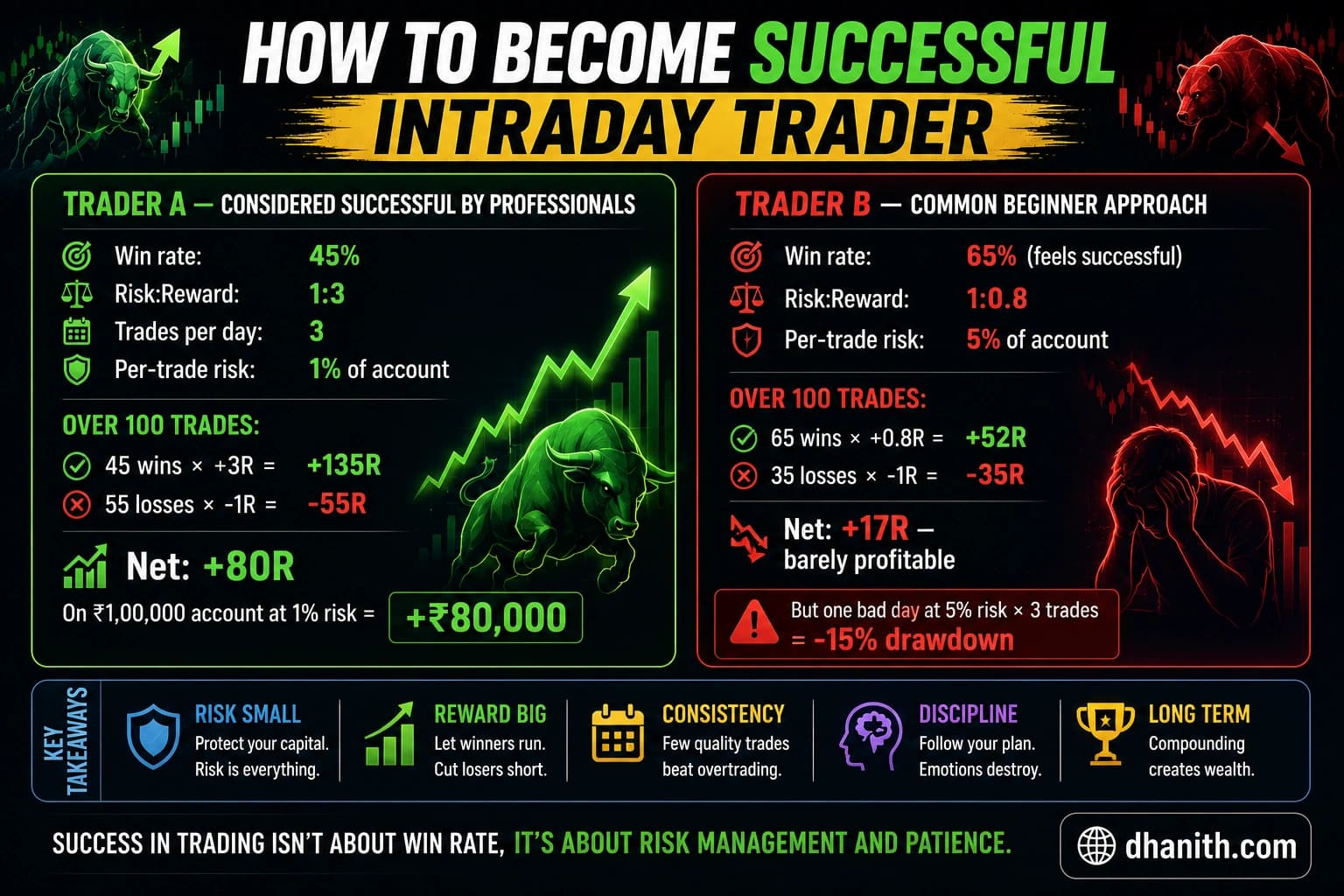
Here is what successful actually looks like in numbers:
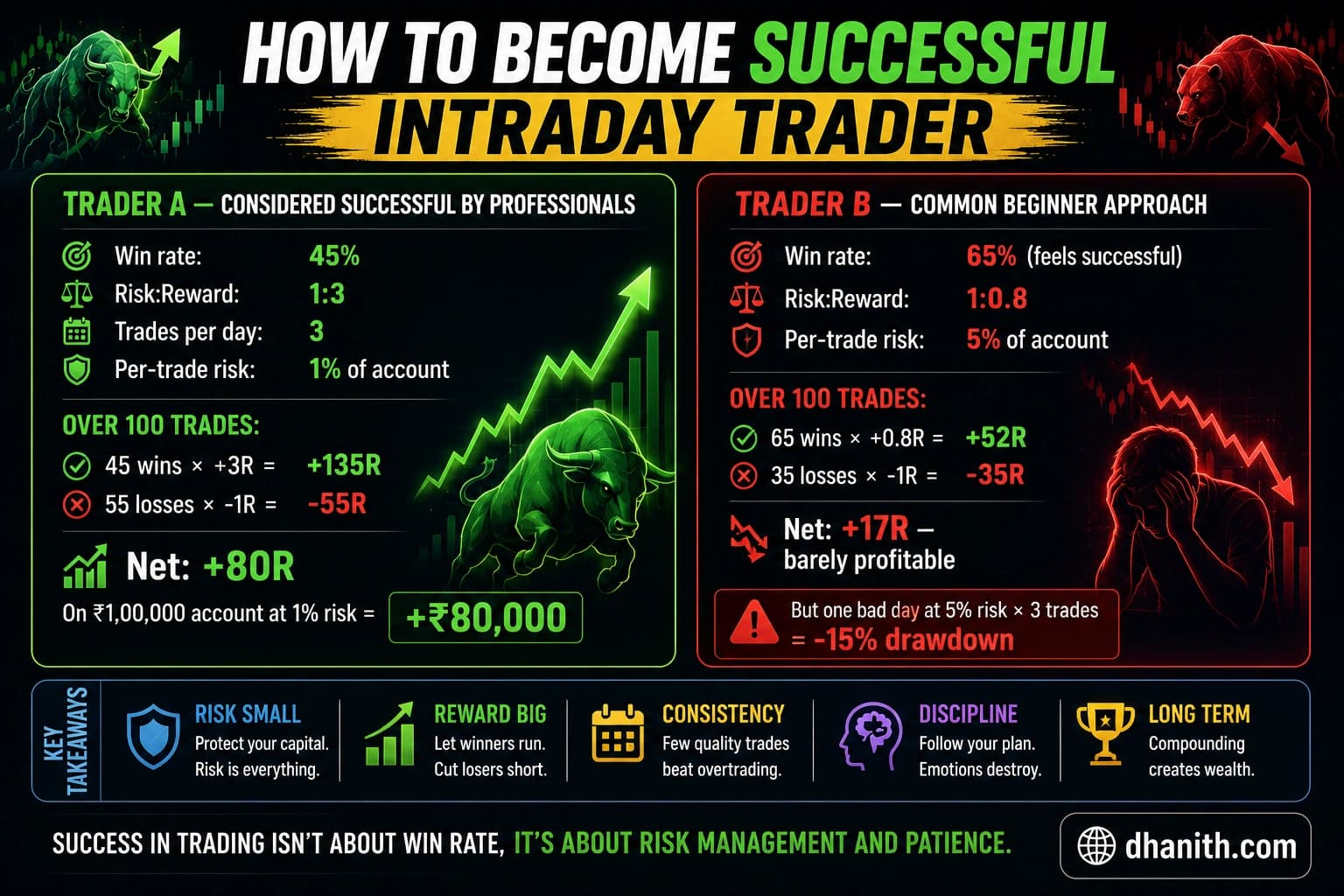
Trader A wins fewer trades but is significantly more profitable and more psychologically stable. Trader B wins more often but makes less money and is one bad session away from a major account drawdown.
Success in intraday trading is not about win rate. It is about expectancy — the mathematical edge your strategy produces over a large sample of trades.
Step 1: Commit to Learning Before Earning
Nothing can happen overnight since intraday trading is not a place to get wealthy fast. To succeed in intraday trading, one must work hard and invest a lot of time.
The most honest thing about successful intraday traders is that almost none of them were profitable in their first three to six months. Most had at least one period where they lost a meaningful amount of capital and had to start again — this time with humility and structure replacing overconfidence.
The realistic learning curve timeline:
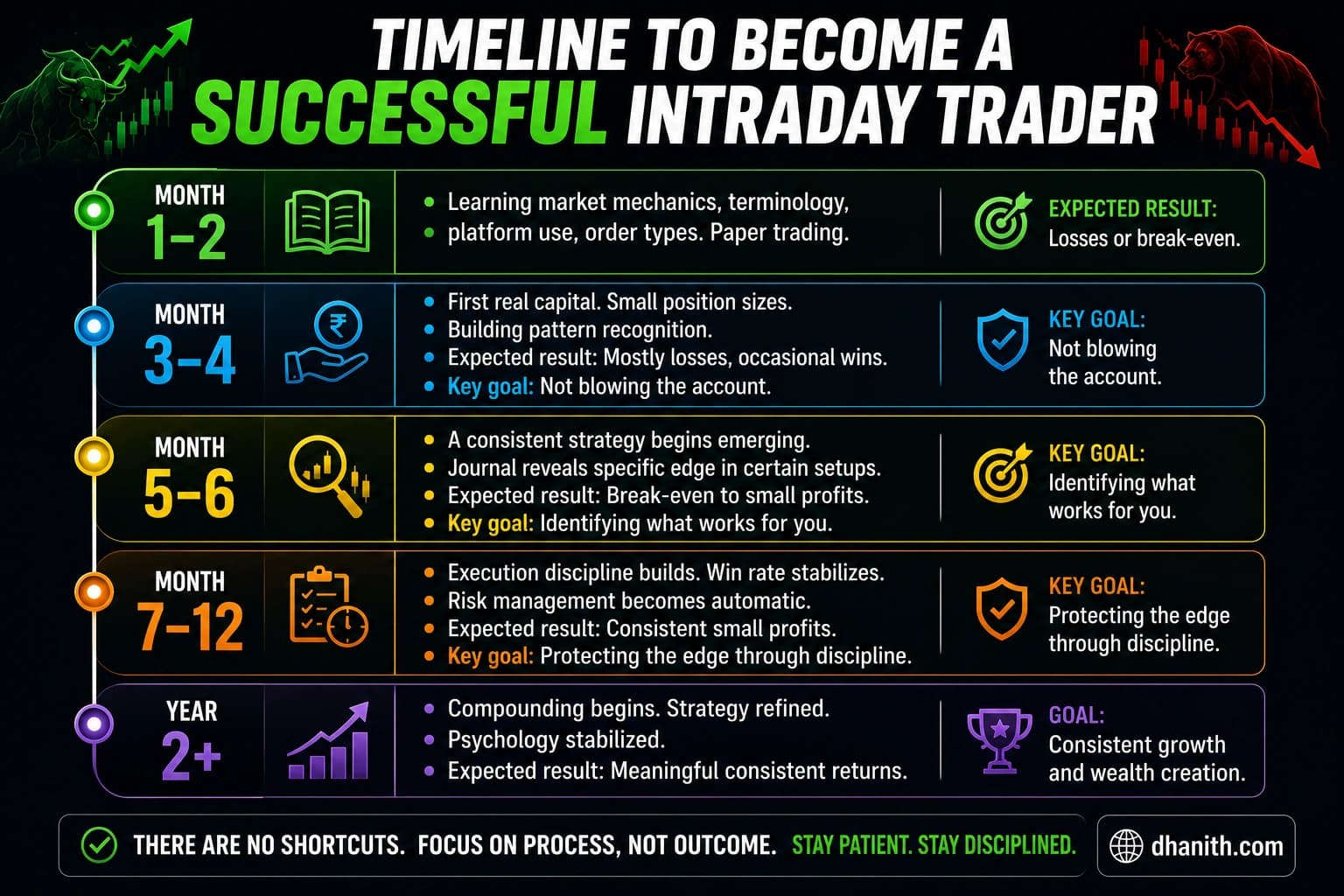
The traders who skip this curve — who jump to large capital and aggressive sizing in month one — almost universally blow their accounts and quit. The traders who respect the curve build something that lasts.
Example:
A trader named Rohan started with ₹4,00,000 in month one. Lost ₹1,20,000 in the first three weeks chasing momentum trades with no defined stop. Rebuilt with ₹3,80,000, started paper trading for 30 days, then returned with strict 1% risk per trade. By month eight, his account was back to ₹4,00,000 and growing. By month fourteen, it was ₹7,60,000. The six-week paper trading period felt like wasted time. It was actually the most valuable six weeks of his trading education.
Step 2: Master One Setup — Trade Nothing Else
Successful strategies are those that take as much emotion out of trading as possible.
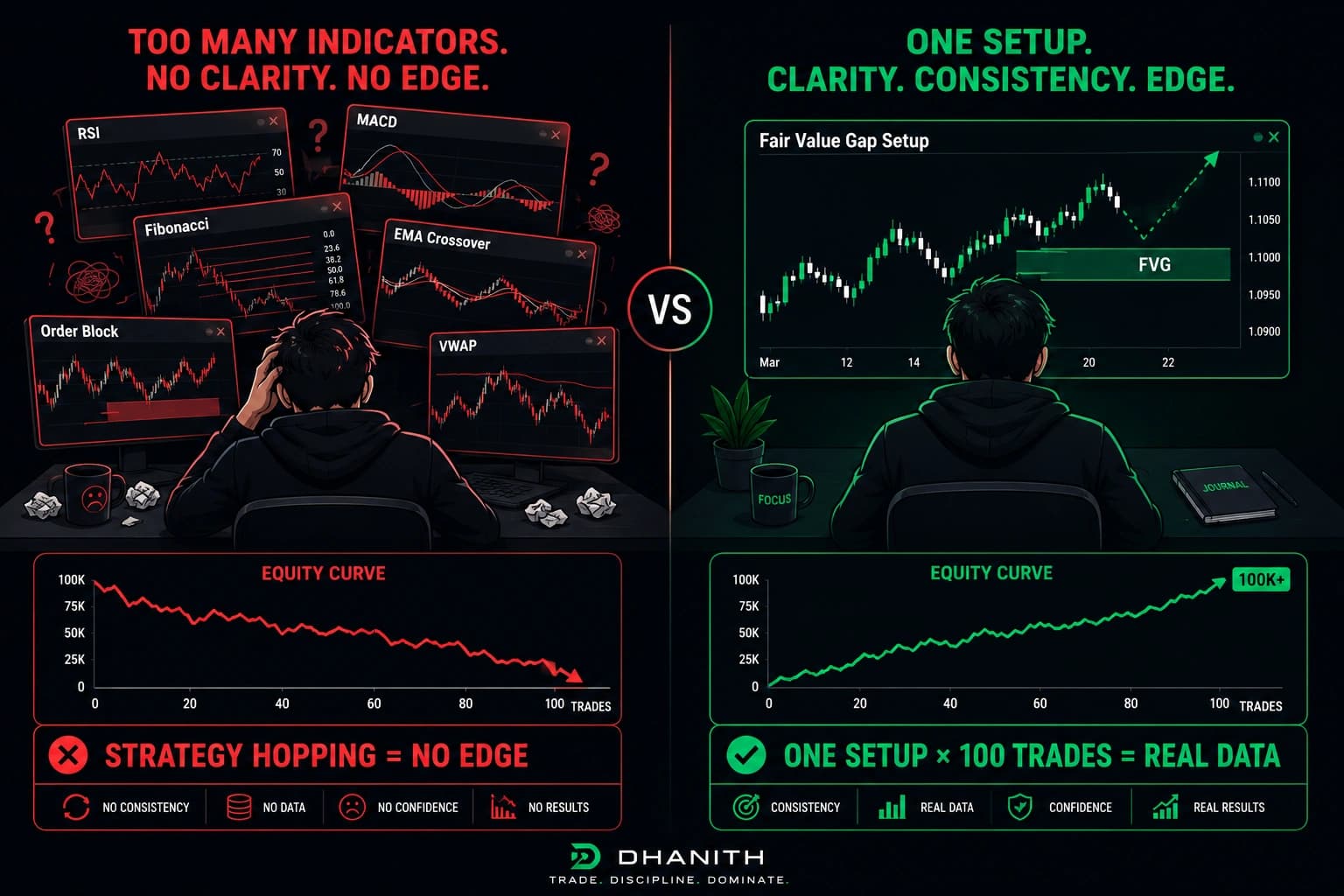
The single habit that separates traders who improve from traders who plateau indefinitely is this: they trade one specific setup, deeply, until they know every condition under which it works and every condition under which it fails.
Not five setups. One.
Why one setup works better:
When you trade five different setups, your data after 100 trades tells you very little — because each setup only has 20 samples, which is not statistically significant. You cannot tell if the setup has an edge or if you just ran lucky for 20 trades.
When you trade one setup for 100 trades, you know:
- The actual win rate (not hoped-for, actual)
- Which market conditions it works in
- Which market conditions it fails in
- The average R multiple per winning trade
- Your personal execution edge within the setup
Example of setup mastery:
A trader chose Opening Range Breakout as her only setup for four months. She initially had a 38% win rate and was frustrated. Her journal revealed she was entering ORB breakouts in the middle of the session — around 11:30 AM — where the opening range had long since dissolved and the "breakout" was just random noise. When she restricted ORB entries to before 10:15 AM only, her win rate jumped to 58% on that subset of trades. She found her edge inside her own data. That only happened because she had enough trades on one setup to see the pattern.
Step 3: Define Your Risk Before Every Trade — Without Exception
Successful intraday traders never get into a trading position without defining the maximum loss on the trade.
Risk management is not a rule you follow when you remember to. It is the pre-condition for every trade existing in the first place. If you do not know:
- Where your stop loss is (the specific price, not "I'll see how it feels")
- How many units you are trading (based on position sizing, not intuition)
- What your maximum rupee loss on this trade is
...then you are not ready to take the trade.
For the complete list of non-negotiable execution rules — stop loss placement, minimum R:R, trade limits, and margin discipline — see Intraday Trading Rules You Must Follow.
Position sizing example:
Account:        ₹2,00,000
Risk per trade: 1% = ₹2,000

Stock: HDFC Bank
Entry:      ₹1,650
Stop:       ₹1,630
Risk/share: ₹20

Position size:  ₹2,000 ÷ ₹20 = 100 shares
Position value: 100 × ₹1,650 = ₹1,65,000

Maximum loss:  100 × ₹20 = ₹2,000 (exactly 1%) ✓
This calculation happens before the trade is entered — not after. The numbers are committed to before emotions are involved. Once you are in a losing trade and watching the position move against you, your brain starts rationalizing why the stop should be moved. If the position size and stop are locked in before entry, the decision is already made. There is nothing to rationalize.
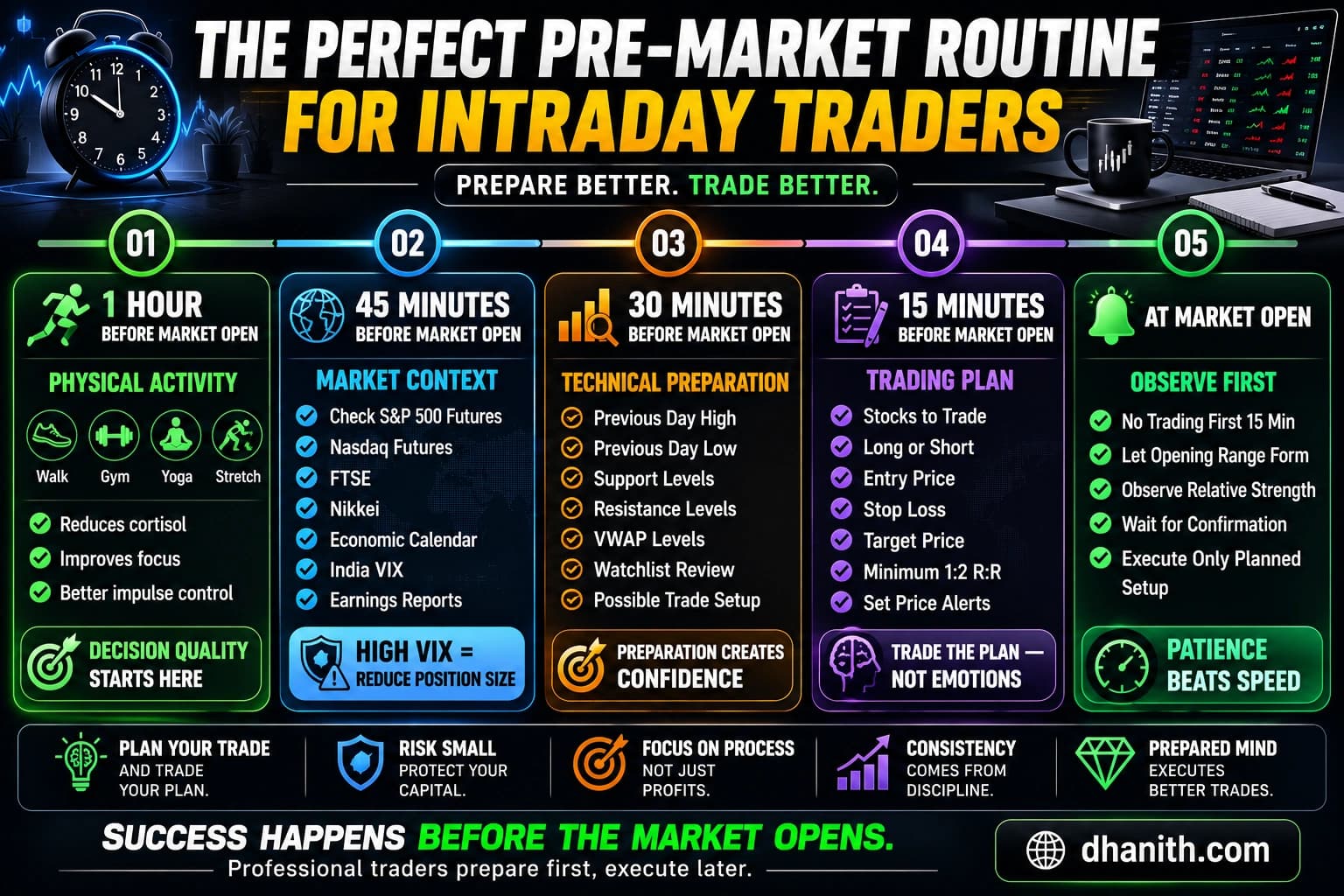
Step 4: Develop a Pre-Market Routine and Execute It Daily
A professional intraday trader must regard trading as a full-time career rather than a part-time hobby. You should set a timer for waking up, finishing breakfast, and planning daily trades.
The difference between a professional trader and an amateur is visible before the market even opens. The professional has a routine that prepares them technically, informationally, and psychologically for the session. The amateur opens their charts at 9:28 AM and starts looking for something to trade.
A practical pre-market routine:
Example of routine impact:
Two traders, same strategy. Trader A arrives at his desk at 9:14 AM, scans charts quickly, and starts trading at 9:20 AM. Trader B finishes his routine at 9:10 AM, has his alerts set, his plan written, and his position sizes calculated. On any given month, Trader A takes more trades and makes more impulsive decisions. Trader B takes fewer trades and follows his plan more consistently. Over six months, Trader B's results are materially better despite using the identical strategy — because the routine reduces impulsive decision-making.
Step 5: Keep a Trading Journal — Review It Weekly, Not Just When You Feel Like It
Successful intraday traders do make mistakes — and in fact a lot of them. The difference is that they learn from their mistakes and do not repeat them.
The trading journal is the mechanism that converts experience into improvement. Without it, you repeat the same errors for months without realizing it. With it, patterns in your behavior become visible within weeks.
What every journal entry must capture:
Date and time
Instrument traded
Setup name (be specific — "ORB" not "momentum")
Entry price, stop price, target price
Position size (units and total value)
Actual exit price (may differ from target)
R:R planned vs R:R realized
Emotional state at entry (1 word: calm, rushed, FOMO, confident)
Did you follow your rules? Yes / No
If No — which rule did you break?
One lesson from this trade
What the weekly review reveals:
A trader reviewed her journal after 8 weeks and found:
- Her win rate on trades entered before 10:00 AM: 61%
- Her win rate on trades entered after 11:30 AM: 28%
- Every trade where she logged "rushed" as her emotional state: 6 wins, 19 losses
- Trades where she logged "calm": 31 wins, 18 losses
None of this was visible without the journal. With it, the improvement path was obvious: only trade before 10:00 AM, and if you feel rushed, do not trade.
Dhanith Trading Journal
Track every trade. Find your real edge.
Log your setups, grade your entries, and review your trading patterns — all in one place. The journal built for serious SMC traders.
Step 6: Control Emotions by Building a System That Controls Itself
Greed is every intraday trader's enemy. It only takes a few minutes for the market to switch sides. The trick lies in not getting greedy once that target is reached.
The most dangerous emotional states in intraday trading are not just fear and panic. Overconfidence after a winning streak is equally dangerous — it leads to oversizing, skipping stop losses, and taking trades that do not meet your criteria because "I'm on a roll."
The systematic solution:
Rules should remove the need for real-time emotional decisions. If your position size is always calculated the same way, there is no decision to make about size. If your stop is always placed before entry at a structural level, there is no decision to make about whether to hold past it. If your daily loss limit automatically ends your trading day, there is no decision to make about "one more trade to recover."
Example — the overconfidence trap:
A trader had an exceptional Monday: three winning trades, +4.2R on the day. On Tuesday, still riding the confidence of Monday, he increased his position size by 50% without adjusting his stop. His first trade on Tuesday was a loser. The 50% larger position turned what would have been a -1R day into a -1.5R day. He then took a fourth trade to recover — outside his normal setup criteria — and lost another -1.5R. Two days: +4.2R then -3R. The solution is a hard rule: position size does not change regardless of recent results. Monday's win is Monday's win. Tuesday is a new day with the same rules.
Step 7: Treat Trading as a Business — Not a Casino
Unlike long-term investors or delivery traders, successful intraday traders rely heavily on discipline, strategy, and mental agility.
The mindset shift that separates the 30% who survive from the 70% who do not is simple: they treat trading as a business with defined processes, performance metrics, and improvement systems — not as a game where you try to predict what happens next.
What a trading business looks like:
Product:         Your trading strategy (the edge)
Quality control: Your checklist before every trade
Risk management: Your 1% rule and daily loss limit
Performance review: Your weekly journal analysis
Customer service: Your relationship with the market
                  (give it good setups, it pays you)
Business metric:  Expected value per trade (not P&L per day)
Expected value calculation:
Strategy: Win rate 45%, R:R 1:2.5
Risk per trade: ₹1,000

Expected value per trade:
= (Win rate × Reward) - (Loss rate × Risk)
= (0.45 × ₹2,500) - (0.55 × ₹1,000)
= ₹1,125 - ₹550
= +₹575 per trade expected value

Over 100 trades: +₹57,500 expected
Over 200 trades: +₹1,15,000 expected
A business with a positive expected value, run consistently, compounds over time. But only if the process is consistent. Every rule violation — every stop that gets moved, every revenge trade, every position that gets oversized — reduces the actual expected value below the theoretical one.
The Qualities Every Successful Intraday Trader Shares
After everything above, the successful intraday traders across all markets and all strategies tend to share the same foundational qualities:
Patience. They wait for their specific setup to appear. They do not force trades because they feel like they should be doing something. They trade in the direction of the strong trend, buying when prices are trending up, selling when trending down — and they wait for the conditions to be right rather than trading constantly.
Acceptance of losses. Managing risk is far more important than chasing returns. Returns are the outcome, but risk is what you can control. They stop each trade where their analysis tells them they are wrong, take the small loss, and move to the next trade without emotional residue.
Consistent execution. They apply the same rules to trade 89 as to trade 3. The market does not know or care that you had a great week last week. The rules do not change based on recent results.
Intellectual honesty. They review their journal honestly, acknowledge their rule violations, and identify their actual performance rather than their perceived performance. Most traders who think they have a 55% win rate actually have a 42% win rate when they review the data carefully.
Ongoing education. Markets evolve. The ORB that worked perfectly in 2022 may work differently in 2026 as more algorithms detect and exploit the same patterns. Successful traders continuously study, adapt, and refine.
The Honest Answer: How Long Does It Actually Take?
Most traders who become genuinely consistently profitable do so after 12–24 months of serious, structured practice — including paper trading, small-size live trading, journaling, and weekly review.
The traders who get there faster almost always had:
- A mentor or community providing structured feedback
- A specific single strategy rather than a scattered approach
- A trading journal from day one
- Sufficient starting capital to avoid being crushed by costs (see how much capital intraday trading actually requires)
The traders who take longer, or never get there, typically:
- Switched strategies every few weeks
- Never kept a journal
- Started with too little capital
- Traded emotionally without defined risk
This is not talent. It is structure, applied consistently over enough time.
Final Thought
Becoming a successful intraday trader is achievable. There are no successful intraday traders without discipline. Set your trading plan, keep a backup plan of action and execute your trades. Discipline is not a skill or a quality. For successful intraday traders it is a habit and a way of life.
The path is not complicated. It is: one strategy, consistent risk management, a journal, a routine, and enough time to build a statistically meaningful edge from real performance data.
What makes it hard is not the technical knowledge. It is the execution of the same process, with the same discipline, on the hundredth trade as on the first — regardless of what the last five trades did.
That is the entire difference between the 30% and the 70%.
Your toolkit for becoming a successful intraday trader:
- Dhanith Trading Journal — log every trade, review weekly, track your actual edge
- Dhanith Risk Calculator — calculate position size before every entry
- Dhanith Stock Screener — build your daily watchlist before the market opens
Disclaimer: This article is for educational purposes only and does not constitute financial or investment advice. Intraday trading involves substantial risk of capital loss. Most retail intraday traders lose money. Past performance of any trader, strategy, or approach is not indicative of future results. Always use appropriate risk management and consult a qualified financial advisor before trading with real capital.
FAQ
Q: What are the things you must avoid in intraday trading? The most damaging habits to avoid are: trading without a pre-defined stop loss (the single fastest way to blow an account), revenge trading after a loss (taking the next trade to recover rather than because a valid setup appeared), overtrading (taking 10–15 trades per day in search of more profit when 2–3 quality setups outperform quantity consistently), averaging down on a losing intraday position (adding more capital to a trade that is already wrong), trading against the established trend (countertrend intraday trades fail far more often than trend-aligned ones), chasing stocks that have already moved significantly before your entry (buying after a 5% move means entering at someone else's exit), and ignoring risk-reward (entering a trade that risks ₹500 to make ₹200 requires a 72% win rate just to break even).
Q: Is intraday trading gambling? Intraday trading without rules is gambling — if you enter trades with no stop loss, no defined strategy, no risk-reward calculation, and no tested edge, the outcome is determined by chance. That is the definition of gambling. However, intraday trading with a tested strategy, defined entry criteria, strict stop loss discipline, and a minimum 1:2 risk-reward ratio is not gambling — it is a skill-based activity with measurable positive expectancy over a large sample of trades. The distinction is not the activity itself. It is whether you have a mathematical edge that can be demonstrated over 100+ trades. A coin flip cannot be made more accurate through practice. A tested intraday setup can. That difference is what separates structured trading from gambling.
Q: Is intraday trading profitable? Yes — for the minority of traders who approach it with proper structure, risk management, and sufficient practice. Studies consistently show that 70% of intraday traders lose money. The remaining 30% who break even or profit are not fundamentally more intelligent — they manage risk differently. A trader with a 45% win rate and a 1:3 risk-reward ratio is significantly more profitable than a trader with a 65% win rate and a 1:0.8 ratio. Profitability comes from positive expected value over many trades, not from winning more often. It is achievable but requires 12–24 months of structured learning, consistent journaling, and the discipline to follow the same rules on every trade.
Q: How do you earn profits in intraday trading? Intraday profits come from one source: buying at a lower price and selling higher, or selling short at a higher price and covering lower, within the same session. The technical side is straightforward. The execution side is where most traders fail. The profitable process is: pre-market preparation (mark key levels, build a watchlist, write a trading plan), observe without trading for the first 15 minutes, wait for a specific predefined setup to trigger with volume confirmation, enter with a stop loss and target already set, exit at the target or stop without deviation, and close all positions before the session ends. Profitability over time comes from applying this process consistently across a large sample of trades with a favorable risk-reward ratio — not from predicting the market correctly on any single trade.
Q: How long does it take to become a successful intraday trader? Most traders who achieve genuine, consistent profitability do so after 12–24 months of structured practice — including paper trading, small-size live trading, consistent journaling, and weekly performance review. Traders with a mentor, a single focused strategy from the beginning, and sufficient starting capital typically reach consistency faster. There is no shortcut: you need enough trades across enough market conditions to know whether your setup has a real edge.
Q: What is the most important quality of a successful intraday trader? Discipline — specifically the ability to apply the same rules to every trade regardless of recent results. Overconfidence after winning streaks and desperation after losing streaks are the two most common causes of good strategies producing bad results. The trader who executes trade 87 with exactly the same discipline as trade 3 is the trader who lets the mathematical edge of a good strategy compound over time.
Q: Do successful intraday traders win most of their trades? No — and this surprises most beginners. A 45% win rate with a 1:3 risk-reward ratio produces a stronger account than a 65% win rate with a 1:0.8 ratio. Professional traders focus on expected value per trade — (win rate × reward) minus (loss rate × risk) — not on the percentage of winning trades. Consistent profitability comes from having a positive expected value over many trades, not from winning more trades than you lose.
Q: Should I use a trading journal? Yes — this is the single most impactful habit for long-term improvement. Without a journal, you repeat the same mistakes for months without realizing it. With one, patterns become visible within weeks: which setups produce the best results, which emotional states precede your worst trades, which time windows you are most and least effective in. Every piece of improvement a trader makes comes from data — and the journal is where that data lives.
Q: Is intraday trading suitable for everyone? No. Intraday trading requires the ability to monitor markets during trading hours, make fast decisions under pressure, handle losing periods emotionally without abandoning a structured process, and commit enough time to the learning curve before expecting meaningful returns. It also requires sufficient capital — trading with money you cannot afford to lose produces the kind of emotional pressure that destroys decision quality. For people who cannot commit full attention during market hours, swing trading or long-term investing is a more appropriate starting point.
Related Articles
| Article | How It Connects |
|---|---|
| Intraday Trading Rules You Must Follow | The specific rules that disciplined execution requires |
| How to Become a Disciplined Trader | The behavioral habits behind consistent execution |
| Best Risk Reward Ratio for Day Trading | The R:R math that determines whether a strategy has a positive expected value |
| How Much Capital Is Required for Intraday Trading? | How much capital the learning curve in Step 1 actually requires to survive |
| Best Online Trading Journal | The tool for building the journal habit described in Step 5 |
| 5 Best Intraday Trading Strategies | The specific strategies to master as described in Step 2 |
Have a question about this article?
Comment on our latest Instagram post or send us a DM — we reply to every one.
@dhanith_officialWas this article helpful?
Click to rate
Founder, Dhanith Trading
7+ years trading Nifty, Bank Nifty, NSE stocks, and commodities — specializing in Smart Money Concepts (SMC) and ICT price action. Founder of Dhanith — a trading journal, intraday screener, and risk tools platform built for retail traders.
Dhanith Newsletter
Enjoyed this article? Get more like it.
New trading guides, candlestick patterns, SMC strategies, and tool updates — straight to your inbox. Free, for Indian traders.
No spam. Unsubscribe anytime.
Continue Reading