On this page
- Rule 1: Trade Only During Specific Time Windows
- Rule 2: Trade Only With a Proper Setup
- Rule 3: Always Define Your Stop Loss Before Entry
- Rule 4: Respect Your Stop Loss — Without Exception
- Rule 5: Never Average Down on a Losing Intraday Position
- Rule 6: Require a Minimum 1:2 Risk:Reward Ratio
- Rule 7: Always Trade With the Trend
- Rule 8: Use Margin Wisely — Maximum 5X, Responsibly
- Rule 9: Limit Trades — Maximum 3 Per Day
- Rule 10: Keep a Trading Journal — Review Every Week
- The 10 Rules — Quick Reference
- Final Thought
- FAQ
- Related Articles
These intraday trading rules can protect your capital and improve results — specific time windows, stop loss discipline, trend rules, and margin guidelines for NSE.
10 Must-Follow Rules for Intraday Traders.
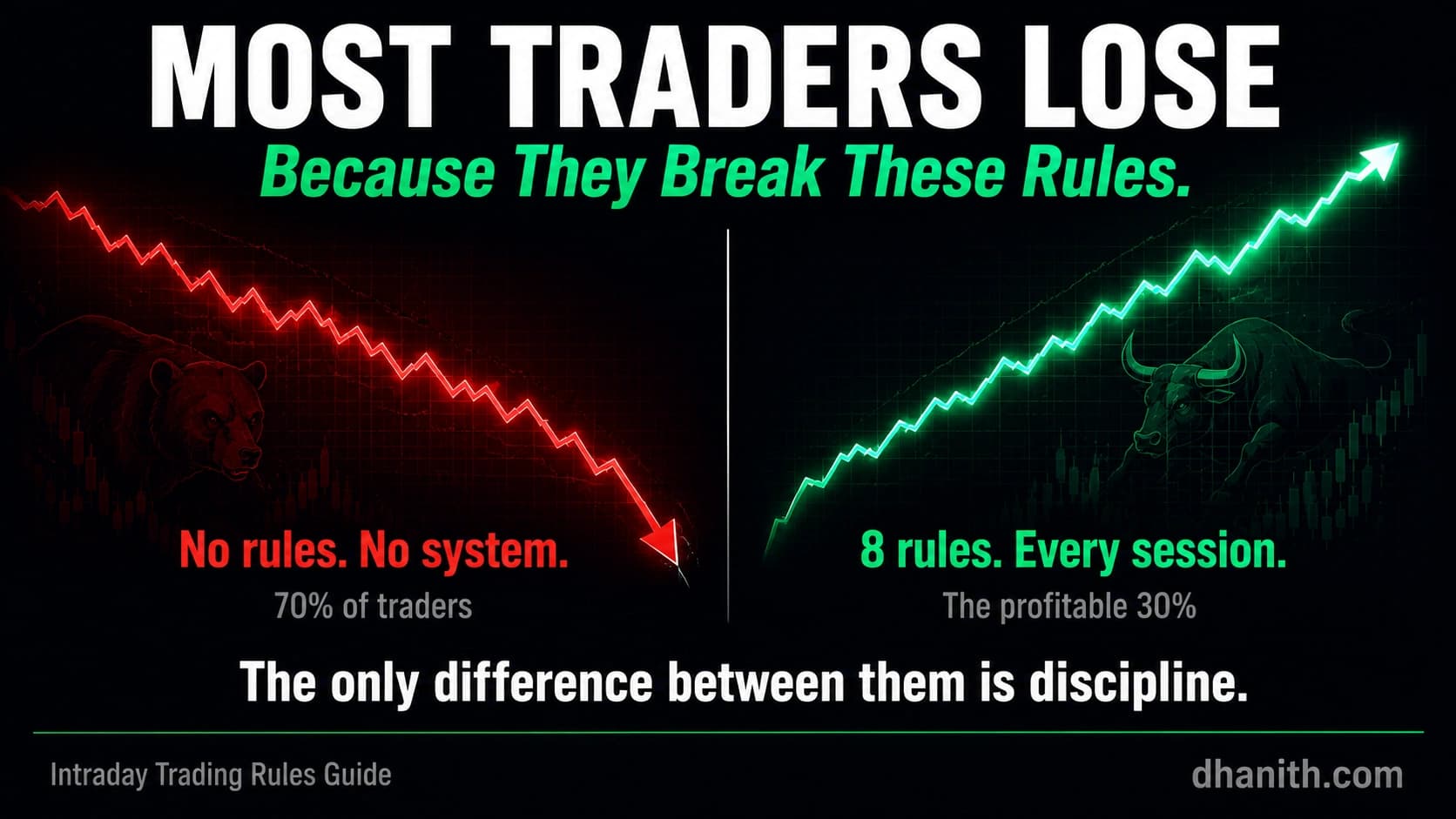
Most intraday traders do not lose because they picked the wrong stock. They lose because they broke a rule — skipped a stop loss, traded at the wrong time, sized too large, or chased a move that had already finished.
Studies consistently show that 70–80% of intraday traders in India lose money in the long run. The difference between the minority who profit and the majority who lose is rarely about stock-picking instincts — it is about structure.
These intraday trading rules are that structure. Follow them on every trade, every session, without exception.
Disclaimer: This article is for educational purposes only. Intraday trading involves substantial risk of capital loss. Always use stop losses and consult a SEBI-registered advisor before trading with real capital.
Rule 1: Trade Only During Specific Time Windows
Not every hour of the NSE session produces tradeable moves. The two best windows are 9:15–10:30 AM and 2:00–3:15 PM. The opening hour sees the highest volume and volatility. Trading aggressively in the 11:30 AM–1:30 PM range is where most beginners lose money to choppy, directionless price action.
9:15–9:30 AM    Observe only. No trades.
9:30–11:00 AM   Primary window — best setups here.
11:00–1:30 PM   Reduce activity. Choppy market.
1:30–2:30 PM    Secondary window.
2:30–3:15 PM    Manage open trades only.
3:15 PM         Close ALL positions. Hard stop.
Why each window behaves differently:
The 9:30–11:00 AM window is where institutional orders — FII and DII flows, overnight gap fills, news-driven momentum — hit the market simultaneously. Volume is highest, direction is clearest, and the biggest intraday moves of the day typically form here. This is when your setups have the strongest follow-through.
The 11:00 AM–1:30 PM midday zone is where most beginner accounts lose money. Volume dries up significantly, price action becomes random and choppy, and false breakouts are most frequent. A setup that would have worked at 9:45 AM will fail repeatedly at 12:30 PM in the same stock. The fix is simple: reduce your activity or stop trading entirely in this window.
The 1:30–2:30 PM secondary window sees institutional activity pick up again as traders position ahead of the close. Momentum setups work reasonably well here — but use tighter stops than the morning window since volatility is lower.
If you do not manually close positions, brokers automatically square them off around 3:20 PM at unfavourable prices, and square-off charges apply. Always close your own positions by 3:15 PM — never let the broker do it for you.
Rule 2: Trade Only With a Proper Setup
Random entries based on gut feel or social media tips are not setups. A proper intraday setup has three objective conditions — all must be present before you enter.
Condition 1: Defined technical trigger
             ORB breakout, VWAP crossover, EMA rejection,
             Bollinger Band reversal, or PDH/PDL candle

Condition 2: Volume confirmation
             Entry candle must show above-average volume

Condition 3: Trend alignment
             Setup direction must match the intraday trend
If any condition is missing — wait. The setup is not complete. A trade without all three conditions is not a setup. It is a guess.
For the exact entry, stop, and target rules behind each of these triggers, see 5 Best Intraday Trading Strategies for NSE India.
What happens when you trade without a proper setup:
Most traders who lose money intraday are not losing on their planned trades. They are losing on the trades they took between their planned setups — the impulsive "this looks interesting" entries that had no defined trigger, no volume confirmation, and no trend alignment. These unplanned trades tend to be larger than they should be (taken with emotion) and held longer than they should be (because there is no stop logic attached to them).
The discipline is to define your setups in writing before the market opens — specific conditions, specific instruments, specific timeframes — and then trade only when those conditions appear. Everything else on the screen is noise.
Dhanith Intraday Screener
Build your watchlist in 30 seconds.
Automatically scan NSE stocks by turnover, gap percentage, sector momentum, and volume — so your pre-market checklist is ready before 9:00 AM.
Rule 3: Always Define Your Stop Loss Before Entry
A stop loss is the price level at which you accept your trade thesis was wrong and exit the position. It must be defined before you enter the trade — not after you are already in it and the position is moving against you.
The stop loss is not placed after entry. It is placed simultaneously with entry — as a condition of the trade existing at all. If you do not know where your stop is before clicking buy or sell, you are not ready to take the trade.
Stop loss placement by setup:
ORB trade:        Below first 15-min candle low (long)
VWAP trade:        Below VWAP (long)
EMA rejection:     Below the rejection candle low
Bollinger Band:    Below the reversal candle low
PDH/PDL trade:     Below the reversal candle or below PDL
Every stop must be at a structural level — where the trade is definitively proven wrong — not at a random percentage below entry.
Rule 4: Respect Your Stop Loss — Without Exception
Knowing your stop and respecting it are two different things. Most traders know where their stop is. Most also move it when price gets close.
The most common mistake Indian intraday traders make is moving their stop loss further away when price approaches it. This turns a small, defined loss into a large, account-damaging one.
The absolute rule: Once placed, a stop loss moves only toward the trade (trailing). Never away from it. When price hits your stop — you exit. Immediately. Without waiting. Without hoping it will recover.
A stopped-out trade with a 1% loss is a good trade. A trade held past the stop that becomes a 7% loss is an account-destroying decision.
The stop loss is not failure. It is the planned cost of being wrong on this one trade. Every trader is wrong regularly. The profitable traders keep the cost of being wrong small.
What moving a stop actually costs:
Stop placed at ₹580. Price hits ₹580. Trader moves stop to ₹565 "to give it room." Price continues to ₹560. Loss is ₹40 per share instead of ₹20 — double the planned risk on 50 shares means ₹1,000 extra loss from one emotional decision. Across 10 such decisions in a month, that is ₹10,000 in additional losses — a 10% drawdown on a ₹1,00,000 account from one habit alone.
Moving the stop does not give the trade more room to work. It gives the loss more room to grow.
Rule 5: Never Average Down on a Losing Intraday Position
Averaging down means you were wrong and you are adding more capital to a losing idea. In intraday trading, where time is compressed, averaging down turns small, manageable losses into large, account-damaging ones.
There is no time for the "give it room to recover" logic that some swing and positional traders use. A stock that moves against your thesis intraday has, by definition, invalidated the setup you entered on. Adding size at a worse price does not improve the trade — it doubles the position sitting on the wrong side of the move while giving it less time to work.
Original position:  100 shares at ₹500, stop at ₹490
Price drops to ₹485:

Averaging down:      Buy 100 more at ₹485
                      Average cost now ₹492.50
                      Position size doubled — on a losing trade
                      Loss is now 2x on further downside

Respecting the stop:  Exit at ₹490 as planned
                      Small, defined loss
                      Capital preserved for the next setup
If the setup is genuinely still valid after a stop-out, that is a new trade — with its own fresh trigger, stop loss, and entry, not an addition to the position that just failed.
Rule 6: Require a Minimum 1:2 Risk:Reward Ratio
If the distance to your target is not at least twice the distance to your stop loss, skip the trade. This single rule means you can be wrong 60% of the time and still be profitable.
Entry:       ₹500
Stop loss:   ₹490   (Risk = ₹10)
Target:      ₹520   (Reward = ₹20)
R:R:         1:2 — trade qualifies

Entry:       ₹500
Stop loss:   ₹490   (Risk = ₹10)
Target:      ₹512   (Reward = ₹12)
R:R:         1:1.2 — skip. Does not qualify.
Calculate R:R before entry, not after. If the nearest logical target does not offer at least 2x the risk, the trade is not worth taking regardless of how confident the setup looks. For the full math behind why this ratio protects you even with a mediocre win rate, see Best Risk Reward Ratio for Day Trading.
Rule 7: Always Trade With the Trend
Trading against the intraday trend is the lowest-probability approach available. Price moves in the direction of the established trend more often than against it — this is the foundation of every profitable intraday strategy.
Identify the intraday trend:
Bullish trend:   Price above VWAP + 5 EMA above 15 EMA
                 → Take LONG setups only

Bearish trend:   Price below VWAP + 5 EMA below 15 EMA
                 → Take SHORT setups only

Neutral/choppy:  VWAP flat, EMAs crossing
                 → Reduce activity significantly
When the trend is bullish — only buy setups. Do not short a stock pulling back in an uptrend. When the trend is bearish — only short. Do not buy dips expecting them to hold.
Countertrend trades occasionally work. But they fail far more often than trend-aligned trades, and when they fail, they fail fast. The risk-reward of countertrend intraday trading almost never justifies the attempt.
Using VWAP and EMA together for trend confirmation:
VWAP alone tells you the session's institutional average price. EMA slope tells you the short-term momentum direction. When both agree, the trend signal is strong. When they disagree — price above VWAP but EMAs flat or crossing — the market is transitioning and the trend is unclear. In unclear market conditions, the best decision is to wait for clarity rather than guess.
Strong bullish signal:
    Price above VWAP + 5 EMA above 15 EMA
    + Both EMAs sloping upward at ~45 degrees
    → High confidence bullish trend. Long setups only.

Weak / unclear signal:
    Price above VWAP + EMAs flat or crossing
    → Wait. Trend is not established. No trades.
Rule 8: Use Margin Wisely — Maximum 5X, Responsibly
NSE brokers typically offer up to 5X intraday margin — a ₹1,00,000 account can control ₹5,00,000 in stock positions. This is a tool. Used correctly it improves capital efficiency. Used carelessly it amplifies every loss proportionally.
Available margin:     5X your account capital
Maximum recommended:  2X–3X on any single position
Safe approach:        1X–2X without leverage pressure
At full 5X leverage, a 1% stock move against you creates a 5% loss on actual capital. Three such trades in one session equals a 15% drawdown in one day.
Never risk more than 1–2% of your trading capital on any single intraday trade. If your account is ₹50,000, your maximum loss on one trade should be ₹500–₹1,000. For a full breakdown of how much starting capital that actually requires, see How Much Capital Is Required for Intraday Trading?
Use margin to deploy capital efficiently across setups — not to make each individual bet larger.
Calculate your exact position size for every trade using the Dhanith Risk Calculator — enter account size, risk %, entry, and stop to get precise quantity instantly.
Rule 9: Limit Trades — Maximum 3 Per Day
Having a trade limit is as important as having a stop loss. Most intraday traders do not blow their accounts on one bad trade — they blow them on the fifth, sixth, and seventh trade of the day, each taken with less discipline than the one before it as cognitive fatigue and emotional frustration build up.
Maximum trades per day:        3
Stop after consecutive losses: 2 in a row — done for the day
Daily loss limit:              3% of account OR
                                3 consecutive losses,
                                whichever comes first
After hitting either limit — close the charts. The market opens again tomorrow. A disciplined stop protects the capital needed to trade another 20 days this month. An undisciplined continuation of trading after two bad trades often erases those 20 days of gains in a single afternoon.
The first losing trade is just a trade. The second creates frustration. The third trade taken from that emotional state is almost never a real setup — it is a revenge trade dressed up as one. The rule stops you before that third trade happens.
For the full behavioral framework behind sticking to limits like this under pressure, see How to Become a Disciplined Trader.
Rule 10: Keep a Trading Journal — Review Every Week
Consistent profitability starts with honest trade tracking. Log your entries, exits, setup type, and emotional state after every trade. Patterns in your journal will reveal your edge — and your most costly mistakes.
No rule in this list improves without measurement. If you are not tracking which setups are working, which time windows produce your best results, and how often you are breaking each of the other nine rules — you are flying blind. The same mistakes repeat invisibly for months.
Minimum journal entry for every intraday trade:
Setup name:       ORB / VWAP / EMA / BB / PDH-PDL
Entry price:      ₹___
Stop loss:        ₹___
Target:           ₹___
R:R:              1:___
Outcome:          Win / Loss / Partial
Emotional state:  Calm / FOMO / Revenge / Confident
Rule violation:   Yes / No — which rule?
Lesson:           One sentence
Weekly review — the five questions that matter:
1. Which setup had the best win rate this week?
2. How many times did I move my stop? (Rule 4)
3. Did I trade outside my time windows? (Rule 1)
4. How many trades exceeded my daily limit? (Rule 9)
5. What is the one thing to fix next week?
The weekly review is where improvement actually happens. Without it, you are repeating the same session every day and expecting different results.
Dhanith Trading Journal
Track every trade. Find your real edge.
Log your setups, grade your entries, and review your trading patterns — all in one place. The journal built for serious SMC traders.
The 10 Rules — Quick Reference
| # | Rule | The Non-Negotiable |
|---|---|---|
| 1 | Trade specific time windows | Primary: 9:30–11 AM. Exit by 3:15 PM. |
| 2 | Trade with a proper setup | All 3 conditions present or wait |
| 3 | Define stop loss before entry | Structural level, placed with entry |
| 4 | Respect your stop loss always | Never move it farther away |
| 5 | Never average down on a loser | Adding size to a losing idea is not a fix |
| 6 | Require minimum 1:2 R:R | No 1:2 = no trade, regardless of confidence |
| 7 | Always trade with the trend | VWAP + EMA define the direction |
| 8 | Use margin wisely — max 5X | Never deploy full margin on one trade |
| 9 | Maximum 3 trades per day | Stop after 2 consecutive losses |
| 10 | Journal every trade, review weekly | Improvement comes from measurement |
Final Thought
These ten rules are not suggestions. They are the minimum framework that separates structured intraday trading from expensive, random betting. Break any one of them consistently and no strategy, screener, or indicator will save your account.
Here is the honest reality about intraday trading rules: most traders know most of these rules already. The problem is not knowledge — it is execution under pressure. When you are down ₹2,000 at 11:30 AM and you see a stock moving sharply, every one of these rules is tested simultaneously. You want to trade the wrong time window. You want to take a setup without full confirmation. You want to move your stop, or add more size to prove you were right. You want to trade against the trend because "this one looks different."
The rules exist precisely for that moment. Write them down. Print them. Put them next to your screen. And follow them on the next trade — not the one after that, not when things are going better — the very next trade.
Follow all ten across 50–100 trades and two things will happen: you will know whether your specific setups have a real edge, and you will have the capital remaining to act on that edge.
Start logging every intraday trade today with the Dhanith Trading Journal — entry, stop, target, R:R, rule compliance, and emotional state. The weekly review is where rules become habits.
Rules are necessary but not sufficient on their own — for the full timeline, habits, and mindset shift behind consistent execution, see How to Become a Successful Intraday Trader.
Disclaimer: This article is for educational purposes only and does not constitute financial or investment advice. Intraday trading in NSE equities involves substantial risk of capital loss. 70–80% of intraday traders lose money in the long run. Always use stop losses and consult a SEBI-registered advisor before trading with real capital.
FAQ
Q: What is the most important intraday trading rule? Respecting your stop loss without exception. Every other rule helps you find good setups and manage risk. This one rule prevents a good strategy from being destroyed by a single emotional decision to hold past the stop. A strategy with a 50% win rate and a respected 1:2 R:R is profitable. The same strategy with stop losses that are routinely moved or ignored is not.
Q: What time is best for intraday trading on NSE? The primary window is 9:30–11:00 AM IST — when institutional volume is highest and directional moves are strongest. A secondary window runs 1:30–2:30 PM. The 11:00 AM–1:30 PM midday period produces the most false breakouts and is where most beginners consistently lose money. Avoid new entries in this window.
Q: Is 5X margin safe for intraday trading? 5X is the maximum available — not the recommended amount to use. At 5X, a 1% stock move against you creates a 5% loss on actual capital. Three such trades at full margin equals a 15% account drawdown in one session. Use 2X–3X at most per position, always ensuring risk per trade stays within 1–2% of actual account capital regardless of the leverage multiplier.
Q: How many intraday trades should I take per day? Maximum 3 trades per day, with a hard stop after 2 consecutive losses. More trades per day does not produce more profit — it produces more commissions, more cognitive fatigue, and a higher rate of impulsive entries that break your rules. The data consistently shows that 2–3 high-quality setups per day outperforms 8–10 low-quality ones.
Related Articles
| Article | How It Connects |
|---|---|
| 5 Best Intraday Trading Strategies for NSE India | The specific setups that apply these 10 rules in practice |
| How Much Capital Is Required for Intraday Trading? | Rule 8 expanded — margin, position sizing, and minimum capital math |
| How to Become a Successful Intraday Trader | The full framework these rules sit inside — timeline, psychology, and business mindset |
| Best Risk Reward Ratio for Day Trading | Rule 6 expanded — full R:R math and position sizing |
| How to Become a Disciplined Trader | Behavioral framework for following these rules under pressure |
| 25 Trading Risk Management Rules | Complete risk system — position sizing, daily limits, and journaling |
| Best Online Trading Journal | Track rule compliance on every trade |
Have a question about this article?
Comment on our latest Instagram post or send us a DM — we reply to every one.
@dhanith_officialWas this article helpful?
Click to rate
Founder, Dhanith Trading
7+ years trading Nifty, Bank Nifty, NSE stocks, and commodities — specializing in Smart Money Concepts (SMC) and ICT price action. Founder of Dhanith — a trading journal, intraday screener, and risk tools platform built for retail traders.
Dhanith Newsletter
Enjoyed this article? Get more like it.
New trading guides, candlestick patterns, SMC strategies, and tool updates — straight to your inbox. Free, for Indian traders.
No spam. Unsubscribe anytime.
Continue Reading