On this page
- The Foundation: The 1% Risk Rule
- Part 1: Capital Required for Intraday Equity Stock Trading (NSE)
- What Margin Does Your Broker Provide?
- Minimum Capital for NSE Intraday Stock Trading
- Real Intraday Stock Trade Example With Margin
- Trading Cost Reality for NSE Intraday
- Common Capital Mistakes to Avoid
- Capital Summary — What You Actually Need
- Final Thought
- FAQ
- Related Articles
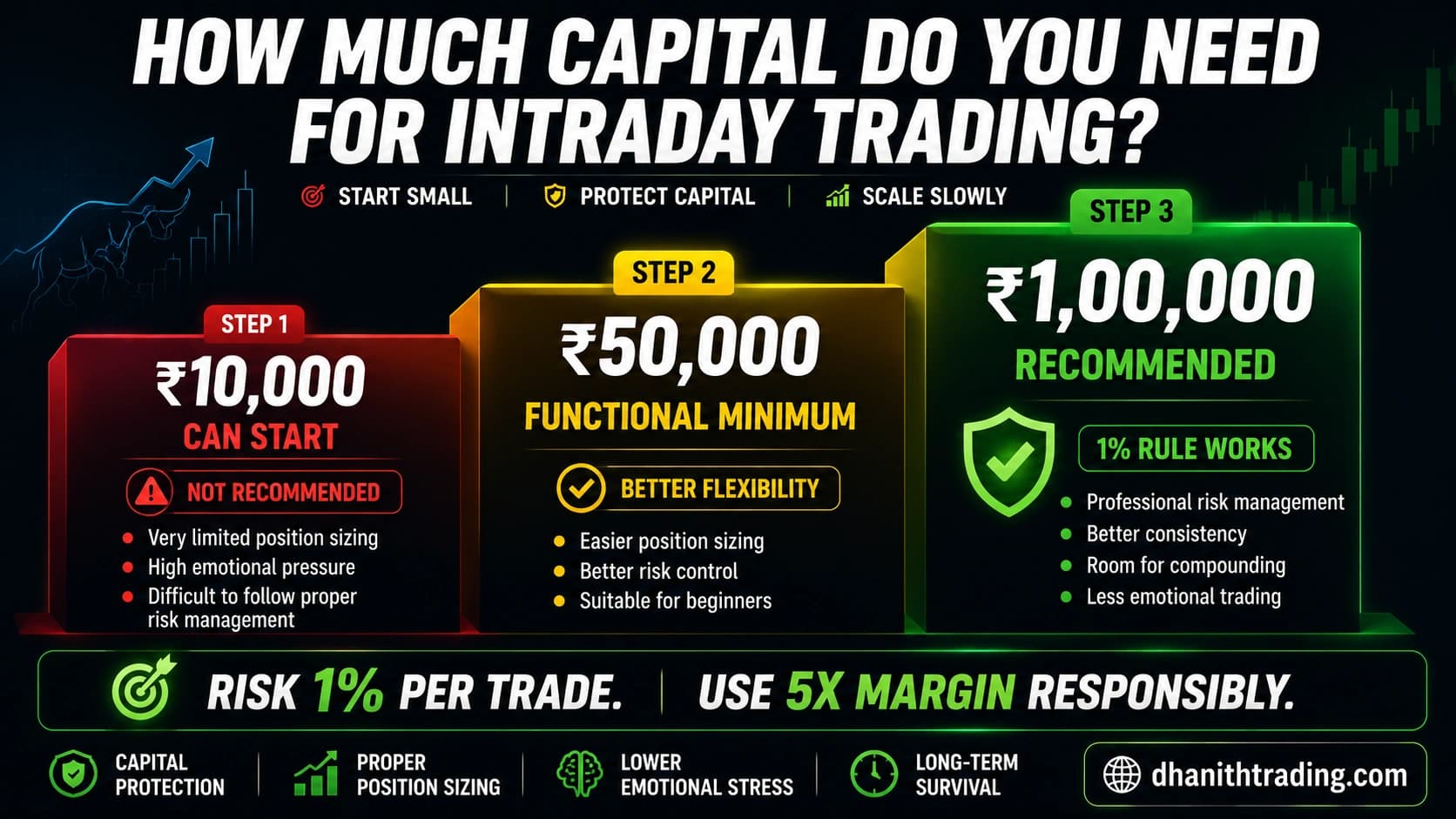
How much capital do you need for intraday trading in India? Real margin examples, position sizing math, 5X leverage explained, and practical minimum capital guidelines for NSE.
This is one of the most asked questions by traders starting out — and one of the most honestly answered. Most articles tell you "you can start with just ₹5,000" without mentioning that ₹5,000 is functionally unusable for intraday trading once you account for brokerage costs, proper position sizing, and risk management.
The real answer depends on two things: how much margin your broker provides, and most importantly — how much you can risk per trade without destroying your ability to keep trading after a losing streak.
This article covers the capital required for NSE intraday equity stock trading — with real margin examples, position sizing math, and honest minimum capital guidelines so you know exactly what you need before you start.
Disclaimer: This article is for educational purposes only. Trading involves substantial risk of capital loss. Studies consistently show that 70–80% of intraday traders in India lose money in the long run. Always use stop losses and consult a SEBI-registered advisor before trading.
The Foundation: The 1% Risk Rule
Before getting to specific capital numbers, understand this rule first — because it determines every capital calculation that follows.
The 1% rule means you risk a maximum of 1% of your total trading capital on any single trade. If you have ₹5 lakh in your account, your maximum loss on one trade is ₹5,000. At 1% risk per trade, a 7-loss streak costs only 7% of capital — completely recoverable. The 1–2% rule keeps you in the game long enough to develop skill. For the full framework this rule sits inside, see Intraday Trading Rules You Must Follow.
This rule works backwards to define your minimum practical capital:
If your stop loss is ₹20 per share and you follow 1% risk:

₹10,000 capital → 1% = ₹100 → 100 ÷ 20 = 5 shares
                   Too small — costs eat all profit

₹50,000 capital → 1% = ₹500 → 500 ÷ 20 = 25 shares
                   Functional but tight

₹1,00,000 capital → 1% = ₹1,000 → 1,000 ÷ 20 = 50 shares
                    Comfortable — recommended minimum
Now apply this to intraday equity stock trading specifically.
Use the Dhanith Risk Calculator to calculate your exact position size for any trade — enter account size, risk %, entry, and stop loss to get precise quantity in seconds.
Part 1: Capital Required for Intraday Equity Stock Trading (NSE)
What Margin Does Your Broker Provide?
Indian brokers offer significant intraday margin — meaning you can take positions many times larger than your actual capital. A trader with ₹1 lakh of capital might control ₹5–10 lakh worth of intraday positions. This amplifies profits on winning trades and amplifies losses on losing ones.
The standard intraday margin on NSE equity stocks from most discount brokers is 5X — meaning every ₹1 in your account controls ₹5 in stock positions. Some brokers offer up to 10X on specific liquid stocks, but 5X is the regulated standard for SEBI peak margin compliance.
Your capital:         ₹1,00,000
Intraday margin (5X): ₹5,00,000 in buying power
This does not mean you should use the full ₹5,00,000. It means you have that capacity — how much you actually use is determined by your risk management rules.
Minimum Capital for NSE Intraday Stock Trading
While you can start intraday trading in India with as little as ₹5,000 to ₹10,000, having a capital base of ₹50,000 to ₹1,00,000 is generally advisable to allow for better risk management, absorb transaction costs, and provide more flexibility in your trading strategy.
| Capital Level | Practical Reality |
|---|---|
| ₹5,000 – ₹10,000 | Technically possible. Costs eat most gains. Not recommended. |
| ₹25,000 – ₹50,000 | Functional minimum. Tight on position sizing. |
| ₹50,000 – ₹1,00,000 | Recommended starting range. Proper risk management possible. |
| ₹1,00,000+ | Comfortable. Full 1% risk rule works cleanly. |
Real Intraday Stock Trade Example With Margin
Account capital:      ₹50,000
Intraday margin (5X): ₹2,50,000 buying power
1% risk rule:         1% of ₹50,000 = ₹500 max risk per trade

Stock:  INOXINDIA
Entry:  ₹1,780
Stop:   ₹1,755  — Risk per share = ₹25

Position size:  ₹500 ÷ ₹25 = 20 shares
Total position: 20 × ₹1,780 = ₹35,600

Margin required at 5X: ₹35,600 ÷ 5 = ₹7,120 actual capital
(Remaining ₹42,880 stays available as buffer)

Target:   ₹1,830  — Reward = ₹50 per share
R:R:      ₹50 ÷ ₹25 = 1:2 ✓

Profit if target hit:  20 × ₹50 = ₹1,000
Loss if stopped out:   20 × ₹25 = ₹500 (1% of account)
Notice: even with 5X margin available, the actual capital deployed (₹7,120) is only 14% of the total account. The rest sits as a buffer. This is correct — the margin is there as capacity, not as an instruction to use it all.
Trading Cost Reality for NSE Intraday
On a ₹1 lakh buy and sell, costs add up to roughly ₹80–₹85 with a discount broker. Make four trades a day and you pay over ₹6,500 a month before you earn a rupee.
This cost reality is why ₹10,000 accounts are functionally unworkable — a single round-trip trade on a ₹10,000 position costs roughly ₹10–15 in charges, which represents 0.1–0.15% of the position. When your expected gain per trade is 0.5–1%, costs are consuming 15–30% of your gross profit before you see a net rupee.
Common Capital Mistakes to Avoid
Mistake 1 — Starting too small and expecting meaningful returns. A ₹10,000 account generating 2% per trade produces ₹200. After brokerage of ₹15–20, net profit is ₹180–185. This is not a business — it is an expensive hobby. You need sufficient capital for the math to work in your favor after costs.
Mistake 2 — Using full margin on every trade. A trader with ₹1 lakh of capital might control ₹5–10 lakh worth of intraday positions. This amplifies losses on losing trades just as dramatically as it amplifies gains. Using the full margin capacity on one trade means a 2% stock move against you equals a 10% account loss at 5X leverage.
Mistake 3 — Not accounting for drawdown capital. Your account needs enough capital not just to open trades — but to survive a realistic losing streak. At 1% risk per trade, 10 consecutive losses cost 10% of the account. Plan for this reality. An account that cannot survive 10 consecutive losses at 1% risk is too small.
Mistake 4 — Treating options premium as "cheap risk." Buying a ₹15 Nifty OTM option feels cheap — ₹15 × 75 = ₹1,125 per lot. But buying 5 such lots "because they are cheap" commits ₹5,625 — and all 5 positions frequently expire worthless on the same day. The premium IS the maximum loss on each lot. Sizing by "cheapness" rather than by the 1% risk rule is the most common options buying mistake.
Capital Summary — What You Actually Need
| Account Size | 1% Risk Per Trade | Position Size (₹20 stop) | Practical Verdict |
|---|---|---|---|
| ₹10,000 | ₹100 | 5 shares | Not recommended — costs eat gains |
| ₹25,000 | ₹250 | 12 shares | Too tight — limited flexibility |
| ₹50,000 | ₹500 | 25 shares | Functional minimum |
| ₹1,00,000 | ₹1,000 | 50 shares | Recommended starting point |
| ₹2,00,000 | ₹2,000 | 100 shares | Comfortable — full flexibility |
| ₹5,00,000 | ₹5,000 | 250 shares | Professional-level sizing |
Final Thought
The minimum capital to start is not the same as the minimum capital to trade profitably. The gap between those two numbers is where most traders get caught — they start with the technical minimum, experience normal losing streaks, run out of margin buffer, and conclude that trading does not work.
The right capital is the amount that allows you to follow the 1% risk rule on every trade, cover your trading costs without them consuming your edge, and survive a realistic 10-trade losing streak without psychological or financial damage.
For most Indian traders starting intraday equity trading on NSE, that number is ₹1,00,000 — the point where the 1% risk rule works cleanly, costs are manageable, and a realistic losing streak does not end your trading career before it begins.
Capital is only one half of the equation. See How to Become a Successful Intraday Trader for the strategy, psychology, and realistic timeline that make that capital productive instead of just sitting in a margin account.
Calculate your exact position size for any market — equity, options, or crypto — using the Dhanith Risk Calculator. Enter your capital, risk %, entry, and stop to get your precise quantity instantly.
Dhanith Trading Journal
Track every trade. Find your real edge.
Log your setups, grade your entries, and review your trading patterns — all in one place. The journal built for serious SMC traders.
Disclaimer: This article is for educational purposes only and does not constitute financial or investment advice. Intraday trading in NSE equity stocks, F&O derivatives, and cryptocurrency involves substantial risk of capital loss. Margin and leverage amplify both gains and losses. The capital figures mentioned are guidelines based on general risk management principles, not guarantees of profitability. Always consult a SEBI-registered advisor before trading with real capital.
FAQ
Q: What is the minimum capital required to start intraday trading in India? You can technically start with ₹5,000–₹10,000, but the practical minimum for intraday equity stock trading with proper risk management is ₹50,000. Below this, trading costs consume too large a share of gains and position sizing becomes too constrained to apply the 1% risk rule effectively. The recommended starting capital is ₹1,00,000 for NSE equity intraday trading.
Q: How much margin do NSE intraday stock traders get? Most discount brokers in India offer 5X intraday margin on NSE equity stocks — meaning ₹1,00,000 in capital gives ₹5,00,000 in buying power. Some brokers offer higher on specific liquid stocks, but SEBI peak margin rules set the regulatory framework. Using the full 5X on a single trade is extremely risky — a 1% stock move at 5X leverage creates a 5% loss on actual capital.
Q: Should I use the full 5X intraday margin available? No. The 5X intraday margin is a capacity — not an instruction to use it all. The correct approach is to size positions based on the 1% risk rule first, then check that the resulting position is within your margin capacity. In most properly sized trades, only 15–30% of available margin is actually deployed — leaving the rest as a buffer for adverse moves and additional setups.
Q: How does the 1% risk rule determine position size? Divide your maximum risk amount (1% of account) by the risk per share (entry minus stop loss). Example: ₹1,00,000 account, 1% = ₹1,000 risk. Entry at ₹600, stop at ₹575 = ₹25 risk per share. Position size = ₹1,000 ÷ ₹25 = 40 shares. Total position value = 40 × ₹600 = ₹24,000 — only 24% of the account deployed despite 5X margin being available.
Q: Can I do intraday trading with ₹10,000? Technically yes — there is no regulatory minimum. Practically, a ₹10,000 account has significant disadvantages: brokerage costs consume a disproportionate share of small gains, the 1% risk rule limits you to ₹100 per trade which only allows 5 shares at a ₹20 stop, and a single losing streak of 3–4 trades at slightly over 1% can seriously impair the account. Most experienced traders recommend waiting until you have at least ₹50,000 before starting intraday trading seriously.
Related Articles
| Article | How It Connects |
|---|---|
| Intraday Trading Rules You Must Follow | The 1% risk rule and margin discipline that determines capital needs |
| How to Become a Successful Intraday Trader | The strategy and psychology that make this capital productive |
| Best Risk Reward Ratio for Day Trading | R:R math that determines how much capital generates meaningful returns |
| 5 Best Intraday Trading Strategies for NSE India | The strategies that determine how much capital you actually need per setup |
| How to Become a Disciplined Trader | Managing capital psychologically as well as mathematically |
| Best Online Trading Journal | Track capital utilisation and margin per trade to optimise position sizing |
Have a question about this article?
Comment on our latest Instagram post or send us a DM — we reply to every one.
@dhanith_officialWas this article helpful?
Click to rate
Founder, Dhanith Trading
7+ years trading Nifty, Bank Nifty, NSE stocks, and commodities — specializing in Smart Money Concepts (SMC) and ICT price action. Founder of Dhanith — a trading journal, intraday screener, and risk tools platform built for retail traders.
Dhanith Newsletter
Enjoyed this article? Get more like it.
New trading guides, candlestick patterns, SMC strategies, and tool updates — straight to your inbox. Free, for Indian traders.
No spam. Unsubscribe anytime.
Continue Reading